Does enhancing partner support and interaction improve smoking cessation? A meta-analysis
- PMID: 15083859
- PMCID: PMC1466648
- DOI: 10.1370/afm.64
Does enhancing partner support and interaction improve smoking cessation? A meta-analysis
Abstract
Background: We wanted to determine whether an intervention to enhance partner support helps as an adjunct to a smoking cessation program.
Methods: We undertook a meta-analysis of English-language, randomized controlled trials of smoking cessation interventions through July 2002 using the following data sources: Cochrane Tobacco Addiction Group specialized register, Cochrane controlled trials register, CDC Tobacco Information and Prevention Database, MEDLINE, Cancer Lit, EMBASE, CINAHL, PsycINFO, ERIC, PsycLIT, Dissertation Abstracts, SSCI and HealthSTAR, with reviews of bibliographies of included articles. Included were trials that assessed a partner support component with a minimum follow-up of 6 months. The outcomes measured were abstinence and biochemical assessment at 6 to 9 months and more than 12 months after treatment. Partner Interaction Questionnaire scores were primary and secondary outcomes.
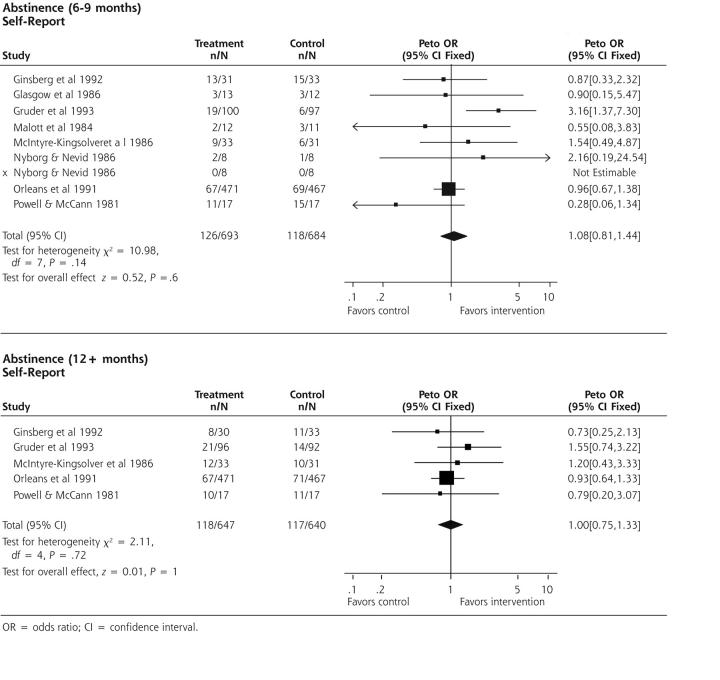
Results: Nine studies (31 articles) met inclusion criteria. Partner definition varied among studies. All studies included self-reported smoking cessation rates, but there was limited biochemical validation of abstinence. For self-reported abstinence at 6 to 9 months after treatment, the Peto odds ratio (OR) = 1.08 (95% confidence interval [CI], 0.81-1.44) and at 12 months Peto OR = 1.0 (95% CI, 0.75-1.34). Sensitivity analysis of studies using live-in, married, and equivalent-to-married partners found a higher odds ratio at 6 to 9 months after treatment, Peto OR = 1.64 (95% CI, 0.5-4.64). Sensitivity analysis of studies reporting significant increases in partner support found at 6 to 9 months after treatment Peto OR = 1.83 (95% CI, 0.9-3.47); and at 12 months Peto OR = 1.22 (95% CI, 0.67-2.23).
Conclusions: Interventions to enhance partner support showed the most promise for clinical practice when implemented with live-in, married, and equivalent-to-married partners. Such interventions should focus on enhancing supportive behaviors, while minimizing behaviors critical of smoking.
Figures
References
-
- US Department of Health and Human Services. Reducing Tobacco Use: A Report of the Surgeon General. Washington, DC: US Department of Health and Human Services; 2000.
-
- Venters M, Jacobs DJ, Luepker R, Maiman L, Gillum R. Spouse concordance of smoking patterns: the Minnesota Heart Survey. Am J Epidemiol. 1984;120:608–616. - PubMed
-
- Waldron I, Lye D. Family Roles and Smoking. Am J Prev Med. 1989;5:136–141. - PubMed
-
- Graham S, Gibson R. Cessation of patterned behaviour: withdrawal from smoking. Soc Sci Med. 1971;5:319–337. - PubMed
-
- Ockene JK BR, Nuttal RL, Hurwitz I, Ockene IS. Relationship of psychosocial factors to smoking behavior change in an intervention program. Prev Med. 1982;11:13–28. - PubMed
Publication types
MeSH terms
LinkOut - more resources
Full Text Sources
Medical
Miscellaneous