


Hypoxia-inducible factor 1 alpha in high-risk breast cancer: an independent prognostic parameter?
- PMID: 15084243
- PMCID: PMC400672
- DOI: 10.1186/bcr775
Hypoxia-inducible factor 1 alpha in high-risk breast cancer: an independent prognostic parameter?
Abstract
Background: Hypoxia-inducible factor 1 alpha (hif-1alpha) furnishes tumor cells with the means of adapting to stress parameters like tumor hypoxia and promotes critical steps in tumor progression and aggressiveness. We investigated the role of hif-1alpha expression in patients with node-positive breast cancer.
Methods: Tumor samples from 77 patients were available for immunohistochemistry. The impact of hif-1alpha immunoreactivity on survival endpoints was determined by univariate and multivariate analyses, and correlations to clinicopathological characteristics were determined by cross-tabulations.
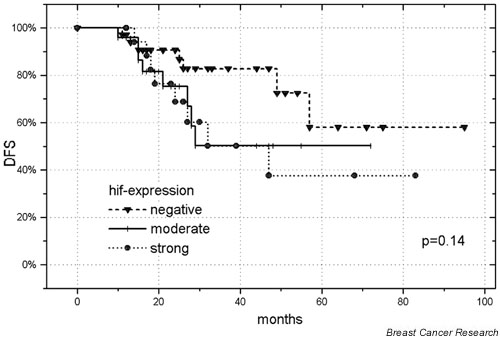
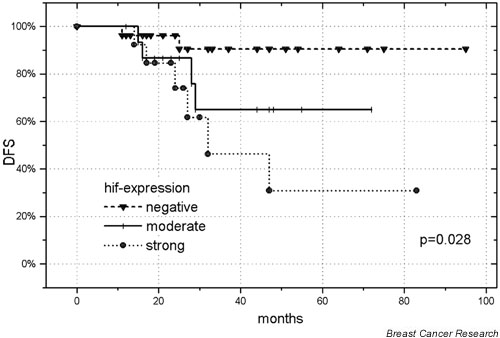
Results: hif-1alpha was expressed in 56% (n = 43/77) of the patients. Its expression correlated with progesterone receptor negativity (P = 0.002). The Kaplan-Meier curves revealed significantly shorter distant metastasis-free survival (DMFS) (P = 0.04, log-rank) and disease-free survival (DFS) (P = 0.04, log-rank) in patients with increased hif-1alpha expression. The difference in overall survival (OS) did not attain statistical significance (5-year OS, 66% without hif-1alpha expression and 55% with hif-1alpha expression; P = 0.21). The multivariate analysis failed to reveal an independent prognostic value for hif-1alpha expression in the whole patient group. The only significant parameter for all endpoints was the T stage (T3/T4 versus T1/T2: DMFS, relative risk = 3.16, P = 0.01; DFS, relative risk = 2.57, P = 0.03; OS, relative risk = 3.03, P = 0.03). Restricting the univariate and multivariate analyses to T1/T2 tumors, hif-1alpha expression was a significant parameter for DFS and DMFS.
Conclusions: hif-1alpha is expressed in the majority of patients with node-positive breast cancer. It can serve as a prognostic marker for an unfavorable outcome in those with T1/T2 tumors and positive axillary lymph nodes.
Figures
References
-
- Stone HB, Brown JM, Phillips TL, Sutherland RM. Oxygen in human tumors: correlations between methods of measurement and response to therapy. Summary of a workshop held November 19–20, 1992, at the National Cancer Institute, Bethesda, Maryland. Radiat Res. 1993;136:422–434. - PubMed
-
- Raleigh JA, Dewhirst MW, Thrall DE. Measuring tumor hypoxia. Semin Radiat Oncol. 1996;6:37–45. - PubMed
-
- Vukovic V, Haugland HK, Nicklee T, Morrison AJ, Hedley DW. Hypoxia-inducible factor-1alpha is an intrinsic marker for hypoxia in cervical cancer xenografts. Cancer Res. 2001;61:7394–7398. - PubMed
Publication types
MeSH terms
Substances
LinkOut - more resources
Full Text Sources
Other Literature Sources
Medical
Research Materials
