


Case Reports
doi: 10.1136/hrt.2003.031294.
Vasovagal syncope interrupting sleep?
Affiliations
- PMID: 15084573
- PMCID: PMC1768202
- DOI: 10.1136/hrt.2003.031294
Item in Clipboard
Case Reports
Vasovagal syncope interrupting sleep?
Heart.
2004 May.
Abstract
Clinical data are reported for 13 patients who were referred with recurrent loss of consciousness at night interrupting their sleep. Most of the patients were women (10 of 13) with a mean age of 45 years (range 21-72 years). The histories were more consistent with vasovagal syncope than with epilepsy. This was supported by electroencephalographic and tilt test results. More polysomnographic monitoring data are required to confirm the diagnosis of vasovagal syncope interrupting sleep. This will be difficult because, although the condition may not be rare, the episodes are usually sporadic.
Figures
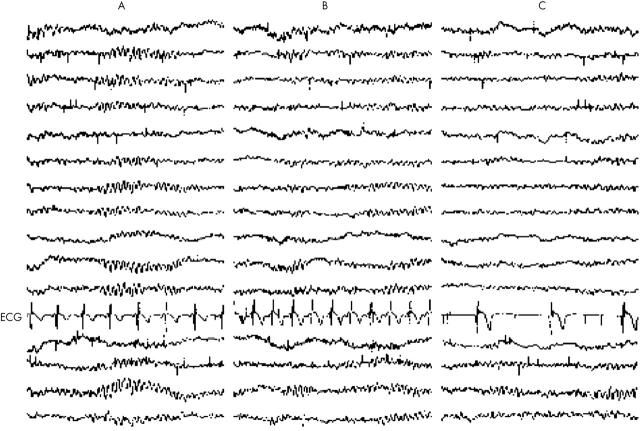
Simultaneous electroencephalographic (EEG) and cardiac recordings before and during typical nocturnal episode in patient 1. The montage consists of four sets of channels running anteriorly to posteriorly and recorded from the right parasagittal, left parasagittal, right temporal, and left temporal areas. (A) Time 5.49 am, normal sleep EEG, heart rate 90 beats/min. (B) Time 5.50 am, EEG unchanged, heart rate 126 beats/min. (C) Time 5.52 am (after calling for a nurse), with the patient lying supine in bed unable to move, EEG unchanged, heart rate 36 beats/min. At this time the patient was pale and sweating profusely.
References
-
- Hopkins AP. Disorders of consciousness. In: Weatherall DJ, Ledlingham JGG, Warrell DA, eds. Oxford textbook of medicine, 3rd ed. Oxford: Oxford University Press, 1996:3909–25.
-
- Brignole M, Alboni P, Benditt D, et al. Guidelines on management (diagnosis and treatment) of syncope. Eur Heart J 2001;22:1256–306. - PubMed
-
- Van Lieshout JJ, Wieling W, Karemaker M, et al. The vasovagal response. Clin Sci (Lond) 1991;81:575–86. - PubMed
-
- Shneerson JM. Handbook of sleep medicine. Oxford: Blackwell Science, 2000:1–15.
Publication types
MeSH terms
LinkOut - more resources
Full Text Sources
Medical
