. 2004 Apr 14;24(15):3770-6.
doi: 10.1523/JNEUROSCI.4775-03.2004.

Endoplasmic reticulum export site formation and function in dendrites

Affiliations

Endoplasmic reticulum export site formation and function in dendrites

Meir Aridor et al. J Neurosci. .

Abstract

The elongated and polarized characteristics of neurons render targeting of receptors to the plasma membrane of distal axonal projections and dendritic branches a major sorting task. Although the majority of biosynthetic cargo synthesis, transport, and sorting are believed to occur in the soma, local membrane protein translation and sorting has been reported recently to take place in dendrites and axons. We investigated where endoplasmic reticulum (ER) export occurs in dendrites using an in vitro permeabilized neuron system that enables us to specifically control the assembly of ER export sites. We show that ER export sites are assembled regularly throughout the entire dendritic tree by the regulated sequential recruitment of Sar1 and COPII (coat protein complex II). Moreover, activation of metabotropic glutamate receptors leads to the recruitment of the NMDA receptor subunit NR1 to remodeled ER export sites. We propose that regulation of receptor assembly and export from the ER in dendrites plays an important role in modulating receptor surface expression and neuronal function.


Figures
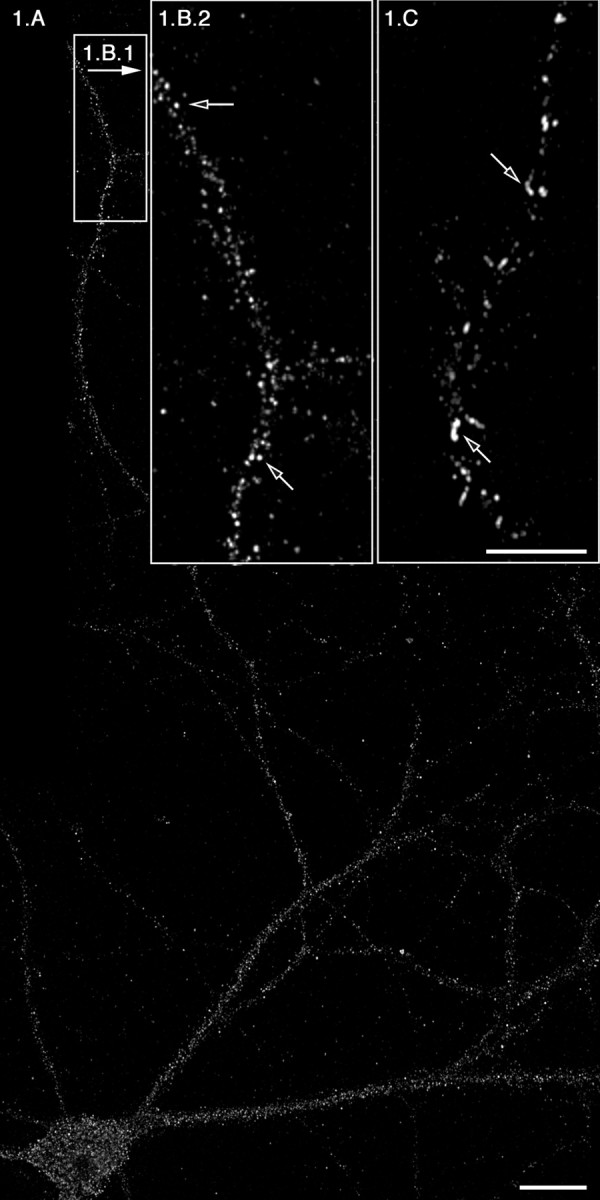
Figure 1.
Figure 1.
ER export occurs efficiently and regularly at distances >350 μm from the soma. Rat hippocampal neurons were rinsed with PBS, permeabilized, and washed as described in Materials and Methods. Cells were then incubated in the presence of RLC and 5 μg of Sar1-GTP (A, B1, B2) or with Sar1-GTP only (C). At the end of the incubations, the distribution of Sec13 (A, B1, B2) and Sar1 (C) was determined using IF microscopy. The open arrows in B2 denote punctate VTCs. The open arrows in C denote ER membrane tubules coated with Sar1. B2 and C are higher magnifications of tertiary dendrites that are >350 μm away from soma. Scale bars: A, 20 μm; (in C) B2, C, 10 μm.
Figure 2.
Figure 2.
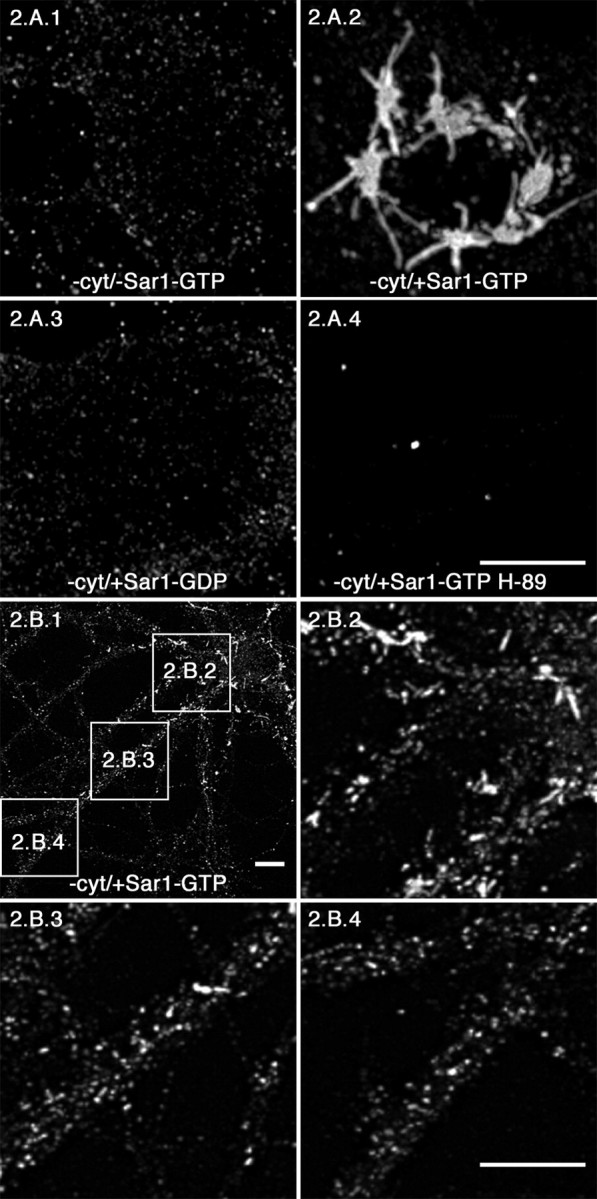
Sar1-GTP triggers the formation of ER membrane tubules in rat hippocampal neurons–sites of ER export. Permeabilized rat hippocampal neurons (A) were incubated in reaction buffer only (A1) or with Sar1-GTP only (A2) as described in Materials and Methods. The neurons in A3 were incubated with Sar1-GDP to determine whether Sar1 activation was required for ER tubule formation. Cultures represented in A4 were incubated in the presence of Sar1-GTP and the isoquinoline protein kinase inhibitor H89. The distribution of Sar1 was determined using IF microscopy. All images in A are 3D reconstructions from confocal image stacks of Sar1 staining in the cell body. B, Rat hippocampal neurons were incubated in the presence of Sar1-GTP only and prepared for IF microscopy using antibody directed toward Sar1 as described above. B2–B4 are higher magnifications of proximal, secondary, and tertiary dendritic branches, respectively. 3D reconstructions were made from confocal stacks taken at the level of the dendrites (1–2.5 μm above the cover glass). Arrows denote Sar-1-coated ER membrane tubules. Scale bars, 10 μm. cyt, Cytosol.
Figure 3.
Figure 3.
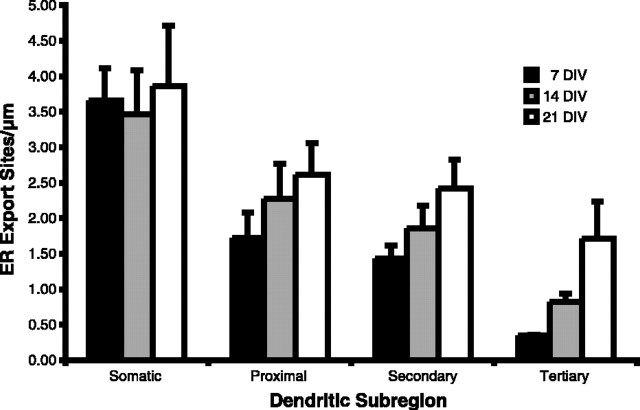
Quantification of ER export sites in hippocampal neurons. Using our two-stage assay (supplemental Fig. 2, available at www.jneurosci.org), Sec23 vesicles were quantified in neurons at the designated DIV. A modification of the “centrifugal method” of dendritic branch ordering was used to describe the density of dendritic arborizations (Uylings and van Pelt, 2002). Our characterization was such that the dendrites emerging from the cell soma are called somatic for one soma diameter distance and then primary up to the point of bifurcation into second-order branches. Therefore, first branches are called secondary and so on, with increasing order until the tips are reached. For these experiments, the vesicles of dendrites from a minimum of five neurons, from at least three different experiments, at each time point were quantified. Values equal mean ± SEM.
Figure 4.
Figure 4.
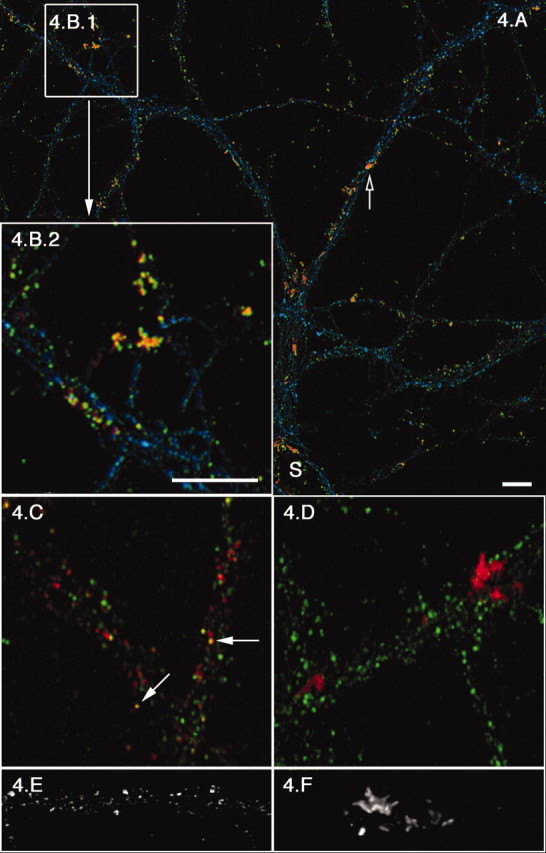
DHPG treatment results in Sar1 tubule reorganization and the selective concentration of NR1 in ER tubule domains. Control (C, E) or DHPG (15 min at a 100 μm final concentration; A, B, D, F) -treated 21 DIV hippocampal neurons were permeabilized, rinsed, incubated with 5 μg of Sar1-GTP, and fixed as described in Figure 1. A is a lower-magnification image of NR1 (green), Sar1 (red), and phalloidin (blue). Open arrows denote hot spots of ER export and Sar1/NR1 colocalization (yellow). B2, which is a 3× magnification of B1, clearly represents the extent of Sar1/NR1 colocalization. C represents a similar region in a control culture (NR1, green; Sar1, red; filled arrows denote sites of colocalization). Specificity of Sar1/NR1 colocalization was controlled for in D, in which there is no colocalization of α subunit of CaMKII (green) with Sar1 (red) in DHPG-treated neurons. A–D are extended focus images compiled from small confocal stacks (sections are 0.1–0.2 μm apart) to avoid false colocalization. E (control) and F (DHPG treated) are 3D reconstructions of Sar1 staining in tertiary dendritic branches. Images were made from confocal stacks with consecutive sections taken 0.1 μm apart. S, Soma. Scale bars, 10 μm.

References

    1. Aridor M, Balch WE (2000) Kinase signaling initiates coat complex II (COPII) recruitment and export from the mammalian endoplasmic reticulum. J Biol Chem 275: 35673–35676. - PubMed
    1. Aridor M, Bannykh SI, Rowe T, Balch WE (1995) Sequential coupling between COPII and COPI vesicle coats in endoplasmic reticulum to Golgi transport. J Cell Biol 131: 875–893. - PMC - PubMed
    1. Aridor M, Weissman J, Bannykh S, Nuoffer C, Balch WE (1998) Cargo selection by the COPII budding machinery during export from the ER. J Cell Biol 141: 61–70. - PMC - PubMed
    1. Aridor M, Bannykh SI, Rowe T, Balch WE (1999) Cargo can modulate COPII vesicle formation from the endoplasmic reticulum. J Biol Chem 274: 4389–4399. - PubMed
    1. Aridor M, Fish KN, Bannykh S, Weissman J, Roberts TH, Lippincott-Schwartz J, Balch WE (2001) The Sar1 GTPase coordinates biosynthetic cargo selection with endoplasmic reticulum export site assembly. J Cell Biol 152: 213–229. - PMC - PubMed

Publication types

MeSH terms

LinkOut - more resources