


Giant tortoises are not so slow: rapid diversification and biogeographic consensus in the Galápagos
- PMID: 15084743
- PMCID: PMC404076
- DOI: 10.1073/pnas.0400393101
Giant tortoises are not so slow: rapid diversification and biogeographic consensus in the Galápagos
Abstract
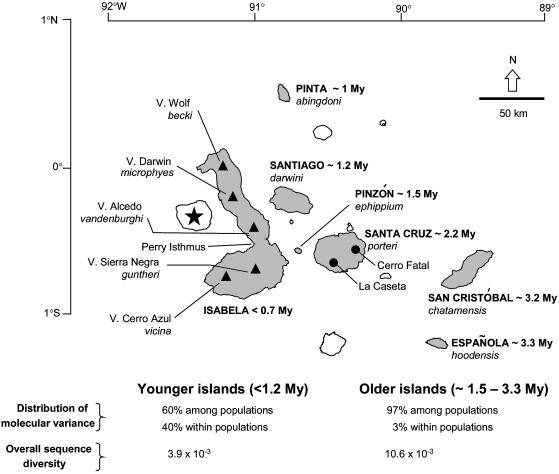
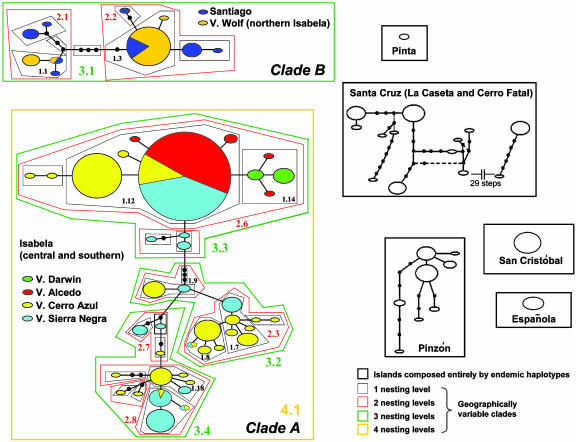
Isolated oceanic archipelagos have played a major role in the development of evolutionary theory by offering a unique setting for studying spatial and temporal patterns of biological diversification. However, the evolutionary events that cause associations between genetic variation and geography in archipelago radiations are largely unknown. This finding is especially true in the Galápagos Islands, where molecular studies have revealed conflicting biogeographic patterns. Here, we elucidate the history of diversification of giant Galápagos tortoises by using mtDNA sequences from 802 individuals representing all known extant populations. We test biogeographic predictions based on geological history and assess the roles of volcano emergence and island formation in driving evolutionary diversification. Patterns of colonization and lineage sorting appear highly consistent with the chronological formation of the archipelago. Populations from older islands are composed exclusively of endemic haplotypes that define divergent monophyletic clades. Younger populations, although currently differentiated, exhibit patterns of colonization, demographic variation and genetic interchange shaped by recent volcanism. Colonization probably occurs shortly after a volcano emerges through range expansion from older volcanoes. Volcanism can also create temporal shifts from historical to recurrent events, such as promoting gene flow by creating land bridges between isolated volcanoes. The association of spatial and temporal patterns of genetic variation with geophysical aspects of the environment can best be attributed to the limited dispersal and migration of tortoises following an oceanographic current. The endangered giant Galápagos tortoises represent a rapid allopatric radiation and further exemplify evolutionary processes in one of the world's greatest natural laboratories of evolution.
Figures
References
-
- Darwin, C. (1859) The Origin of Species by Means of Natural Selection (John Murray, London).
-
- Emerson, B. C. (2002) Mol. Ecol. 11, 951-966. - PubMed
-
- Grant, P. R. & Grant R. (1996) Philos. Trans. R. Soc. London B 351, 765-772.
-
- Rassmann, K., Tautz, D., Trillmich, F. & Gliddon, C. (1997) Mol. Ecol. 6, 437-452.
-
- Wright, J. W. (1983) in Patterns of Evolution in Galápagos Organisms, eds. Bowman, R. I., Berson, M. & Leviton, A. E. (Am. Assoc. Adv. Sci. Pacific Div., San Francisco), pp. 123-155.
Publication types
MeSH terms
Substances
Associated data
- Actions
- Actions
- Actions
- Actions
- Actions
- Actions
- Actions
- Actions
- Actions
- Actions
- Actions
- Actions
- Actions
- Actions
- Actions
- Actions
- Actions
- Actions
- Actions
- Actions
- Actions
- Actions
- Actions
- Actions
- Actions
- Actions
- Actions
- Actions
- Actions
- Actions
- Actions
- Actions
- Actions
- Actions
- Actions
- Actions
- Actions
- Actions
- Actions
- Actions
- Actions
- Actions
- Actions
- Actions
- Actions
- Actions
- Actions
- Actions
- Actions
- Actions
- Actions
- Actions
- Actions
- Actions
- Actions
- Actions
- Actions
- Actions
- Actions
- Actions
- Actions
- Actions
- Actions
- Actions
- Actions
- Actions
- Actions
- Actions
- Actions
- Actions
- Actions
- Actions
- Actions
- Actions
- Actions
- Actions
- Actions
- Actions
- Actions
- Actions
- Actions
- Actions
LinkOut - more resources
Full Text Sources
