. 2004 Apr;113(8):1210-7.
doi: 10.1172/JCI18195.

Murine autoimmune hearing loss mediated by CD4+ T cells specific for inner ear peptides

Affiliations

Murine autoimmune hearing loss mediated by CD4+ T cells specific for inner ear peptides

C Arturo Solares et al. J Clin Invest. 2004 Apr.

Abstract

Autoimmune sensorineural hearing loss (ASNHL) is characterized typically by bilateral, rapidly progressive hearing loss that responds therapeutically to corticosteroid treatment. Despite its name, data implicating autoimmunity in the etiopathogenesis of ASNHL have been limited, and targeted self-antigens have not been identified. In the current study we show that the inner ear-specific proteins cochlin and beta-tectorin are capable of targeting experimental autoimmune hearing loss (EAHL) in mice. Five weeks after immunization of SWXJ mice with either Coch 131-150 or beta-tectorin 71-90, auditory brainstem responses (ABR) showed significant hearing loss at all frequencies tested. Flow cytometry analysis showed that each peptide selectively activated CD4(+) T cells with a proinflammatory Th1-like phenotype. T cell mediation of EAHL was determined by showing significantly increased ABR thresholds 6 weeks after adoptive transfer of peptide-activated CD4(+) T cells into naive SWXJ recipients. Immunocytochemical analysis showed that leukocytic infiltration of inner ear tissues coincided with onset of hearing loss. Our study provides a contemporary mouse model for clarifying our understanding of ASNHL and facilitating the development of novel effective treatments for this clinical entity. Moreover, our data provide experimental confirmation that ASNHL may be a T cell-mediated organ-specific autoimmune disorder of the inner ear.


Figures
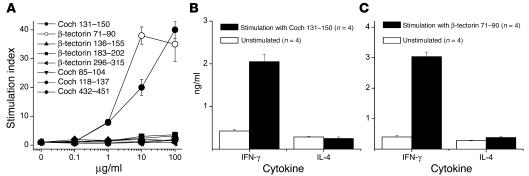
Figure 1
Figure 1
Immunogenicity of cochlin and β-tectorin peptides containing the KXXS MHC class II–binding motif. Female SWXJ mice were immunized with selected peptides containing the KXXS motif and derived from the sequences of inner ear–specific proteins. Eight to 10 days after immunization, LN cells were tested for recall proliferative responses to each peptide immunogen. (A) Coch 131–150 and β-tectorin 71–90 elicited marked dose-response reactivity compared with several other cochlin and β-tectorin peptides that were relatively nonimmunogenic. (B) ELISA analysis of 48-hour culture supernatants showed that recall responses to Coch 131–150 involved the proinflammatory Th1-like phenotype with elevated production of IFN-γ and virtually no production of IL-4. (C) Recall responses to β-tectorin 71–90 showed a similar Th1-like cytokine profile. Error bars show ± SE.
Figure 2
Figure 2
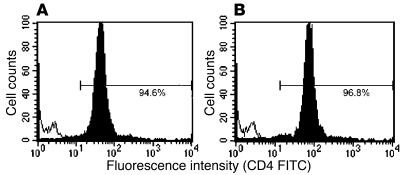
CD4+ T cells respond to Coch 131–150 and β-tectorin 71–90. LN cells from mice primed to (A) Coch 131–150 and (B) β-tectorin 71–90 were stimulated in vitro for 3–4 days with 100 μg/ml peptide, washed repeatedly, and examined by flow cytometry after staining with FITC-conjugated mAb to mouse CD4 or CD8. The gated lymphocyte populations identified by intermediate size (forward scatter) and intermediate granularity (side scatter) consisted of predominantly CD4+ T cells responding to each peptide. The hollow unshifted peak shows superimposed staining with isotype control Ab’s.
Figure 3
Figure 3
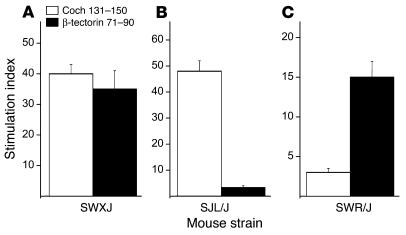
T cell responses to Coch 131–150 and β-tectorin 71–90 are restricted by IAs and IAq, respectively. Eight to 10 days after immunization of female SWXJ (H-2q,s), SWR/J (H-2q), and SJL/J (H-2s) mice with either Coch 131–150 or β-tectorin 71–90, LN cells were tested for elicitation of recall proliferative responses to 100 μg/ml of each peptide. (A) LN cells from primed SWXJ mice responded to each peptide. (B) LN cells from primed SJL/J mice responded to Coch 131–150 but did not respond to β-tectorin 71–90, whereas (C) LN cells from primed SWR/J mice responded to β-tectorin 71–90 but did not respond to Coch 131–150. Thus, responses to Coch 131–150 showed restriction by IAs, whereas responses to β-tectorin 71–90 showed restriction by IAq. Error bars show ± SE.
Figure 4
Figure 4
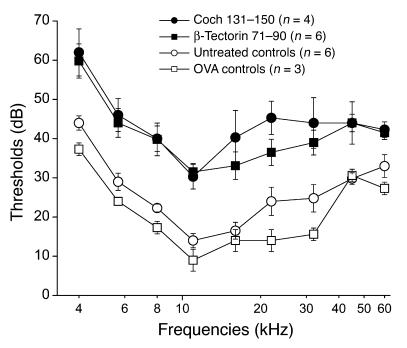
Increased ABR thresholds show hearing loss in SWXJ mice immunized with Coch 131–150 or β-tectorin 71–90. Five weeks after immunization with either Coch 131–150 or β-tectorin 71–90, female SWXJ mice underwent ABR testing for determining hearing loss. Significant hearing loss was detected at all thresholds from 4 to 60 kHz in mice immunized with Coch 131–150 and β-tectorin 71–90 when compared with untreated age- and sex-matched controls (P = 0.01 and P = 0.024, respectively) and OVA-immunized controls (P = 0.012 and P = 0.017, respectively). Error bars show ± SE.
Figure 5
Figure 5
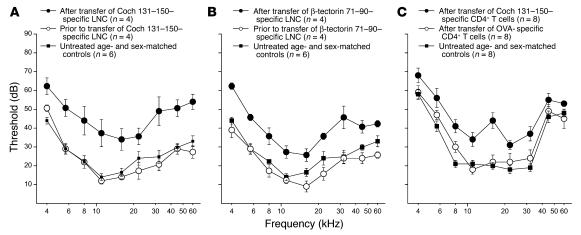
Hearing loss occurs in SWXJ mice following adoptive transfer of activated T cells specific for Coch 131–150 or β-tectorin 71–90. Ten days after immunization of female SWXJ mice with either Coch 131–150 or β-tectorin 71–90, LN cells were activated in vitro and transferred (107 cells) into γ-irradiated (4.5 Gy) 8-week-old naive female recipients that had undergone ABR testing 1 day prior to cell transfer. Six weeks later, ABR testing showed significantly increased thresholds and hearing deficit in mice that had received activated T cells specific for either (A) Coch 131–150 (P = 0.018) or (B) β-tectorin 71–90 (P = 0.002). Untreated 14-week-old female SWXJ mice showed no spontaneous hearing loss and are provided in each figure as reference. Eight to 10 days after immunization with either Coch 131–150 or OVA, splenocytes were activated in vitro with 100 μg/ml immunogen, and CD4+ T cells were purified more than 95% by magnetic bead separation. CD4+ T cells (2 × 10⁷) were injected i.v. into γ-irradiated (4.5 Gy) 8-week-old naive female recipients. (C) Six weeks after transfer of purified CD4+ T cells, ABR testing showed significantly increased thresholds and hearing deficit in recipients of Coch 131–150–specific CD4+ T cells when compared with either age- and sex-matched controls (P = 0.001) or with recipients of OVA-specific CD4+ T cells (P = 0.001). Age- and sex-matched control mice and mice transferred with CD4+ T cells specific for OVA showed no differences in ABR thresholds (P = 0.39). Thus, purified CD4+ T cells specific for Coch 131–150 are capable of mediating EAHL. Error bars show ± SE. LNC, LN cells.
Figure 6
Figure 6
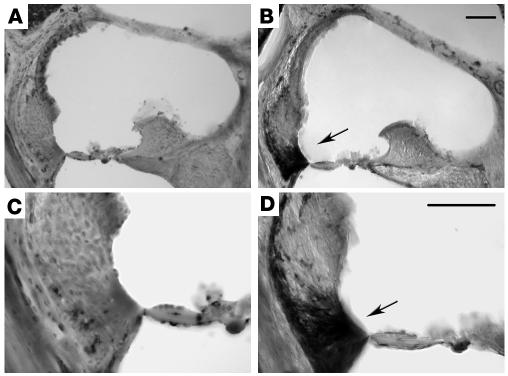
Inner ear inflammatory infiltrates are associated with onset of EAHL. Cochleas from SWXJ mice were immunostained with CD45 Ab at 2, 3, 4, and 5 weeks after immunization with Coch 131–150. (A) Photomicrograph under ×10 magnification showing the organ of Corti from an untreated age- and sex-matched control SWXJ mouse. (B) Photomicrograph under ×10 magnification showing the organ of Corti from an SWXJ mouse 5 weeks after immunization with Coch 131–150, the earliest time of detection of hearing loss. Arrow shows prominent CD45+ immunostaining in the spiral ligament. (C) Photomicrograph at ×20 magnification showing the organ of Corti from an untreated age- and sex-matched control SWXJ mouse. (D) Photomicrograph at ×20 magnification showing the organ of Corti from an SWXJ mouse 5 weeks after immunization with Coch 131–150. Arrow shows prominent CD45+ immunostaining concentrated in the lower spiral ligament. Scale bars: 50 μm.

Comment in

References

    1. NICDC. 2001. Health information on sudden deafness. National Institute on Deafness and Other Communication Disorder (NIDCD). http://www.nidcd.nih.gov/health/hearing/sudden.asp.
    1. Harris, J.P., Moscicki, R.A., and Hughes, G.B. 1997. Immunologic disorders of the inner ear. In Clinical otology. G.B. Hughes and M.L. Pensak, editors. Thieme Medical Publishers. New York, New York, USA. 381–391.
    1. Arnold W, Pfaltz R, Altermatt HJ. Evidence of serum antibodies against inner ear tissues in the blood of patients with certain sensorineural hearing disorders. Acta Otolaryngol. 1985;99:437–444. - PubMed
    1. Veldman, J.E., Hughes, G.B., and Roord, J.J. 1986. Immune-mediated inner ear disorders: immunological investigations in the neurotology clinic. In Handbook of neurotological diagnosis. J.W. House and A.F. Connor, editors. Marcel Dekker Inc. New York, New York, USA. 339–371.
    1. Elies, W., and Plester, D. 1985. Sensorineural hearing loss and immunity. In Immunobiology, autoimmunity and transplantation in otorhinolaryngology. J.E. Veldman, B.F. McCabe, E.H. Huizing, and N. Mygind, editors. Kugler Publications. Amsterdam, Holland. 111–117.

Publication types