


Surface Electromyographic Activity of the Abdominal Muscles During Pelvic-Tilt and Abdominal-Hollowing Exercises
- PMID: 15085209
- PMCID: PMC385259
Surface Electromyographic Activity of the Abdominal Muscles During Pelvic-Tilt and Abdominal-Hollowing Exercises
Abstract
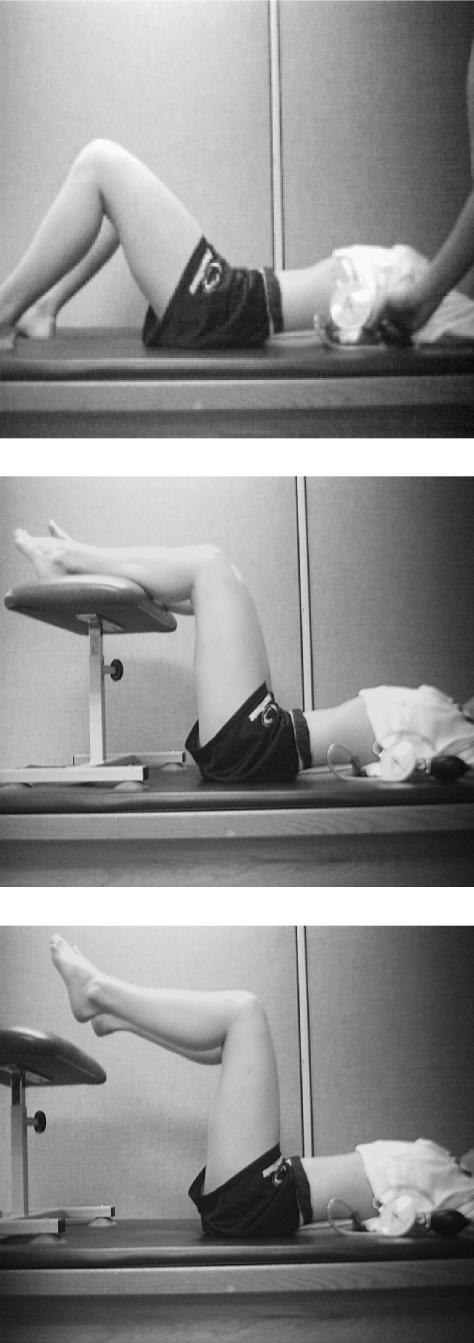
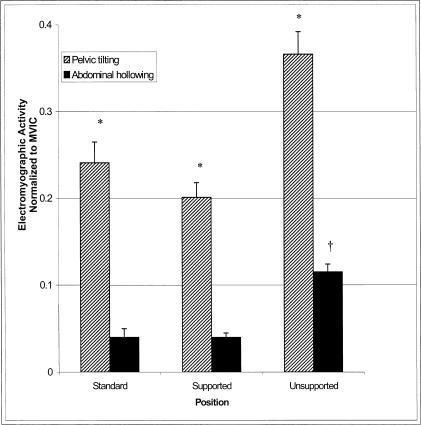
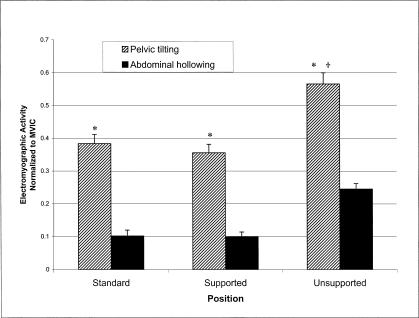
OBJECTIVE: To investigate surface electromyographic (EMG) activity of the rectus abdominus and external oblique abdominus muscles during pelvic-tilt and abdominal-hollowing exercises performed in different positions. DESIGN AND SETTING: 2 x 3 (exercise by position) within-subjects design with repeated measures on both factors. All testing was performed in a university laboratory. SUBJECTS: Twenty-six healthy, active young adult females. MEASUREMENTS: Surface EMG activity was recorded from the left and right rectus abdominus and external oblique muscles while the 2 exercises (pelvic tilt and abdominal hollowing) were performed in different positions (standard, legs supported, and legs unsupported). The standard position was supine in the crook-lying position, the supported position was with hips and knees flexed to 90 degrees and legs supported on a platform, and the unsupported position was with hips and knees flexed to 90 degrees without external support. Peak EMG activity was normalized to a maximum voluntary isometric contraction for each muscle. RESULTS: For the rectus abdominus, there was an interaction between position and activity. Abdominal hollowing produced significantly less activity than the pelvic tilt in all positions. The difference between the 2 exercises with the legs unsupported was of a greater magnitude than the other 2 positions. For the external obliques, there was significantly lower activity during the abdominal hollowing compared with the pelvic tilting. The greatest muscle activity occurred with the legs-unsupported position during both exercises. CONCLUSIONS: Abdominal-hollowing exercises produced less rectus abdominus and external oblique activity than pelvic-tilting exercises. Abdominal hollowing may be performed with minimal activation of the large global abdominal muscles.
Figures
References
-
- Bergmark A. Stability of the lumbar spine: a study in mechanical engineering. Acta Orthop Scand. 1989;230:20–24. - PubMed
-
- Saal JA. The new back school prescription: stabilization training, part 2. Occup Med. 1992;7:33–42. - PubMed
-
- McKenzie RA. The Lumbar Spine: Mechanical Diagnosis and Therapy. Auckland, New Zealand: Spinal Publications; 1981.
-
- Singer KP. A new musculoskeletal assessment in a student population. J Orthop Sports Phys Ther. 1986;8:34–41. - PubMed
LinkOut - more resources
Full Text Sources