Review
. 2004 Dec;53(12):1055-67.
doi: 10.1007/s00262-004-0530-z.

Targeting the immune system: novel therapeutic approaches in squamous cell carcinoma of the head and neck

Affiliations
Review

Targeting the immune system: novel therapeutic approaches in squamous cell carcinoma of the head and neck

Thomas K Hoffmann et al. Cancer Immunol Immunother. 2004 Dec.

Abstract

Despite advances in surgery, radiotherapy, and chemotherapy, the overall survival rates for patients with squamous cell carcinoma of the head and neck (SCCHN) have not changed over the last decades. Clearly, novel therapeutic strategies are needed for this cancer, which is highly immunosuppressive. Therefore, biologic therapies able to induce and/or up-regulate antitumor immune responses could represent a complementary approach to conventional treatments. Because patients with SCCHN are frequently immunocompromised due to the elimination or dysfunction of critical effector cells of the immune system, it might be necessary to restore these immune functions to allow for the generation of more effective antitumor host responses. Simultaneously, to prevent tumor escape, it might be necessary to alter attributes of the malignant cells. The present review summarizes recent advances in the field of immunotherapy of SCCHN, including techniques of nonspecific immune stimulation, the use of monoclonal antibodies, advances in adoptive immunotherapy and genetic engineering, as well as anticancer vaccines. These biologic therapies, alone or in combination with conventional treatment, are likely to develop into useful future treatment options for patients with SCCHN.


Figures
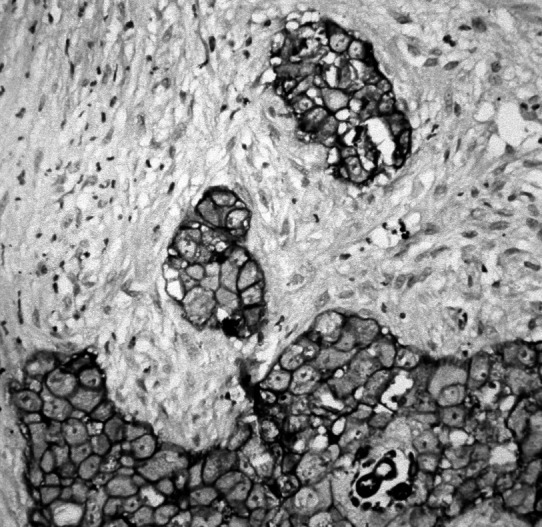
Fig. 1
Fig. 1
A representative section of human SCCHN stained for EGFR/erbB-1 protein and showing the characteristic membranous immunostaining. Sections of formalin-fixed and paraffin-embedded tumor tissue of 3–5 μm thickness were air-dried, dewaxed, rehydrated, and treated with Pronase E for 15 min at 37°C to enhance immunoreactivity. Staining was performed with a mouse mAb directed against human erbB-1 (TissuGnost anti-EGF-R “P”; Merck, Darmstadt, Germany) employing an avidin-biotin–based immunoperoxidase technique
Fig. 2
Fig. 2
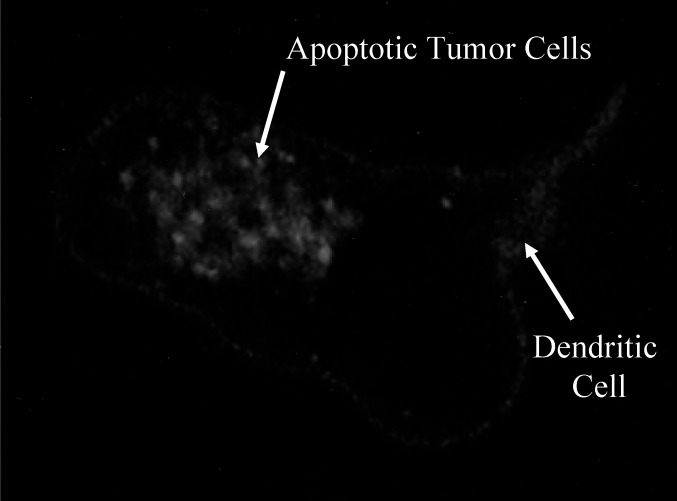
Up-take of apoptotic human SCCHN cells by monocyte-derived DCs cultured in IL-4 and GM-CSF. Tumor cells were stained with (DiOC16; Molecular Probes, Eugene, OR, USA) before induction of apoptosis (UVB irradiation) and cocultured with monocyte-derived (IL-4 and GM-CSF) DCs on glass coverslips. After overnight incubation, attached cells were stained with an anti-CD80 Ab (Becton Dickinson, San Jose, CA, USA) in combination with a rabbit antimouse Cy3-conjugated secondary Ab (Jackson ImmunoResearch Laboratory, West Grove, PA, USA). Apoptotic SCCHN were detected inside DCs by confocal laser scanning microscopy (mid plane image)
Fig. 3
Fig. 3
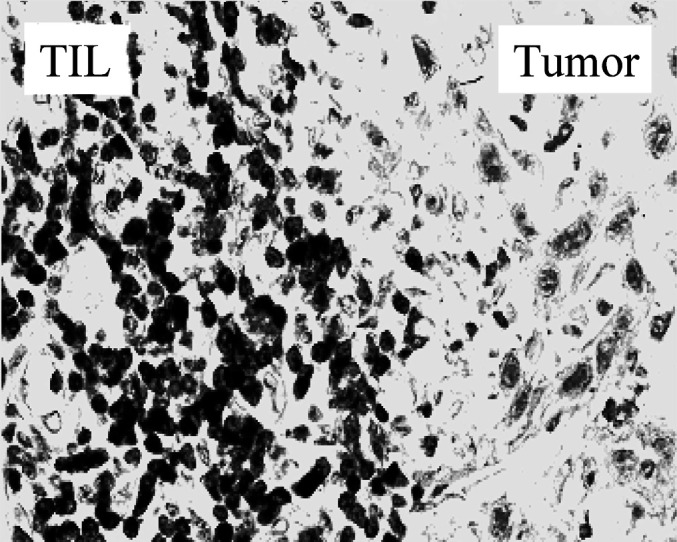
A cryosection of human SCCHN immunostained with an anti-CD3 Ab, showing an extensive accumulation of CD3+ T lymphocytes at the tumor site. Immunoperoxidase staining, ×400

References

    1. Reichert J Immunother. 1998;21:295. - PubMed
    1. Whiteside Semin Cancer Biol. 2002;12:43. doi: 10.1006/scbi.2001.0402. - DOI - PubMed
    1. Hadden Int J Immunopharmacol. 1997;19:629. doi: 10.1016/S0192-0561(97)00063-5. - DOI - PubMed
    1. Richtsmeier Arch Otolaryngol Head Neck Surg. 1988;114:432. - PubMed
    1. Whiteside Cancer Immunol Immunother. 1998;46:175. - PMC - PubMed