


doi: 10.1128/IAI.72.5.2989-2994.2004.
Tick saliva reduces adherence and area of human neutrophils
Affiliations
- PMID: 15102811
- PMCID: PMC387908
- DOI: 10.1128/IAI.72.5.2989-2994.2004
Item in Clipboard
Tick saliva reduces adherence and area of human neutrophils
Infect Immun.
2004 May.
Abstract
During natural infection with the agent of Lyme disease, Borrelia burgdorferi, spirochetes are delivered with vector saliva, which contains anti-inflammatory and antihemostatic activities. We show here that the saliva of ixodid ticks reduces polymorphonuclear leukocyte (PMN) adhesion via downregulation of beta2-integrins and decreases the efficiency of PMN in the uptake and killing of spirochetes. Inhibition of integrin adhesion and signaling reduces anti-inflammatory functions of PMN. These effects may favor the initial survival of spirochetes in vivo.
Figures
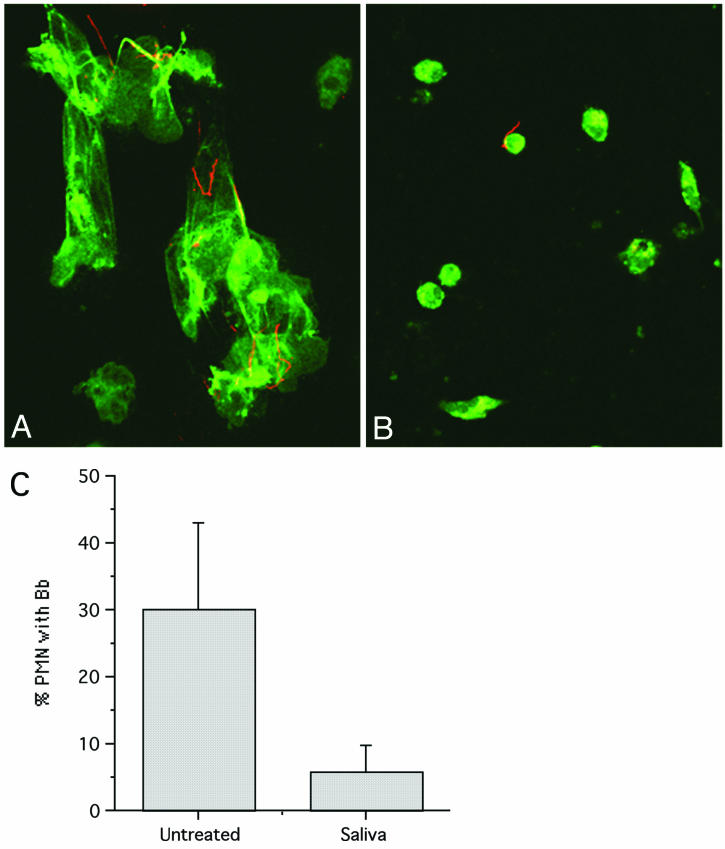
Saliva reduces adherence of PMN and attachment to spirochetes. Fresh human PMN on coverslips were incubated in KRPG containing 10% human serum with opsonized B. burgdorferi. Samples were fixed after 5 min of incubation at 37°C and double labeled with antibodies specific for myeloperoxidase (green) and spirochetes (red). Images were recorded at a magnification of ×63. (A) Control PMN are adherent and spread. (B) PMN treated with saliva spread less and bind few spirochetes. (C) Reduced percentage of PMN with attached B. burgdorferi after saliva treatment (P = 0.09). The number of attached B. burgdorferi (Bb) cells per 100 cells was determined (n = 3).
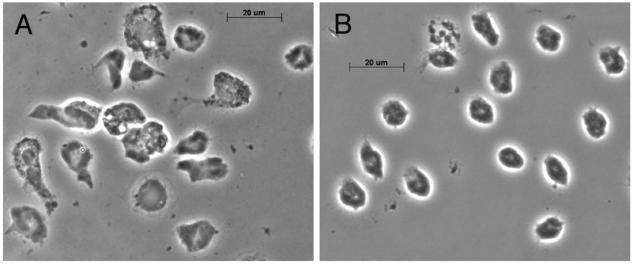
Saliva reduces PMN spreading. Adherent PMN on glass coverslips were incubated alone (A) or with a 1:10 dilution of saliva (B) for 1 h at 37°C before fixation. Cell spreading was examined at a magnification of ×63 by phase-contrast microscopy. Note the reduction in cell area after saliva treatment (n = 4).
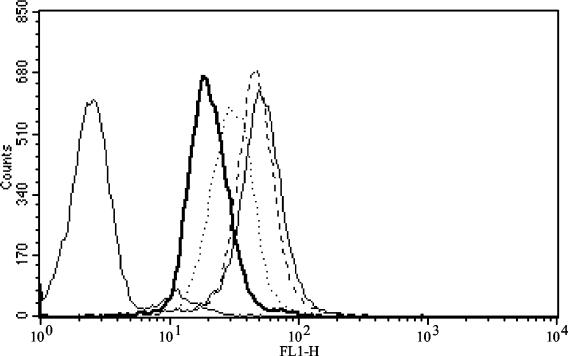
Saliva downregulates integrin expression on PMN. Freshly isolated PMN were incubated with dilutions of saliva for 60 min at 37°C prior to stimulation by 15 ng of TNF-α per ml for 30 min. Cells were stained before fixation for FACS analysis. The data are representative of four separate experiments; unstained cells are at the far left. Light solid line, untreated PMN; heavy solid line, PMN treated with saliva at a dilution of 1:10; dotted line, PMN treated with saliva at a dilution of 1:20; dashed line, PMN treated with saliva at a dilution of 1:100.
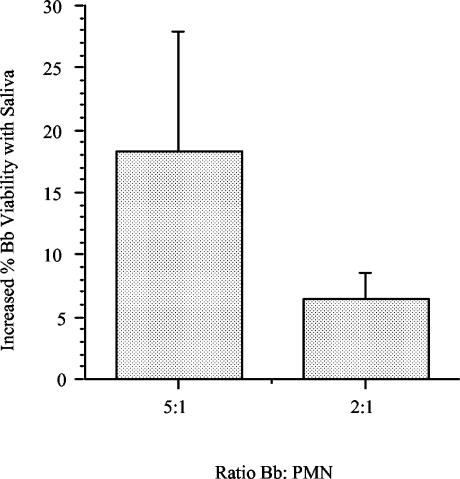
Saliva reduces killing of spirochetes by PMN. Freshly isolated PMN were preincubated with saliva at a 1:10 dilution for 60 min at 37°C prior to incubation with 5 × 10⁶ B. burgdorferi (Bb) cells for 1 h at 37°C. The data show the increase in the percentage of viable spirochetes recovered after incubation with saliva-treated PMN compared with the results obtained with control PMN after 48 h of regrowth in BSK II medium at 33°C (n = 3). Increases in the percentage of spirochetes recovered were statistically significant at the 2:1 ratio (P = 0.04).
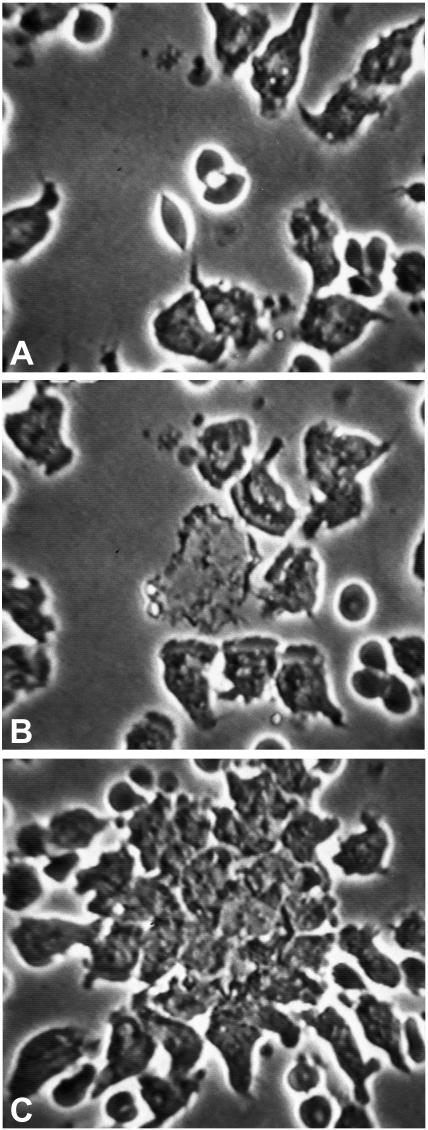
Saliva does not affect orientation or chemotaxis of PMN. Freshly isolated PMN were incubated with saliva (1:10 dilution) and examined live by videomicroscopy at a magnification of ×40. (A) PMN in the field, compressed to minimize the need for adhesion molecules, move randomly. The white dot indicates two erythrocytes targeted for laser destruction. (B) Twenty-two seconds after the laser flash, leading fronts of nearby PMN orient toward the newly created chemoattractant source. (C) By 3 min 25 s later, nearby PMN and other PMN from outside the field arrive at the target. This response is indistinguishable from that of control PMN (data not shown). No effect of saliva was noted.
References
-
- Alekseev, A. N., E. A. Arumova, and I. S. Vasilieva. 1995. Borrelia burgdorferi sensu lato in female cement plug of Ixodes persulcatus ticks (Acari, Ixodiae). Exp. Appl. Acarol. 19:519-522. - PubMed
-
- Barthold, S. W., M. de Souza, E. Fikrig, and D. H. Persing. 1992. Lyme borreliosis in the laboratory mouse, p. 223-242. In S. E. Schutzer (ed.), Lyme disease: molecular and immunologic approaches. Cold Spring Harbor Press, Cold Spring Harbor, N.Y.
-
- Coxon, A., P. Rieu, F. J. Barkalow, S. Askari, A. H. Sharpe, U. H. von Andrian, M. A. Arnaout, and T. N. Mayadas. 1996. A novel role for the beta 2 integrin CD11b/CD18 in neutrophil apoptosis: a homeostatic mechanism in inflammation. Immunity 5:653-666. - PubMed
Publication types
MeSH terms
Grants and funding
LinkOut - more resources
Full Text Sources
Other Literature Sources
