


doi: 10.1073/pnas.0401516101.
Epub 2004 Apr 26.
Deficiency of carbohydrate response element-binding protein (ChREBP) reduces lipogenesis as well as glycolysis
Affiliations
- PMID: 15118080
- PMCID: PMC409910
- DOI: 10.1073/pnas.0401516101
Item in Clipboard
Deficiency of carbohydrate response element-binding protein (ChREBP) reduces lipogenesis as well as glycolysis
Proc Natl Acad Sci U S A.
.
Abstract
The liver provides for long-term energy needs of the body by converting excess carbohydrate into fat for storage. Insulin is one factor that promotes hepatic lipogenesis, but there is increasing evidence that glucose also contributes to the coordinated regulation of carbohydrate and fat metabolism in liver by mechanisms that are independent of insulin. In this study, we show that the transcription factor, carbohydrate response element-binding protein (ChREBP), is required both for basal and carbohydrate-induced expression of several liver enzymes essential for coordinated control of glucose metabolism, fatty acid, and the synthesis of fatty acids and triglycerides in vivo.
Figures
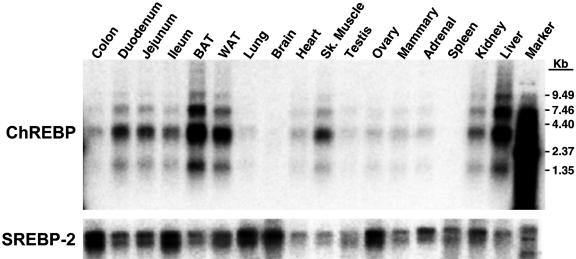
Tissue distribution of ChREBP mRNA expression. Poly(A+) mRNA (5 μg) from various mouse tissues was subjected to Northern blot analysis using a 32P-labeled mouse ChREBP cDNA probe. The blot was stripped and reprobed with a 32P-labeled mouse SREBP-2 cDNA probe to demonstrate the presence of mRNA in all lanes. BAT, brown adipose tissue; Sk., skeletal; WAT, white adipose tissue.
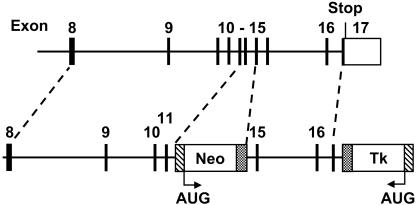
Generation of the ChREBP-/- mice. The schematic diagram of genomic mouse DNA is shown for the region surrounding the basic helix-loop-helix-encoding exons (13 and 14) of the ChREBP gene (GenBank accession no. AC084109). The genomic region spanning coding exons 12-14 was replaced with a neomycin-resistance cassette provided by the pKO Scrambler NTKV-1901 vector (Stratagene). Targeted disruption of the ChREBP allele was generated in 129S6/SvEvTac-derived embryonic stem cells with the resulting progeny comprised of 129S6/SvEvTac:C57BL/6J mixed-strain mice. Homologous recombination of the targeting construct at the appropriate site was confirmed by Southern blot analysis (data not shown). Loss of ChREBP expression was confirmed by real-time PCR (Table 2).
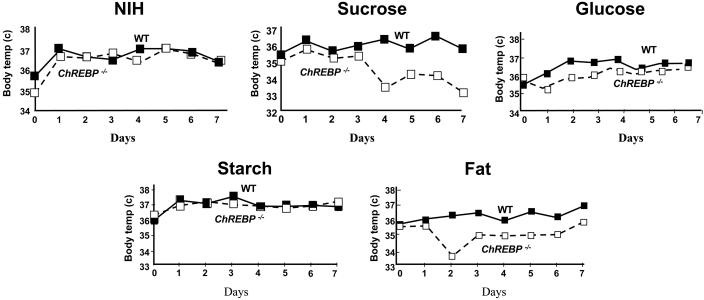
ChREBP-/- mice were unable to ingest sucrose and developed hypothermia. Wild-type and ChREBP-/- mice were fed the indicated diet for 7 days, and changes in body temperature were followed daily. ChREBP deficiency caused hypothermia and death in mice because of their inability to metabolize fructose. Data are means of four animals.
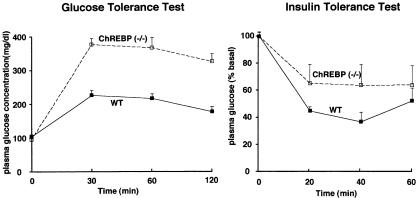
Glucose and insulin tolerance tests of wild-type and ChREBP-/- mice were conducted as described in Materials and Methods (n = 6 each). ChREBP deficiency causes mild insulin resistance.
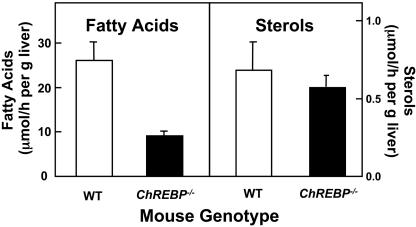
Hepatic synthesis of fatty acids and sterols were determined in wild-type and ChREBP-/- mice as described in Materials and Methods to compare rates of lipogenesis and steroidgenesis in intact animals.
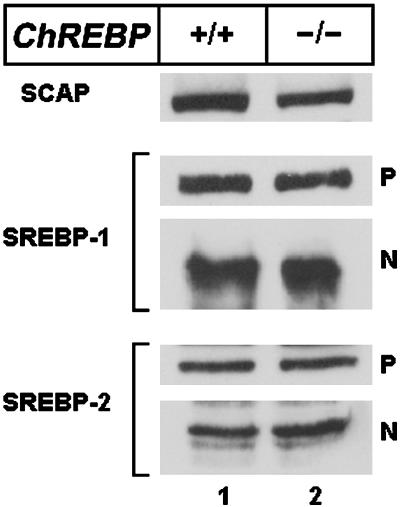
Immunoblot analysis of SREBP-cleavage activating protein (SCAP), SREBP-1, and SREBP-2 in livers from wild type and ChREBP-/- mice fed the high-starch diet described in Table 2. Livers from each group were separately pooled, and 30-μg aliquots of the membrane and nuclear extract fractions were subjected to SDS/PAGE and immunoblot analysis. The precursor and nuclear forms of SREBPs are denoted as P and N, respectively.
References
-
- Hillgartner, F. B., Salati, L. M. & Goodridge, A. G. (1995) Physiol. Rev. 75, 47-76. - PubMed
-
- Towle, H. C., Kaytor, E. N. & Shih, H. M. (1997) Annu. Rev. Nutr. 17, 405-433. - PubMed
-
- Girard, J., Ferre, P. & Foufelle, F. (1997) Annu. Rev. Nutr. 17, 325-352. - PubMed
-
- Vaulont, S., Vasseur-Cognet, M. & Kahn, A. (2000) J. Biol. Chem. 275, 31555-31558. - PubMed
-
- Osborne, T. F. (2000) J. Biol. Chem. 275, 32379-32382. - PubMed
Publication types
MeSH terms
Substances
Grants and funding
LinkOut - more resources
Full Text Sources
Other Literature Sources
Molecular Biology Databases
Research Materials
