A tale of two cities: financing two voucher programs for substance abusers through community donations
- PMID: 15122959
- PMCID: PMC1255912
- DOI: 10.1037/1064-1297.12.2.147
A tale of two cities: financing two voucher programs for substance abusers through community donations
Abstract
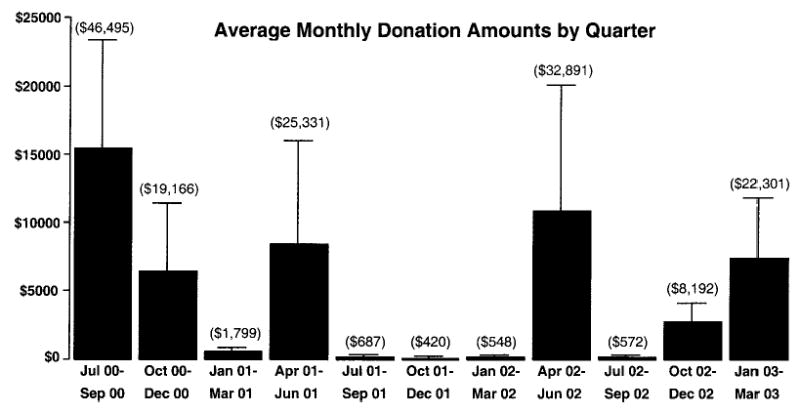
Voucher-based reinforcement therapy (VBRT) is an effective drug abuse treatment, but the cost of VBRT rewards has limited its dissemination. Obtaining VBRT incentives through donations may be one way to overcome this barrier. Two direct mail campaigns solicited donations for use in VBRT for pregnant, postpartum, and parenting drug users in Toronto, Ontario, Canada, and in Los Angeles, California. In Toronto, 19% of those contacted over 2 months donated 8,000 dollars (4,000 dollars/month) of goods and services. In Los Angeles, nearly 26% of those contacted over 34 months donated 161,000 dollars (4,472dollars/month) of goods and services. Maintaining voucher programs by soliciting donations is feasible and sustainable. The methods in this article can serve as a guide for successful donation solicitation campaigns. Donations offer an alternative for obtaining VBRT rewards for substance abuse treatment and may increase its dissemination.
((c) 2004 APA, all rights reserved)
Figures

References
-
- Amass, L. (1997). Financing voucher programs for pregnant substance abusers through community donations. In L. S. Harris (Ed.), Problems of drug dependence 1996: Proceedings of the 58th annual scientific meeting (NIDA Research Monograph 174, p. 60). Rockville, MD: National Institute on Drug Abuse. - PubMed
-
- Amass L, Bickel WK, Crean J, Higgins ST. Preferences for clinic privileges, retail items, and social activities in an outpatient buprenorphine treatment program. Journal on Substance Abuse Treatment. 1996;13:49–55. - PubMed
-
- Amass, L., Ennis, E., Mikulich, S. K., & Kamien, J. B. (1998). Using fee rebates to reinforce abstinence and counseling attendance in cocaine abusers. In L. S. Harris (Ed.), Problems of drug dependence 1997: Proceedings of the 59th annual scientific meeting (NIDA Research Monograph 178, p. 99). Washington, DC: U.S. Government Printing Office. - PubMed
-
- Bigelow GE, Stitzer ML, Griffiths RR, Liebson IA. Contingency management approaches to drug self-administration and drug abuse: Efficacy and limitations. Addictive Behaviors. 1981;6:241–252. - PubMed
-
- Chutuape MA, Silverman K, Stitzer ML. Survey assessment of methadone treatment services as reinforcers. American Journal of Drug Alcohol Abuse. 1998;24:1–16. - PubMed