


Risk factors for feline coronavirus seropositivity in cats relinquished to a UK rescue charity
- PMID: 15123148
- PMCID: PMC7129206
- DOI: 10.1016/j.jfms.2004.01.003
Risk factors for feline coronavirus seropositivity in cats relinquished to a UK rescue charity
Abstract
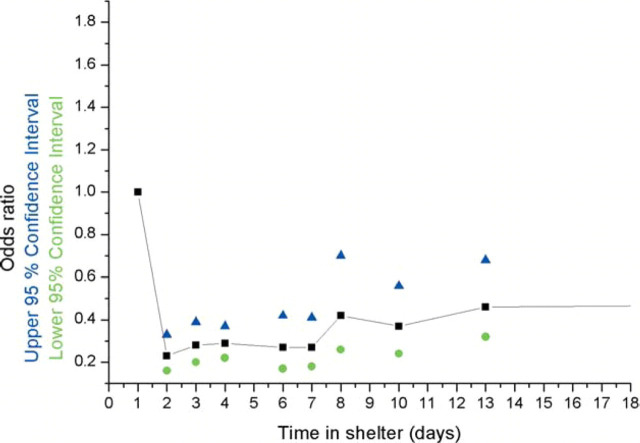
Two thousand, two hundred and seven cats from 14 shelters of a major UK cat charity were blood tested for feline coronavirus (FCoV) antibodies. Data was collated on breed, sex, age, number of cats at original location, outdoor access, health status, and time spent in the shelter prior to sampling (range 0 to 4 years). Some cats were also tested for feline leukaemia virus antigen, feline immunodeficiency virus, and Toxoplasma gondii antibodies. The effect of these variables on FCoV seropositivity was explored by multivariable logistic regression. FCoV seropositivity in cats that had spent 5 days or less in a shelter at sampling was significantly associated with a multi-cat origin, cats aged 3 years or less, and Persian breed. Whether pet, stray or feral, health status, indoor/outdoor access, and sex had no significant effect. Overall FCoV seropositivity was associated with time spent in a shelter but this association was not linear. Cats that had spent more than 60 days in a shelter were over five times as likely to be seropositive. This may be the result of a change in husbandry from solitary to communal housing for cats remaining in shelters long term. Rescue of cats for less than 60 days was not associated with a significant increasing risk of seropositivity. Significant variation existed in seropositivity between individual shelters overall and in cats rescued for less than 5 days. These findings may reflect inter-shelter variation in cat husbandry and variation in seropositivity of shelter intake respectively.
Figures
References
-
- Addie D.D., Jarrett J.O. A study of naturally occurring feline coronavirus infection in kittens, Veterinary Record, 130, 1992, 133–137. - PubMed
-
- Addie D.D., Jarrett J.O. Use of a reverse-transcriptase polymerase chain reaction for monitoring feline coronavirus shedding by healthy cats, Veterinary Record, 148, 2001, 649–653. - PubMed
-
- Legendre A.M., Luria B.J., Gorman S.P., Lee I.T., Levy J.K., 2002. Prevalence of coronavirus antibodies in feral cats in Gainesville, Florida. Second International Feline Coronavirus/Feline Infectious Peritonitis Symposium, Glasgow, Scotland.
Publication types
MeSH terms
Substances
LinkOut - more resources
Full Text Sources
Miscellaneous
