. 2004 May 11;101(19):7335-40.
doi: 10.1073/pnas.0307819101. Epub 2004 May 3.

Production of alpha-1,3-galactosyltransferase null pigs by means of nuclear transfer with fibroblasts bearing loss of heterozygosity mutations

Affiliations

Production of alpha-1,3-galactosyltransferase null pigs by means of nuclear transfer with fibroblasts bearing loss of heterozygosity mutations

Donna Kolber-Simonds et al. Proc Natl Acad Sci U S A. .

Abstract

Hyperacute rejection of porcine organs by old world primate recipients is mediated through preformed antibodies against galactosyl-alpha-1,3-galactose (Galalpha-1,3-Gal) epitopes expressed on the pig cell surface. Previously, we generated inbred miniature swine with a null allele of the alpha-1,3-galactosyltransferase locus (GGTA1) by nuclear transfer (NT) with gene-targeted fibroblasts. To expedite the generation of GGTA1 null pigs, we selected spontaneous null mutant cells from fibroblast cultures of heterozygous animals for use in another round of NT. An unexpectedly high rate of spontaneous loss of GGTA1 function was observed, with the vast majority of null cells resulting from loss of the WT allele. Healthy piglets, hemizygous and homozygous for the gene-targeted allele, were produced by NT by using fibroblasts that had undergone deletional and crossover/gene conversion events, respectively. Aside from loss of Galalpha-1,3-Gal epitopes, there were no obvious phenotypic differences between these null piglets and WT piglets from the same inbred lines. In fact, congenital abnormalities observed in the heterozygous NT animals did not reappear in the serially produced null animals.


Figures

Fig. 1.
Fig. 1.
Derivation of GGTA1 null pigs.
Fig. 2.
Fig. 2.
Selection of GGTA1 null cells from heterozygously targeted fibroblasts. Fibroblasts from heterozygous fetus 355-F1 (A) and neonatal piglet PL556 (B) were analyzed by flow cytometry for binding to FITC-conjugated Galα-1,3-Gal-specific lectin BS-I-B4. 355-F1 4X and PL556#3R populations (solid lines) were selected four and three times, respectively, by lysis with affinity-purified baboon NAb and complement. Stained cells before selection (broken lines) and unstained selected populations (solid lines) served as positive and negative controls for BS-I-B4 binding. (C) Genomic DNA from the above cell populations (and WT fetus F7) was analyzed by PCR by using a forward primer upstream of the selection cassette of the GGTA1 targeting vector (F527) and a reverse primer (GR2520) downstream of the vector end, as described (11). SacI digestion yields a 2,300-bp band from the targeted GGTA1 allele, a 1,250-bp band from the WT allele, and a 7,900-bp band common to both alleles. The WT band is not detected after NAb/complement selection.
Fig. 3.
Fig. 3.
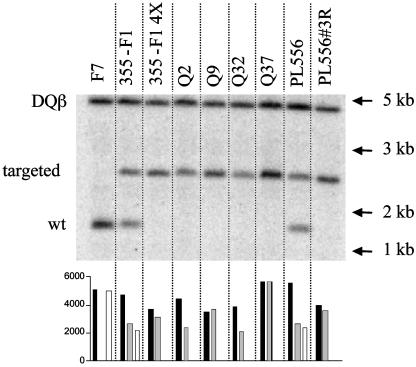
Quantitative Southern blot analysis of NT donor lines. Genomic DNA from the indicated sources was digested with restriction enzyme AflIII, Southern blotted, and hybridized simultaneously with a 116-bp probe from exon 9 of the GGTA1 locus and a 107-bp probe from the porcine SLA DQβ locus. The GGTA1 probe hybridizes a 1.3-kb WT fragment and a 2.3-kb gene-targeted fragment containing an IRES-neo selection cassette. DNA from WT (F7) and heterozygous (355-F1 and PL556) fibroblasts, before NAb/complement selection, served as controls. 355-F1 4X and PL556#3R samples were prepared from cell populations selected four and three times, respectively, with affinity-purified baboon NAb and complement. Q series samples were from clonal cell lines isolated from 355-F1 fetal fibroblasts. Signal quantitation was performed on a Storm 820 PhosphorImager and graphed as absolute values for the DQβ locus (▪), targeted GGTA1 allele (formula image), and WT GGTA1 allele (□).
Fig. 4.
Fig. 4.
Quantitative Southern blot analysis of GGTA1 null piglets. DNA from piglets O177-1 and O177-2 (produced by NT with null fibroblast clone Q32) and piglets PL742-744 (produced by NT with the PL556#3R NAb/complement selected fibroblast population) was analyzed as described in the legend to Fig. 3. DNA from heterozygous 355-F1 and PL556 fibroblasts, without NAb/complement selection, served as controls. Shown are DQβ locus (▪), targeted GGTA1 allele (formula image), and WT GGTA1 allele (□).
Fig. 5.
Fig. 5.
GGTA1 expression in fibroblasts from null piglets and progenitors. A Northern blot of poly(A)+ RNA was hybridized to a 1.4-kb probe containing portions of exons 2-9 of the GGTA1 gene. WT F7 fibroblasts express a 3.6-kb transcript whereas cells from 355-F1 and PL556 heterozygotes express both a 3.6-kb transcript from the WT locus and a 4.7-kb transcript from the targeted locus. Only the 4.7-kb transcript is detected in fibroblasts from the null piglets.
Fig. 6.
Fig. 6.
Flow cytometry analysis of Galα-1,3-Gal epitopes on GGTA1 null piglets and progenitors using BS-I-B4 lectin. Stained heterozygous or WT cells (red) and unstained cells (black) served as positive and negative controls. (A) Stained (blue) and unstained (black) ear fibroblasts from GGTA1 null piglet O177-1 and fetal fibroblasts from heterozygous progenitor 355-F1 (red). (B) Stained ear fibroblasts from null piglets PL742 (orange), PL743 (blue), and PL744 (green); stained (red) and unstained (black) fetal fibroblasts from heterozygous progenitor 355-F1. (C) Stained (blue) and unstained (black) multilineage white blood cells from O177-1 at 6 weeks of age and stained WBC from an age-matched WT control (red).
Fig. 7.
Fig. 7.
Complement-mediated lysis of cells after incubation with purified baboon NAb or human sera. Fibroblasts from GGTA1 null piglet O177-1, WT progenitor fetus F7, and heterozygous progenitor fetus 355-F1 were incubated with the indicated concentrations of affinity-purified polyclonal baboon NAb or heat-inactivated pooled human sera before lysis with rabbit complement. Normal human dermal fibroblasts (NHDF) served as a Galα-1,3-Gal negative control. Release of LDH is expressed as percent of total activity after detergent lysis. Residual metabolic activity, measure as MTS conversion, is expressed as percent of conversion without incubation in complement. Data are the average of three trials.
Fig. 8.
Fig. 8.
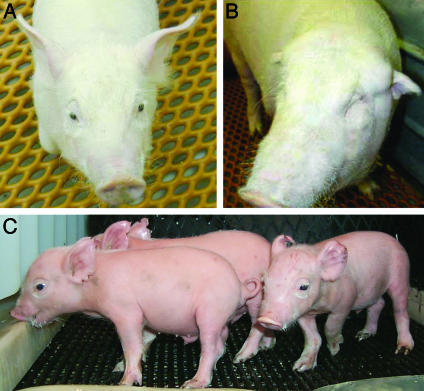
GGTA1 null and heterozygous pigs produced by NT. (A) Third-round NT piglet O177-1, produced using GGTA1 null donor cells selected from second-round heterozygous fetus 355-F1 (age 66 days). (B) First-round NT pig O212-2 (11), ear fibroblasts from which served as NT donor cells for fetus 355-F1 (age 3 months). Eye and ear defects in this pig are not observed in O177-1, nor were they apparent at 33 days gestation in fetus 355-F1 or any of its 11 clonal littermates. (C) Second-round NT piglets PL742-744, produced using GGTA1 null donor cells selected from first round heterozygous neonate PL556 (age 9 days).

References

    1. Cooper, D. K., Koren, E. & Oriol, R. (1993) Lancet 342, 682-683. - PubMed
    1. Lambrigts, D., Sachs, D. H. & Cooper, D. K. (1998) Transplantation 66, 547-561. - PubMed
    1. Galili, U., Clark, M. R., Shohet, S. B., Buehler, J. & Macher, B. A. (1987) Proc. Natl. Acad. Sci. USA 84, 1369-1373. - PMC - PubMed
    1. Tanemura, M., Maruyama, S. & Galili, U. (2000) Transplantation 69, 187-190. - PubMed
    1. Tearle, R. G., Tange, M. J., Zannettino, Z. L., Katerelos, M., Shinkel, T. A., Van Denderen, B. J., Lonie, A. J., Lyons, I., Nottle, M. B., Cox, T., et al. (1996) Transplantation 61, 13-19. - PubMed

Publication types

Substances