. 2004 May 11;101(19):7421-6.
doi: 10.1073/pnas.0400832101. Epub 2004 May 3.

Identification of hepoxilin A3 in inflammatory events: a required role in neutrophil migration across intestinal epithelia

Affiliations

Identification of hepoxilin A3 in inflammatory events: a required role in neutrophil migration across intestinal epithelia

Randall J Mrsny et al. Proc Natl Acad Sci U S A. .

Abstract

The mechanism by which neutrophils [polymorphonuclear leukocyte (PMNs)] are stimulated to move across epithelial barriers at mucosal surfaces has been basically unknown in biology. IL-8 has been shown to stimulate PMNs to leave the bloodstream at a local site of mucosal inflammation, but the chemical gradient used by PMNs to move between adjacent epithelial cells and traverse the tight junction at the apical neck of these mucosal barriers has eluded identification. Our studies not only identify this factor, previously termed pathogen-elicited epithelial chemoattractant, as the eicosanoid hepoxilin A(3) (hepA(3)) but also demonstrate that it is a key factor promoting the final step in PMN recruitment to sites of mucosal inflammation. We show that hepA(3) is synthesized by epithelial cells and secreted from their apical surface in response to conditions that stimulate inflammatory events. Our data further establish that hepA(3) acts to draw PMNs, via the establishment of a gradient across the epithelial tight junction complex. The functional significance of hepA(3) to target PMNs to the lumen of the gut at sites of inflammation was demonstrated by the finding that disruption of the 12-lipoxygenase pathway (required for hepA(3) production) could dramatically reduce PMN-mediated tissue trauma, demonstrating that hepA(3) is a key regulator of mucosal inflammation.


Figures
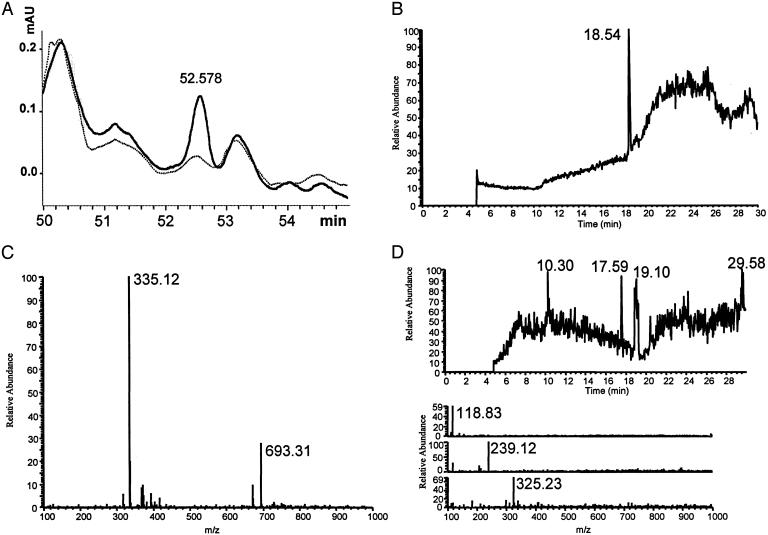
Fig. 1.
Fig. 1.
Identification of PEEC. (A) Absorbance (at 214 nm) of 50- to 55-min region of a semipreparative separation of PEEC-enriched samples obtained from monolayers exposed to S. typhimurium SL1433 (solid tracing) or VV341 (lighter, dashed tracing). (B) Analytical HPLC using neutral methanol of collected PEEC fraction showing one prominent peak with a retention time of 18.5 min. (C) Negative ion mode mass profile of 18.5-min peak with prominent peak at 335 and a secondary peak at 693. (D) Analytical HPLC profile and negative ion electrospray MS analysis of PEEC material after overnight incubation in acid. (Lower) (Top) Mass of 118 with a retention time of 10.3 min. (Middle) Mass of 239 with a retention time of 17.6 min. (Bottom) Mass of 325 with a retention time of 19.1 min.
Fig. 2.
Fig. 2.
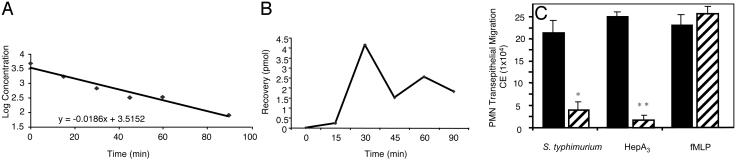
HepA3 functions in a gradient fashion. (A) Rate of hepA3 degradation (shown as log-linear plot) at the basolateral surface. Decay was exponential. t1/2 values were determined by best-fit analysis for each data set. Complex degradation events precluded calculation of accurate transport rates. (B) HepA3 recovered in the basolateral compartment of T84 monolayers after addition of 4,500 pmol to apical compartment. Data points represent means from two separate studies and indicate amount of hepA3 recovered at the basolateral surface is low. (C) Effect of 5 μg/ml basolateral addition of hepA3 (hashed bars) on the PMN transmigration normally induced (black bars) by either infection with wild-type S. typhimurium, apical addition of 5 μg/ml hepA3, or 100 mM formyl-methionylleucyl-phenylalanine (fMLP). Data (expressed as mean ± SD) represent one of at least two experiments performed in triplicate repeated at least three times. Statistical analysis (Student's t test) of the raw data reveal differences, *, P < 0.025 and **, P < 0.010, compared to their respective controls.
Fig. 3.
Fig. 3.
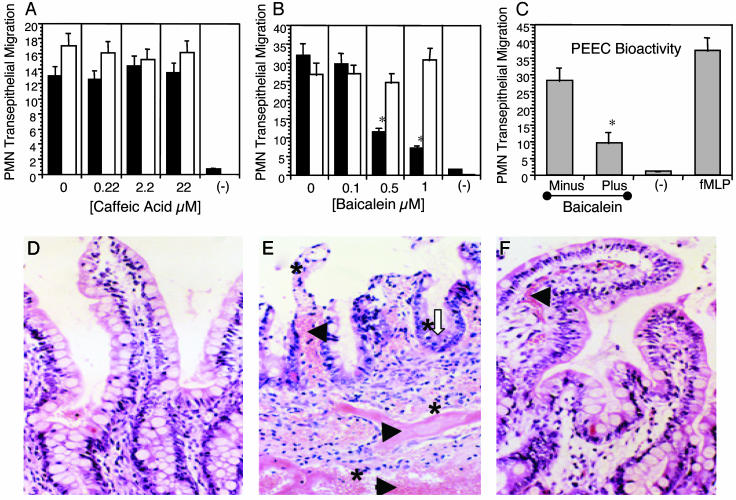
(A) PMN transepithelial migration induced by S. typhimurium (white bars) is unaffected by the specific 5-LO inhibitor caffeic acid (black bars). PMN transport across uninfected T84 monolayers (-) is also shown. (B) The 12-LO inhibitor (baicalein) induced a dose-dependent inhibition in a similar study (black bars). *, P < 0.025; Student's t test. (C) PEEC bioactivity was determined in spent apical media collected from uninfected T84 monolayers (-) or from T84 monolayers after infection with S. typhimurium SL1344 (6) that had been treated with 1 μM baicalein (Plus) or solvent control (Minus) and subsequently added to the apical compartment of naïve T84 monolayers to induce PMN transmigration. Monolayers treated with an apical application of 1 mM fMLP served as a positive control for the transmigration assay. *, P < 0.05; Student's t test. (D) Control intestinal epithelium of a xenograft injected with buffer in the absence of S. typhimurium. (E) S. typhimurium SL1344 infection of these xenografts resulted in profuse dissemination of red blood cells (black arrowheads) and a substantial PMN infiltrate (asterisk) within the mucosa and submucosa. Also shown is an early stage of crypt abscess formation (white open arrow). (F) Introduction of baicalein into the lumen of xenografts 1 hr before S. typhimurium SL1344 infection prevented the severe histopathologal events associated with S. typhimurium infection in this in vivo model. IL-8 was measured in these tissues as detailed (24). fMLP, formyl-methionyl-leucyl-phenylalanine.

References

    1. McCormick, B., Hofman, P., Kim, J., Carnes, D., Miller, S. I. & Madara, J. L. (1995) J. Cell. Biol. 131, 1599-1608. - PMC - PubMed
    1. Kumar, N. B., Nostrant, T. T. & Appelman, H. D. (1982) Am. J. Surg. Pathol. 6, 523-529. - PubMed
    1. McGovern, V. J. & Slavutin, L. J. (1979) Am. J. Surg. Pathol. 3, 483-490. - PubMed
    1. Yardley, J. H. & Donowitz, M. (1977) The Gastrointestinal Tract (Williams & Wilkins, Baltimore).
    1. McCormick, B. A., Parkos, C. A., Colgan, S. P., Carnes, D. K. & Madara, J. L. (1998) J. Immunol. 160, 455-466. - PubMed

Publication types

MeSH terms

Substances

LinkOut - more resources