Comparative Study
. 2004 May;113(9):1328-33.
doi: 10.1172/JCI18838.

The MHC class I-like Fc receptor promotes humorally mediated autoimmune disease

Affiliations
Comparative Study

The MHC class I-like Fc receptor promotes humorally mediated autoimmune disease

Shreeram Akilesh et al. J Clin Invest. 2004 May.

Abstract

The MHC class I family-like Fc receptor, FcRn, is normally responsible for extending the life span of serum IgG Ab's, but whether this molecule contributes to autoimmune pathogenesis remains speculative. To determine directly whether this function contributes to humoral autoimmune disease, we examined whether a deficiency in the FcRn heavy chain influences autoimmune arthritis in the K/BxN mouse model. FcRn deficiency conferred either partial or complete protection in the arthritogenic serum transfer and the more aggressive genetically determined K/BxN autoimmune arthritis models. The protective effects of an FcRn deficiency could be overridden with excessive amounts of pathogenic IgG Ab's. The therapeutic saturation of FcRn by high-dose intravenous IgG (IVIg) also ameliorated arthritis, directly implicating FcRn blockade as a significant mechanism of IVIg's anti-inflammatory action. The results suggest that FcRn is a potential therapeutic target that links the initiation and effector phases of humoral autoimmune disease.


Figures
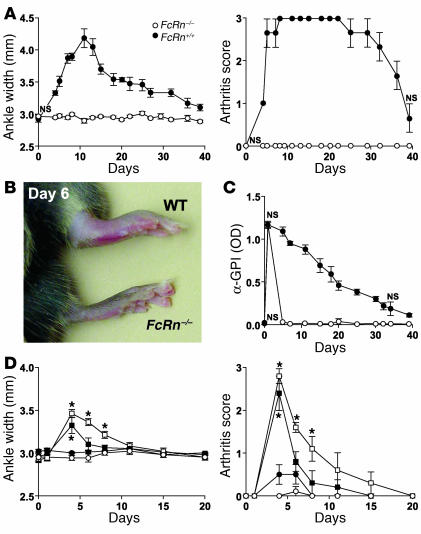
Figure 1
Figure 1
FcRn-deficient mice are resistant to serum-transfer arthritis. Data represented as the mean ± SE. (A_C) A single injection of 250 ∝l of sera pooled from 6- to 20-week-old arthritic K/BxN animals was injected intraperitoneally into three FcRn_/_ (open circles) and three FcRn+/+ (filled circles) B6 control mice. (A) Ankle width determinations and overall arthritis scores are as described (19). All time points except day 0 were significant at P < 0.05. (B) Digital images of representative ankles of FcRn_/_ and WT mice 6 days after serum transfer. (C) Serial serum samples from A were analyzed for anti-GPI Ig by ELISA (21). Data are representative of two independent experiments. NS, not significant. All other time points were significant at P < 0.05. (D) Ankle width and arthritis scores of B6-FcRn_/_ mice (n = 4_5) injected intraperitoneally with 250 (filled circles), 500 (filled squares), or 1,000 (open squares) ∝l arthritogenic K/BxN or 1,000 ∝l normal B6 mouse serum (open circles). *Ankle width and arthritis score time points were P _ 0.004 and P < 0.01 versus B6 serum, respectively. Other time points versus B6 serum were not significant at P < 0.05.
Figure 2
Figure 2
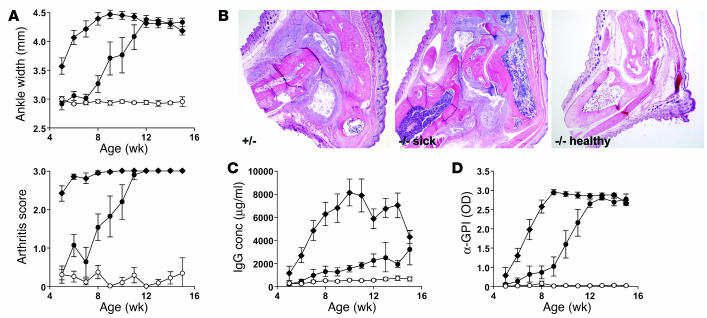
FcRn-deficient K/BxN mice are protected from genetically-induced arthritis. (A) Ankle width measurements and overall arthritis scores (mean ± SE) were performed as in Figure 1. All WT FcRn+/_ littermates (filled diamonds; n = 21; 13 males and 8 females) showed rapid disease onset. Of 21 FcRn_/_ littermates, the mice that remained healthy (open circles; n = 10; 4 males and 6 females) at approximately the 16-week duration of the experiment are plotted separately from FcRn_/_ mice (n = 11; 3 males and 8 females) that became sick (filled circles). The time of disease onset of healthy mice versus WT FcRn+/_ littermates versus FcRn_/_ sick mice was significant at P < 0.0001 by the ANOVA repeated measures test. (B) H&E sections of representative 16-week K/BxN-FcRn+/_ (+/_), sick FcRn_/_ (_/_ sick), and healthy FcRn_/_ (_/_ healthy) mice at ∞20 magnification. (C) Total serum IgG and (D) anti-GPI activity of each cohort from A was measured by ELISA at the weekly time points indicated. IgG levels of FcRn_/_ healthy versus WT FcRn+/_ mice and FcRn_/_ sick versus WT FcRn+/_ mice was significant at P _ 0.0001 by the Scheffe test. FcRn_/_ healthy versus FcRn_/_ sick (filled circles) mice did not differ significantly by the Scheffe test. Anti-GPI levels of FcRn_/_ healthy mice versus WT FcRn+/_ mice versus FcRn_/_ sick mice was significant at P _ 0.0004 by the Scheffe test. conc, concentration.
Figure 3
Figure 3
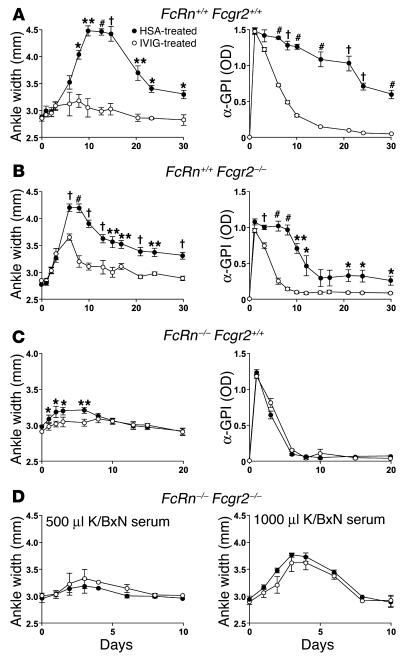
Both FcRn and Fcgr2 are required for IVIg to ameliorate arthritis. Mice were injected intraperitoneally with K/BxN serum on day 0 and treated intraperitoneally on days _1, 1, 2, and 3 with 25 mg (1 ± 1 g/kg/mouse) IVIg (open circles) or HSA (filled circles). (A) K/BxN serum (500 ∝l) was injected into B6-FcRn+/+ Fcgr2+/+ mice (n = 3). Left panel, ankle width; right panel, anti-GPI Ab’s. Representative of two independent experiments. (B) K/BxN serum (500 ∝l) injected into B6-FcRn+/+ Fcgr2_/_ mice (n = 5). Left panel, ankle width; right panel, anti-GPI Ab’s. Representative of four independent experiments using either 250 or 500 ∝l K/BxN serum. (C) K/BxN serum (500 ∝l) injected into B6-FcRn_/_ Fcgr2+/+ mice (n = 4). Left panel, ankle width; right panel, anti-GPI Ab’s. Representative of two independent experiments. (D) K/BxN serum (500 ∝l; left panel) or (1,000 ∝l; right panel) injected into FcRn_/_ Fcgr2_/_ mice (n = 3_4). *P < 0.05, **P < 0.01, P < 0.001, #P < 0.0001. All other time points were not significant at P < 0.05.

References

    1. Takai T. Roles of Fc receptors in autoimmunity. Nat. Rev. Immunol. 2002;2:580–592. - PubMed
    1. Benoist C, Mathis D. A revival of the B cell paradigm for rheumatoid arthritis pathogenesis? Arthritis Res. 2000;2:90–94. - PMC - PubMed
    1. Feldmann M, Brennan FM, Maini RN. Rheumatoid arthritis. Cell. 1996;85:307–310. - PubMed
    1. Lee DM, Weinblatt ME. Rheumatoid arthritis. Lancet. 2001;358:903–911. - PubMed
    1. Simister NE, Mostov KE. An Fc receptor structurally related to MHC class I antigens. Nature. 1989;337:184–187. - PubMed

Publication types

MeSH terms