. 2004 May;186(10):3238-48.
doi: 10.1128/JB.186.10.3238-3248.2004.

ClgR, a novel regulator of clp and lon expression in Streptomyces

Affiliations

ClgR, a novel regulator of clp and lon expression in Streptomyces

Audrey Bellier et al. J Bacteriol. 2004 May.

Abstract

The clp genes encoding the Clp proteolytic complex are widespread among living organisms. Five clpP genes are present in Streptomyces. Among them, the clpP1 clpP2 operon has been shown to be involved in the Streptomyces growth cycle, as a mutation blocked differentiation at the substrate mycelium step. Four Clp ATPases have been identified in Streptomyces coelicolor (ClpX and three ClpC proteins) which are potential partners of ClpP1 ClpP2. The clpC1 gene appears to be essential, since no mutant has yet been obtained. clpP1 clpP2 and clpC1 are important for Streptomyces growth, and a study of their regulation is reported here. The clpP3 clpP4 operon, which has been studied in Streptomyces lividans, is induced in a clpP1 mutant strain, and regulation of its expression is mediated via PopR, a transcriptional regulator. We report here studies of clgR, a paralogue of popR, in S. lividans. Gel mobility shift assays and DNase I footprinting indicate that ClgR binds not only to the clpP1 and clpC1 promoters, but also to the promoter of the Lon ATP-dependent protease gene and the clgR promoter itself. ClgR recognizes the motif GTTCGC-5N-GCG. In vivo, ClgR acts as an activator of clpC1 gene and clpP1 operon expression. Similarly to PopR, ClgR degradation might be ClpP dependent and could be mediated via recognition of the two carboxy-terminal alanine residues.


Figures
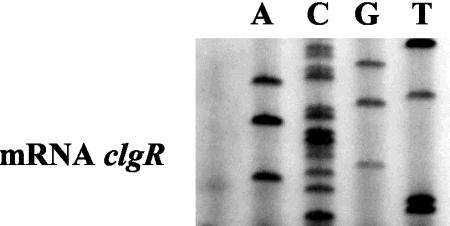
FIG. 1.
FIG. 1.
Primer extension analysis of clgR transcription. Total RNA (40 μg) isolated from the wild-type S. lividans strain was used as a template for reverse transcriptase. The corresponding DNA sequencing reaction is shown on the right.
FIG. 2.
FIG. 2.
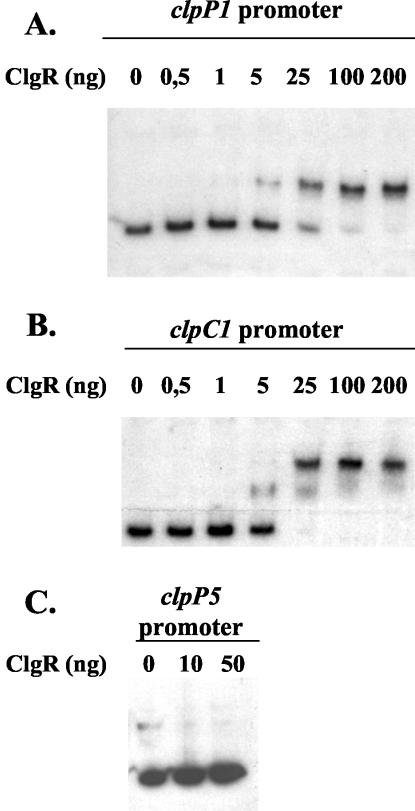
Specific binding of ClgR to the clpP1 and clpC1 promoter regions. Gel mobility shift experiments were performed by incubating 0 to 200 ng of purified ClgR with radiolabeled DNA fragments (10,000 cpm) corresponding to the promoter regions of the clpP1 operon (A), the clpC1 gene (B), and the clpP5 gene (C).
FIG. 3.
FIG. 3.
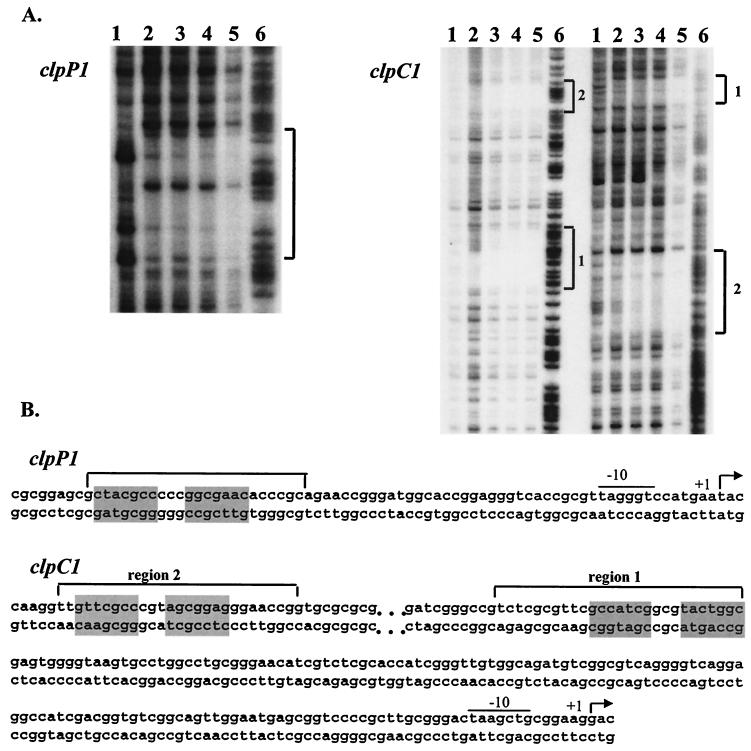
DNase I footprinting analysis of ClgR binding to the clpP1 operon and clpC1 promoter regions. (A) Radiolabeled DNA fragment (50,000 cpm) corresponding to the nontemplate strand of the clpP1 promoter, the template strand (left) and the nontemplate strand (right) of the clpC1 promoter were incubated with increasing amounts of purified ClgR as follows: for clpP1, lanes 1 to 5, 0, 0.1, 0.5, 1, and 2 μg of ClgR, respectively; for clpC1, lanes 1 to 5, 0, 0.05, 0.1, 0.2, and 1 μg of ClgR, respectively; lanes 6, G+A Maxam-and-Gilbert reactions of the corresponding DNA fragments. Regions protected by ClgR are indicated by brackets. (B) Nucleotide sequences of the clpP1 and clpC1 promoter regions. Consensus −10 sequences are indicated by lines; transcriptional start points are indicated by +1; regions protected in DNase I footprinting experiments by ClgR are indicated by brackets; ClgR consensus motifs are shaded.
FIG. 4.
FIG. 4.
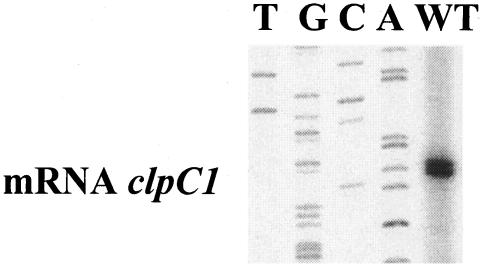
Primer extension analysis of clpC1 transcription. Total RNA (40 μg) isolated from the wild-type (WT) S. lividans strain was used as a template for reverse transcriptase. The corresponding DNA sequencing reaction is shown on the left.
FIG. 5.
FIG. 5.
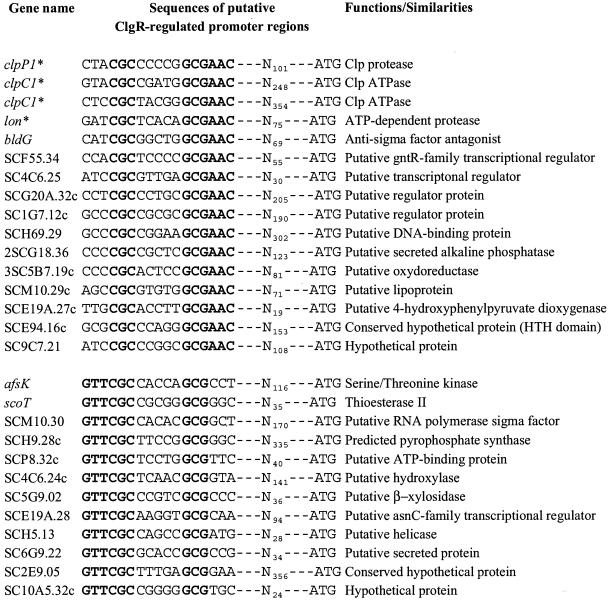
Alignment of nucleotide sequences of putative ClgR-regulated promoter regions. Genes for which direct binding by ClgR was shown are indicated by asterisks.
FIG. 6.
FIG. 6.
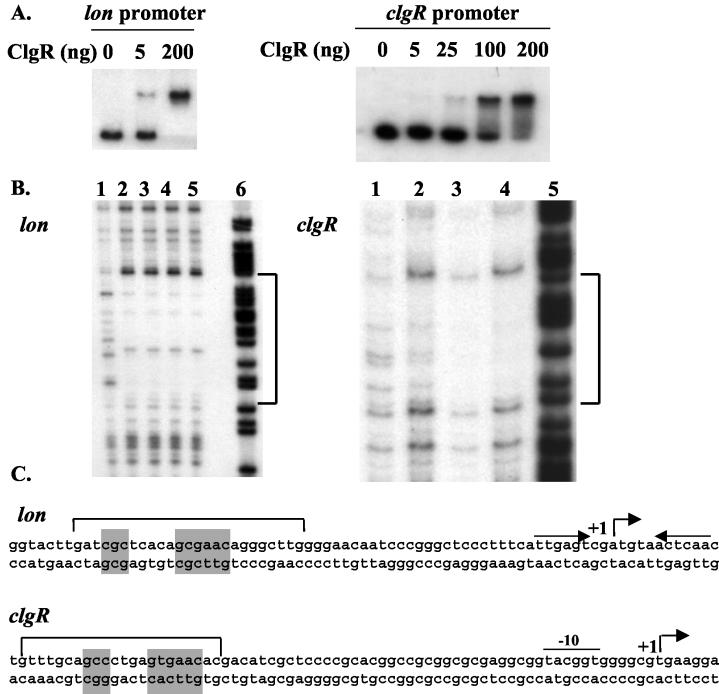
ClgR binds specifically to the lon and clgR promoter regions. (A) Gel mobility shift experiments were performed by incubating 0 to 200 ng of purified ClgR with radiolabeled DNA fragments (10,000 cpm) corresponding to the promoter regions of lon and clgR. (B) Radiolabeled DNA fragments (50,000 cpm) corresponding to the nontemplate strand of the lon promoter and the template strand of the clgR promoter were incubated with increasing amounts of purified ClgR as follows: for lon, lanes 1 to 5, 0, 25, 50, 100, and 500 ng of ClgR, respectively; for clgR, lanes 1 to 4, 0, 0.05, 0.1, and 1 μg of ClgR, respectively; lane 6 for lon and lane 5 for clgR, G+A Maxam-and-Gilbert reactions of the corresponding DNA fragments. The regions protected by ClgR are indicated by brackets. (C) Nucleotide sequences of the lon and clgR promoter regions. Consensus −10 sequences are indicated by lines; transcriptional start points are indicated by +1; regions protected in DNase I footprinting experiments by ClgR are indicated by brackets; ClgR consensus motifs are shaded. The HspR double-inverted repeat recognition target is indicated by inverted arrows in the lon sequence.
FIG. 7.
FIG. 7.
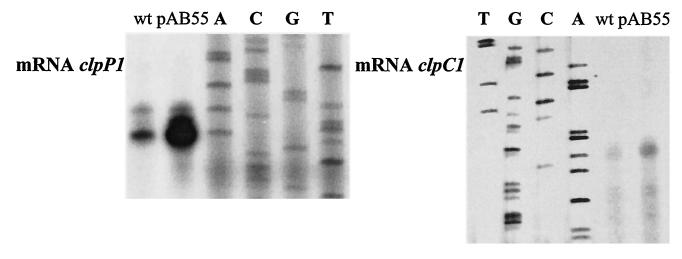
Primer extension analysis of clpP1 and clpC1 transcription. Total RNA (20 μg) isolated from the wild-type (wt) S. lividans strain carrying pHM11a (control) or pAB55 was used as a template for reverse transcriptase. The corresponding DNA sequencing reactions are shown.
FIG. 8.
FIG. 8.
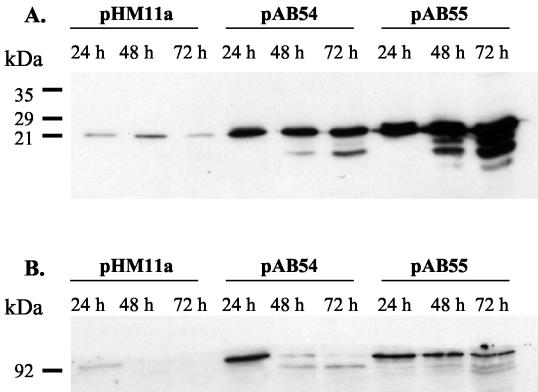
Detection of ClpP1 and ClpC1 by Western blotting. Crude extracts (10 μg) from cultures on plates with 24-, 48-, and 72-h cultures of the wild-type S. lividans strain carrying pHM11a (control), pAB54, and pAB55 were analyzed by Western blotting with anti-ClpP1 antibodies (A) and anti-ClpC (Synechococcus ClpC) antibodies (B).
FIG. 9.
FIG. 9.
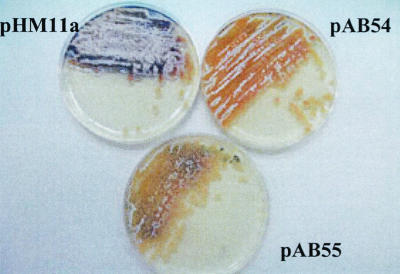
Phenotypes of wild-type S. lividans carrying plasmid pHM11a (control), pAB54 (clgR-AA), or pAB55 (clgR-DD) on R5 plates after 10 days of growth.
FIG. 10.
FIG. 10.
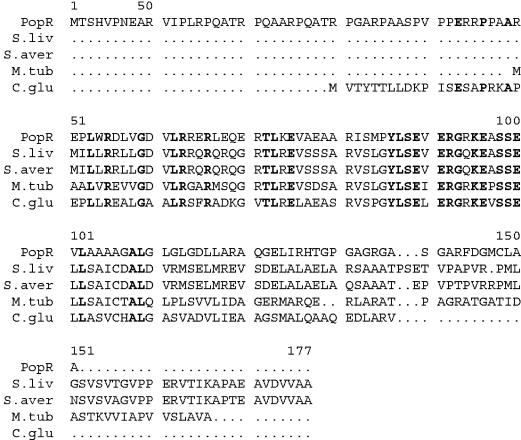
Alignment of PopR and ClgR amino acid sequences of S. lividans (S. liv) with those of S. avermitilis (S. aver), M. tuberculosis (M. tub), and C. glutamicum (C. glu). Conserved amino acids are shown in boldface.

References

    1. Amrein, K. E., B. Takacs, M. Stieger, J. Molnos, N. A. Flint, and P. Burn. 1995. Purification and characterization of recombinant human p50csk protein-tyrosine kinase from an Escherichia coli expression system overproducing the bacterial chaperones GroES and GroEL. Proc. Natl. Acad. Sci. USA 92:1048-1052. - PMC - PubMed
    1. Baldini, R. L., M. Avedissian, and S. L. Gomes. 1998. The CIRCE element and its putative repressor control cell cycle expression of the Caulobacter crescentus groESL operon. J. Bacteriol. 180:1632-1641. - PMC - PubMed
    1. Bentley, S. D., K. F. Chater, A. M. Cerdeno-Tarraga, G. L. Challis, N. R. Thomson, K. D. James, D. E. Harris, M. A. Quail, H. Kieser, D. Harper, A. Bateman, S. Brown, G. Chandra, C. W. Chen, M. Collins, A. Cronin, A. Fraser, A. Goble, J. Hidalgo, T. Hornsby, S. Howarth, C. H. Huang, T. Kieser, L. Larke, L. Murphy, K. Oliver, S. O'Neil, E. Rabbinowitsch, M. A. Rajandream, K. Rutherford, S. Rutter, K. Seeger, D. Saunders, S. Sharp, R. Squares, S. Squares, K. Taylor, T. Warren, A. Wietzorrek, J. Woodward, B. G. Barrell, J. Parkhill, and D. A. Hopwood. 2002. Complete genome sequence of the model actinomycete Streptomyces coelicolor A3(2). Nature 417:141-147. - PubMed
    1. Bradford, M. 1976. A rapid and sensitive method for the quantitation of microgram quantities of protein utilizing the principle of protein-dye binding. Anal. Biochem. 72:248-254. - PubMed
    1. Chastanet, A., J. Fert, and T. Msadek. 2003. Comparative genomics reveal novel heat shock regulatory mechanisms in Staphylococcus aureus and other Gram-positive bacteria. Mol. Microbiol. 47:1061-1073. - PubMed

Publication types

LinkOut - more resources