. 2004 Jul 9;279(28):29085-91.
doi: 10.1074/jbc.M400930200. Epub 2004 May 4.

The heptahelical domain of GABA(B2) is activated directly by CGP7930, a positive allosteric modulator of the GABA(B) receptor

Affiliations

The heptahelical domain of GABA(B2) is activated directly by CGP7930, a positive allosteric modulator of the GABA(B) receptor

Virginie Binet et al. J Biol Chem. .

Abstract

The gamma-aminobutyric acid, type B (GABA(B)) receptor is well recognized as being composed of two subunits, GABA(B1) and GABA(B2). Both subunits share structural homology with other class-III G-protein-coupled receptors. They are composed of two main domains: a heptahelical domain (HD) typical of all G-protein-coupled receptors and a large extracellular domain (ECD). Although GABA(B1) binds GABA, GABA(B2) is required for GABA(B1) to reach the cell surface. However, it is still not demonstrated whether the association of these two subunits is always required for function in the brain. Indeed, GABA(B2) plays a major role in the coupling of the heteromer to G-proteins, such that it is possible that GABA(B2) can transmit a signal in the absence of GABA(B1). Today only ligands interacting with GABA(B1) ECD have been identified. Thus, the compounds acting exclusively on the GABA(B2) subunit will be helpful in analyzing the specific role of this subunit in the brain. Here, we explored the mechanism of action of CGP7930, a compound described as a positive allosteric regulator of the GABA(B) receptor. We showed that it activates the wild type GABA(B) receptor but with a low efficacy. The GABA(B2) HD is necessary for this effect, although one cannot exclude that CGP7930 could also bind to GABA(B1). Of interest, CGP7930 could activate GABA(B2) expressed alone and is the first described agonist of GABA(B2). Finally, we show that CGP7930 retains its agonist activity on a GABA(B2) subunit deleted of its ECD. This demonstrates that the HD of GABA(B2) behaves similar to a rhodopsin-like receptor, because it can reach the cell surface alone, can couple to G-protein, and be activated by agonists. These data open new strategies for studying the mechanism of activation of GABA(B) receptor and examine any possible role of homomeric GABA(B2) receptors.


Figures
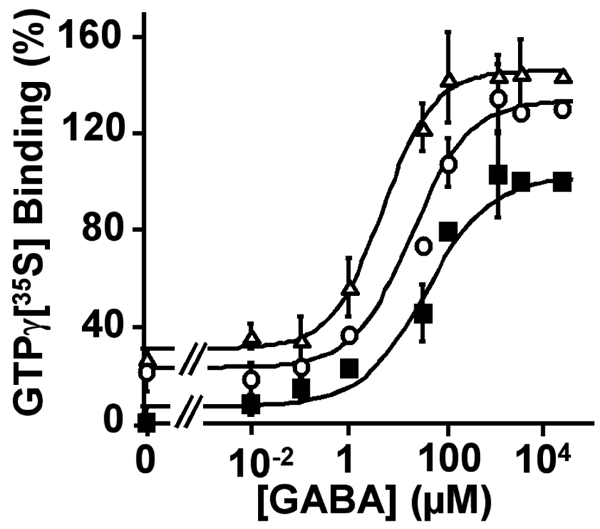
Figure 1
Figure 1
Concentration-response curves for GAB A on wild type GABAB receptor in the absence (■), or in the presence of 100 μM (○) or 1 mM (△) of CGP7930, generated from a GTP-γ[35S] binding assay. The GABA EC50 values determined in the absence, and in the presence of 100 μM or 1 mM CGP7930, were 42 μM, 30 μM and 4.7 μM, respectively. The data were expressed as the % of increase of GTP-γ[35S] binding above basal. The presented data are from one representative experiment among three experiments performed in triplicate.
Figure 2
Figure 2
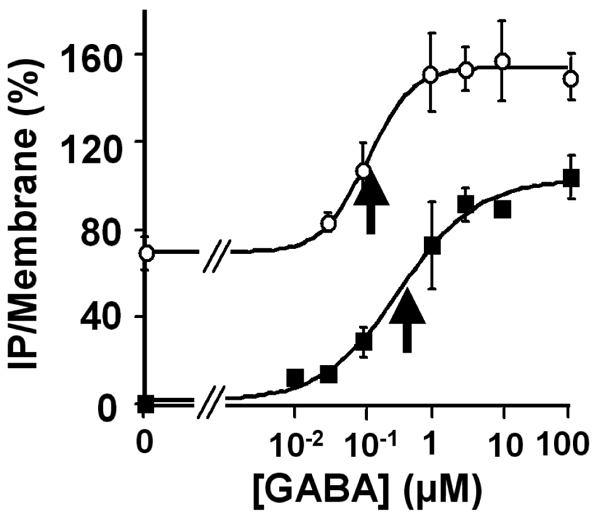
Concentration-response curves for GABA on wild type GABAB receptor, generated from a IP formation assay, in the absence (■), and in the presence of 100 μM of CGP7930 (○). The GABA EC50 values determined in the absence or in the presence of 100 μM CGP7930 were 0.32 μM and 0.11 μM, respectively. The arrows indicate the EC50 determined by the curve fits for the conditions without and with CGP7930 respectively. The results are % of the GABA-induced maximal effect on wild type receptor in the absence of CGP7930. The presented data are means of five experiments performed in triplicate.
Figure 3
Figure 3
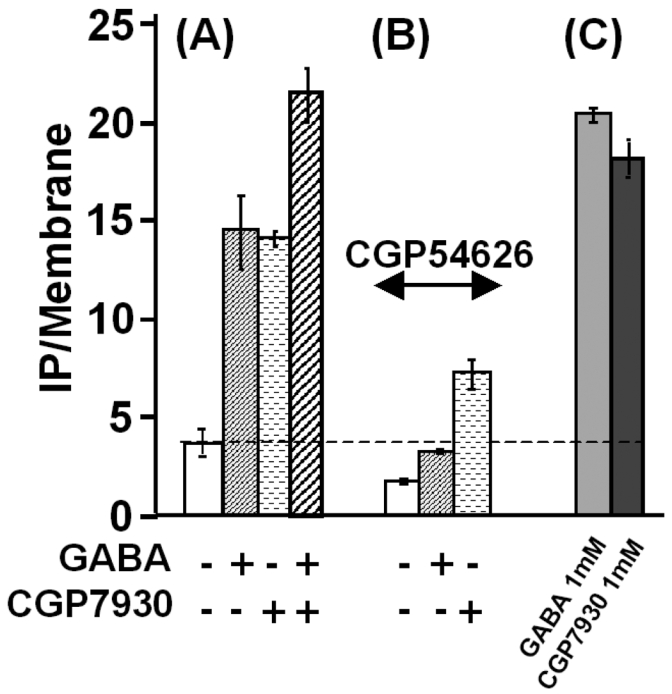
Effect of the CGP7930 (100 μM) and potentiation of the GABA (1 μM) induced-stimulation of IP formation in absence (A) and in presence (B) of 1 μM of the GABB as receptor specific competitive antagonist CGP54626. (C) Maximal effects on IP formation obtained with 1 mM of GABA or 1 mM of CGP7930. The presented data are from one representative experiment among three experiments performed in triplicate.
Figure 4
Figure 4
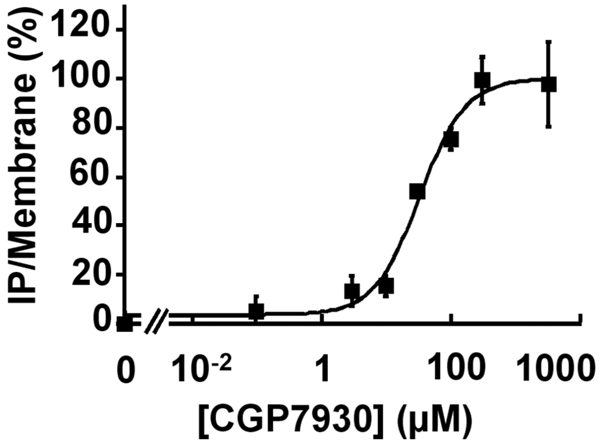
Concentration-response curves for CGP7930 generated from the IP formation assay on wild type GABAB receptor. The EC50 value determined for GABA effect was 32.55 ± 7.23 μM. Results are expressed as the % of the CGP7930-induced maximal effect The presented data are from one representative experiment among eight experiments performed in triplicate.
Figure 5
Figure 5
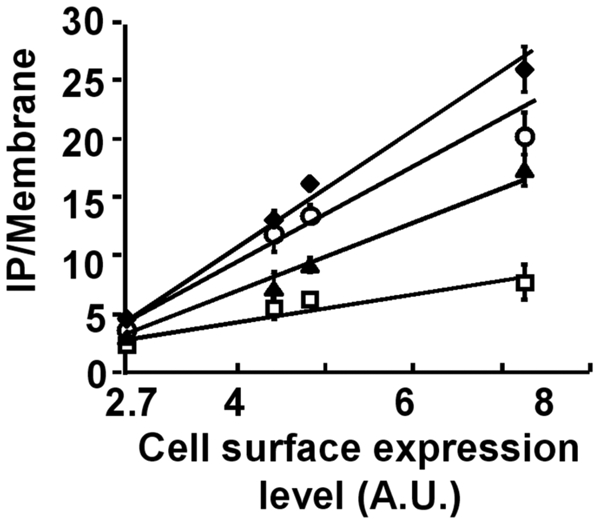
Maximal IP formation response depending of the cell surface receptor expression. IP formation was measured in cells expressing various amounts of the GABAB heterodimer without drug (□), or in presence of 1 mM of CGP7930 (▲), or of 1 mM of GABA (○), or with both drugs (◆). The receptor expression levels are below the level inducing a saturation of the transduction machinery, allowing the observation of the increased maximal response induced by incubation with both compounds, GABA and CGP7930. A.U. stands for Arbitrary Units. The presented data are from one representative experiment among four experiments performed in triplicate.
Figure 6
Figure 6
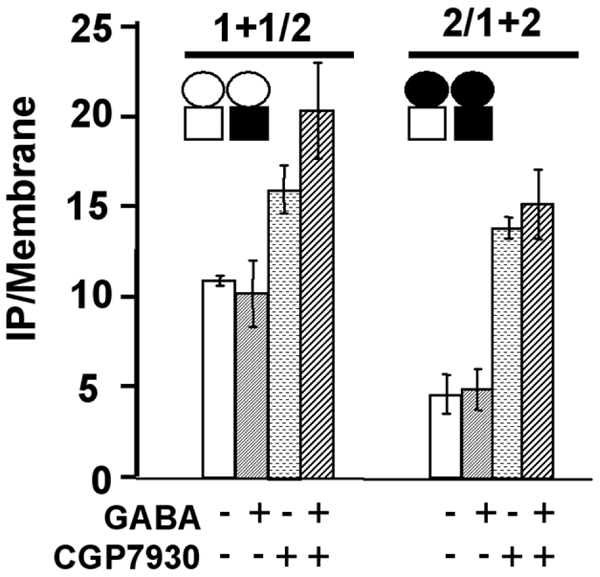
The ECD of GABAB1 or GABAB2 are not required for the effect of CGP7930. Effect of the CGP7930 (100 μM) in presence or no of GABA (1 mM) on chimeric receptor formed by the subunit combination GABAB1 + GABAB1/2 and GABAB2 + GABAB2/1, in which the ECD of GABAB2 and that of GABAB1 is missing respectively. 1 + 1/2 stands for the subunit combinations GABAB1 + GABAB1/2, and 1/2+2 stands for the subunit combination GABAB2/1 + GABAB2. CGP7930 was still able to stimulate the IP formation in cells expressing either combination, indicating that the ECD of GABAB1 or GABAB2 subunits are not necessary for the effect of CGP7930. The empty circle represents the ECD of GABAB1 and the black circle the ECD of GABAB2, and the empty square represents the HD of GABAB1 and the black square the HD of GABAB2. The presented data are means of three experiments performed in triplicate.
Figure 7
Figure 7
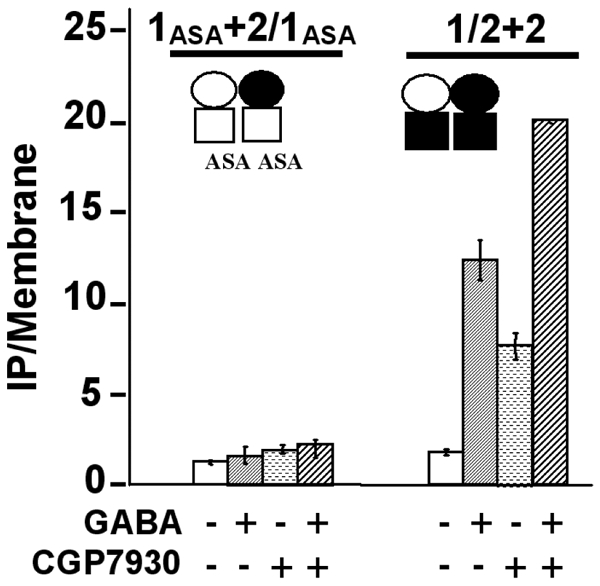
The HD of GABAB2 is required for the effect of CGP7930. The effect of the CGP7930 (100 μM) was examined, in presence or not of GABA (1 mM), on chimeric receptors formed by the subunit combination GABAB1ASA + GABAB2/1ASA and GABAB2 + GABAB1/2, in which the HD of GABAB2 and that of GABAB1 is missing respectively. In these combinations, the heterodimeric association of the ECD is conserved, but in contrast, the HD are identical in each combination, displaying then a homomeric HD association. 1ASA+2/1ASA stands for the subunit combinations GABABASA + GABAB2/1ASA, and 1/2+2 stands for the subunit combination GABAB1/2 + GABAB2. The empty circle represents the ECD of GABAB1 and the black circle the ECD of GABAB2, and the empty square represents the HD of GABAB1 and the black square the HD of GABAB2. The CGP7930 stimulated only the combination of subunits possessing the HD of GABAB2, indicating that the HD of GABAB1 was not necessary, in contrast to the HD of GABAB2. The presented data are means of three experiments performed in triplicate.
Figure 8
Figure 8
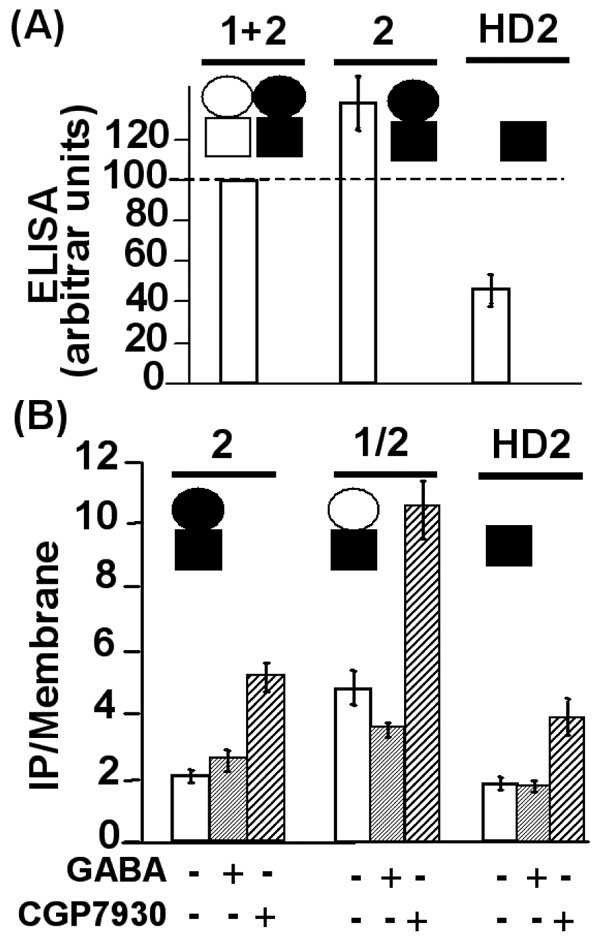
A. Cell surface expression of the wild type GABAB receptor, the GABAB2 subunit alone and the HD2 construct. Using the ELISA procedure, the expression of the different proteins was determined for each condition and normalized as a percentage of the wild type GABAB receptor cell surface expression. B. CGP7930 (100 μM) increased the IP production in cells expressing only the HD of GABAB2. 2, 1/2, and HD2 stand for GABAB2, GABAB1/2 and the HD of GABAB2 respectively. The empty circle represents the ECD of GABAB1 and the black circle the ECD of GABAB2, and the black square the HD of GABAB2. CGP7930 increased IP formation in cells expressing either the GABAB2 subunit alone or the chimeric subunit GABAB1/2. Moreover, the HD of GABAB2 expressed alone was stimulated by CGP7930, confirming that it is enough for the effect of CGP7930. The presented data are means of four to seven experiments performed in triplicate.
Figure 9
Figure 9
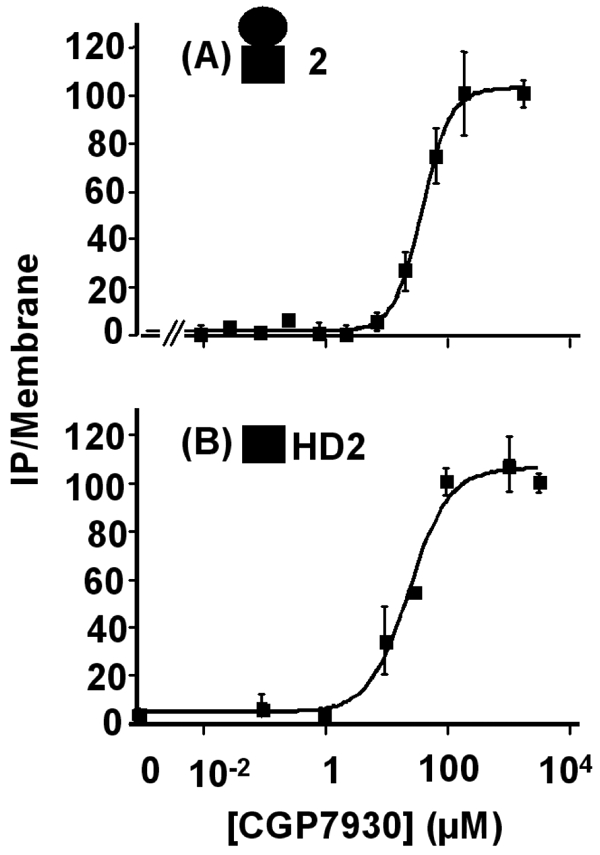
Concentration-response curves for CGP7930 generated from the IP formation assay on GABAB2 subunit alone. (A), and on the HD of GABAB2 alone (B). The results are % of the CGP7930-induced maximal effect on each construct. The EC50 were 57.1 ± 3.8 and 64.7 ± 38.4 μM in cells expressing GABAB2 or the HD of GABAB2, respectively. The black circle represents the ECD of GABAB2, and the black square the HD of GABAB2. The presented data are from representative experiments among four experiments performed in triplicate.

References

    1. Billinton A, Ige AO, Bolam JP, White JH, Marshall FH, Emson PC. Trends Neurosci. 2001;24:277–282. - PubMed
    1. Couve A, Moss SJ, Pangalos MN. Mol Cell Neurosci. 2000;16:296–312. - PubMed
    1. Kaupmann K, Huggel K, Heid J, Flor PJ, Bischoff S, Mickel SJ, McMaster G, Angst C, Bittiger H, Froestl W, Bettler B. Nature. 1997;386:239–246. - PubMed
    1. Pin JP, Galvez T, Prezeau L. Pharmacol Ther. 2003;98:325–354. - PubMed
    1. Kunishima N, Shimada Y, Tsuji Y, Sato T, Yamamoto M, Kumasaka T, Nakanishi S, Jingami H, Morikawa K. Nature. 2000;407:971–977. - PubMed

Publication types

MeSH terms