


Viral activity in two contrasting lake ecosystems
- PMID: 15128555
- PMCID: PMC404444
- DOI: 10.1128/AEM.70.5.2941-2951.2004
Viral activity in two contrasting lake ecosystems
Abstract
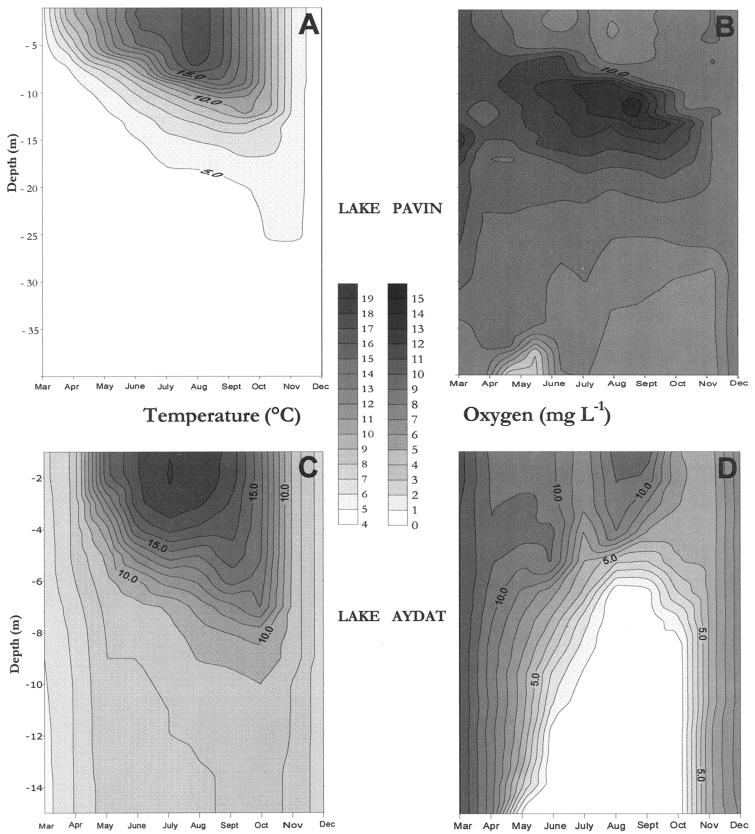
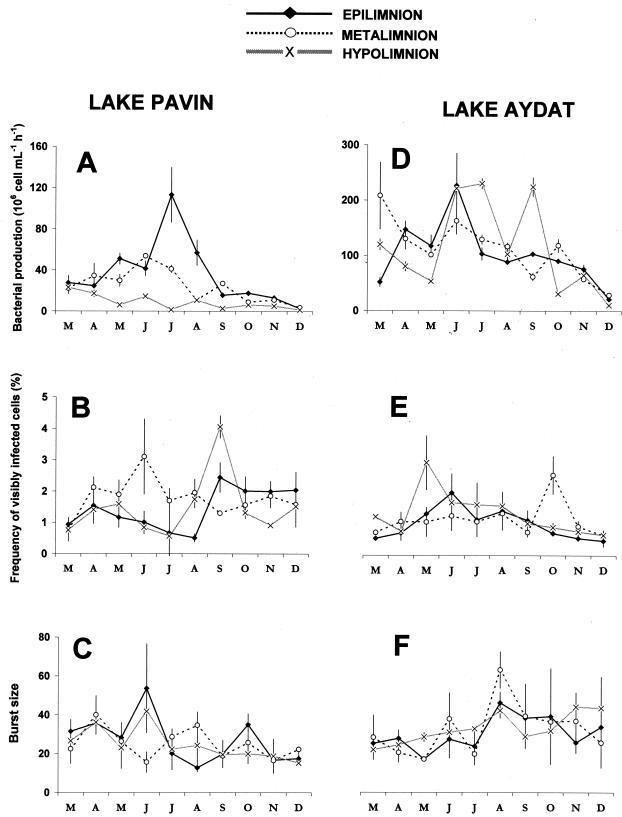
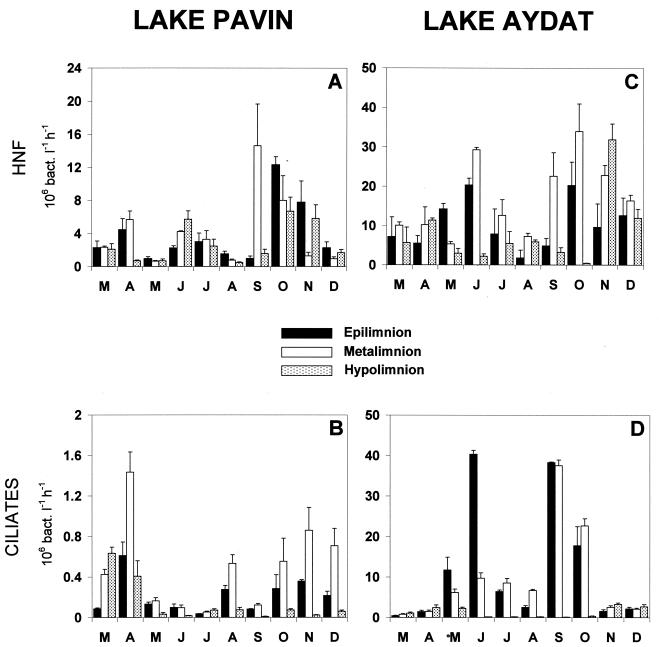
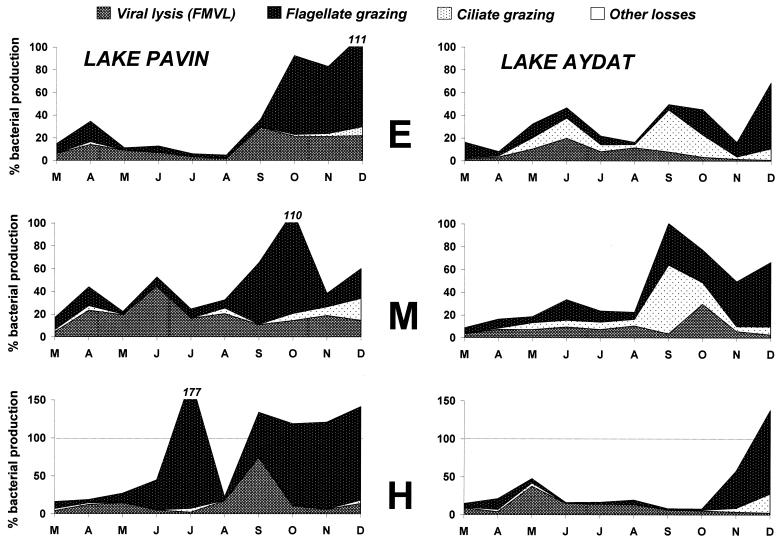
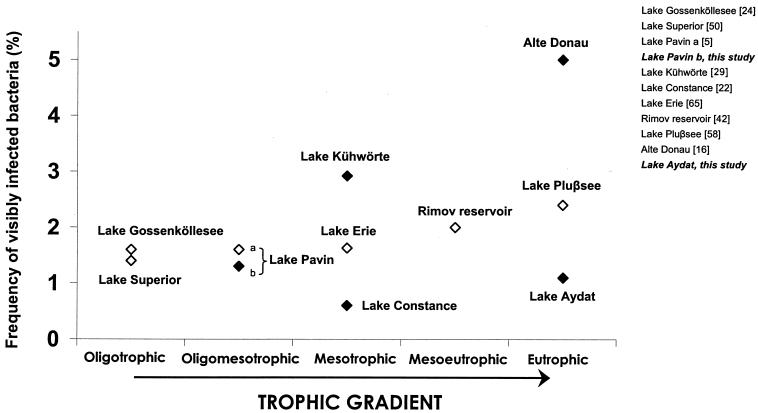
For aquatic systems, especially freshwaters, there is little data on the long-term (i.e., >6-month period) and depth-related variability of viruses. In this study, we examined virus-induced mortality of heterotrophic bacteria over a 10-month period and throughout the water column in two lakes of the French Massif Central, the oligomesotrophic Lake Pavin and the eutrophic Lake Aydat. Concurrently, we estimated nonviral mortality through heterotrophic nanoflagellate and ciliate bacterivory. Overall, viral infection parameters were much less variable than bacterial production. We found that the frequency of visibly infected cells (FVIC), estimated using transmission electron microscopy, peaked in both lakes at the end of spring (May to June) and in early autumn (September to October). FVIC values were significantly higher in Lake Pavin (mean [M] = 1.6%) than in Lake Aydat (M = 1.1%), whereas the opposite trend was observed for burst sizes, which averaged 25.7 and 30.2 virus particles bacterium(-1), respectively. We detected no significant depth-related differences in FVIC or burst size. We found that in both lakes the removal of bacterial production by flagellate grazing (M(Pavin) = 37.7%, M(Aydat) = 18.5%) was nearly always more than the production removed by viral lysis (M(Pavin) = 16.2%, M(Aydat) = 19%) or ciliate grazing (M(Pavin) = 2.7%, M(Aydat) = 8.8%). However, at specific times and locations, viral lysis prevailed over protistan grazing, for example, in the anoxic hypolimnion of Lake Aydat. In addition, viral mortality represented a relatively constant mortality source in a bacterial community showing large variations in growth rate and subject to large variations in loss rates from grazers. Finally, although viruses did not represent the main agent of bacterial mortality, our data seem to show that their relative importance was higher in the less productive system.
Figures
References
-
- Azam, F., T. Fenchel, J. G. Field, J. S. Gray, L. A. Meyer-Reil, and T. F. Thingstad. 1983. The ecological role of water-column microbes in the sea. Mar. Ecol. Prog. Ser. 10:257-263.
-
- Bell, R. T. 1993. Estimating production of heterotrophic bacterioplankton via incorporation of tritiated thymidine, p. 495-503. In P. F. Kemp, B. F. Sherr, E. B. Sherr, and J. J. Cole (ed.), Handbook of methods in aquatic microbial ecology. Lewis Publishers, Boca Raton, Fla.
-
- Bergh, O., K. Y. Børsheim, G. Bratbak, and M. Heldal. 1989. High abundance of viruses found in aquatic environments. Nature 340:467-468. - PubMed
-
- Bettarel, Y., J. R. Dolan, K. Hornak, R. Lemee, M. Masin, M.-L. Pedrotti, E. Rochell-Newell, K. Simek, and T. Sime-Ngando. 2002. Strong, weak, and missing links in a microbial community of the N. W. Mediterranean Sea. FEMS Microb. Ecol. 42:451-462. - PubMed
-
- Bettarel, Y., C. Amblard, T. Sime-Ngando, J.-F. Carrias, D. Sargos, F. Garabetian, and P. Lavandier. 2003. Viral lysis, flagellate grazing potential, and bacterial production in Lake Pavin. Microb. Ecol. 45:119-127. - PubMed
Publication types
MeSH terms
Substances
LinkOut - more resources
Full Text Sources
