


Correlation between viral loads of cytomegalovirus in blood and bronchoalveolar lavage specimens from lung transplant recipients determined by histology and immunohistochemistry
- PMID: 15131185
- PMCID: PMC404658
- DOI: 10.1128/JCM.42.5.2168-2172.2004
Correlation between viral loads of cytomegalovirus in blood and bronchoalveolar lavage specimens from lung transplant recipients determined by histology and immunohistochemistry
Abstract
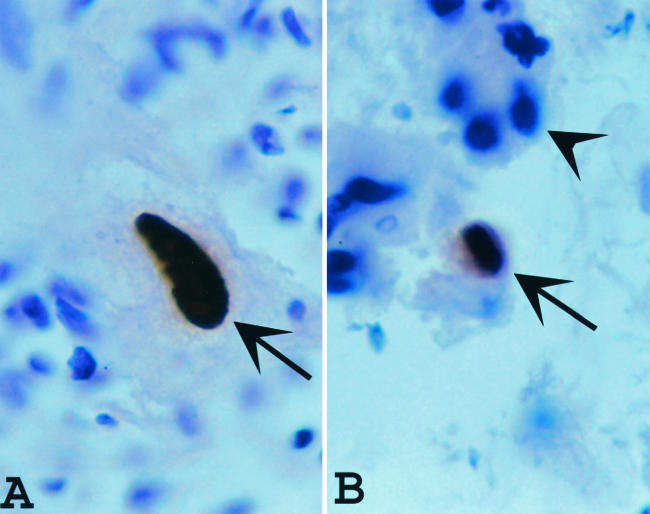
Cytomegalovirus (CMV) is an important pathogen in lung transplant recipients. Early detection of CMV end-organ disease should help with treatment management. We determined the CMV viral load by hybrid capture in bronchoalveolar lavage (BAL) fluid samples from patients who had undergone lung transplantation. For 39 of these samples (from 25 patients), corresponding transbronchial biopsy samples were available for CMV immunohistochemistry (IHC). The CMV IHC results were interpreted and categorized as positive or negative, and the positive results were subcategorized as typical if cells with both significant nuclear enlargement or Cowdry A-type inclusions and positive staining were present or as atypical if definitive nuclear staining was seen but significant nuclear enlargement was not. Diagnostic CMV viral inclusions were reported in the anatomic diagnosis, based on hematoxylin-eosin staining alone, for three (8%) of the biopsy samples. CMV was detected by IHC in 13 (33%) samples (5 typical, 8 atypical). The median CMV viral load in BAL samples was 0 copies/ml for BAL samples from patients with IHC-negative biopsy samples; 47,678 copies/ml for BAL samples from patients with biopsy samples with positive, atypical staining; and 1,548,827 copies/ml for BAL samples from patients with biopsy samples with positive, typical staining (P < 0.001). Compared to routine pathology of biopsy samples, the use of IHC increased the diagnostic yield of CMV. Also, the CMV viral load in BAL fluid samples increased along with immunoreactivity from negative to positive, atypical staining to positive, typical staining. The CMV viral load determined with the end-organ sample, the BAL fluid sample, was higher than the corresponding viral load determined with blood. Both IHC and determination of the CMV viral load in BAL samples may be useful for the detection of individuals at risk for the development of fulminant invasive CMV disease.
Figures
References
-
- Cagle, P. T., G. Buffone, V. A. Holland, T. Samo, G. J. Demmler, G. P. Noon, and E. C. Lawrence. 1992. Semiquantitative measurement of cytomegalovirus DNA in lung and heart-lung transplant patients by in vitro DNA amplification. Chest 101:93-96. - PubMed
-
- Cathomas, G., P. Morris, K. Pekle, I. Cunningham, and D. Emanuel. 1993. Rapid diagnosis of cytomegalovirus pneumonia in marrow transplant recipients by bronchoalveolar lavage using the polymerase chain reaction, virus culture, and the direct immunostaining of alveolar cells. Blood 81:1909-1914. - PubMed
-
- Crawford, S. W., R. A. Bowden, R. C. Hackman, C. A. Gleaves, J. D. Meyers, and J. G. Clark. 1988. Rapid detection of cytomegalovirus pulmonary infection by bronchoalveolar lavage and centrifugation culture. Ann. Intern. Med. 108:180-185. - PubMed
-
- Dauber, J. H., I. L. Paradis, and J. S. Dummer. 1990. Infectious complications in pulmonary allograft recipients. Clin. Chest Med. 11:291-308. - PubMed
-
- Duncan, A. J., J. S. Dummer, I. L. Paradis, J. H. Dauber, S. A. Yousem, M. A. Zenati, R. L. Kormos, and B. P. Griffith. 1991. Cytomegalovirus infection and survival in lung transplant recipients. J. Heart Lung Transplant. 10:638-644. - PubMed
Publication types
MeSH terms
LinkOut - more resources
Full Text Sources
Medical
