. 2004 May 25;101(21):8215-20.
doi: 10.1073/pnas.0400081101. Epub 2004 May 12.

Proximal renal tubular acidosis in TASK2 K+ channel-deficient mice reveals a mechanism for stabilizing bicarbonate transport

Affiliations

Proximal renal tubular acidosis in TASK2 K+ channel-deficient mice reveals a mechanism for stabilizing bicarbonate transport

Richard Warth et al. Proc Natl Acad Sci U S A. .

Abstract

The acid- and volume-sensitive TASK2 K+ channel is strongly expressed in renal proximal tubules and papillary collecting ducts. This study was aimed at investigating the role of TASK2 in renal bicarbonate reabsorption by using the task2 -/- mouse as a model. After backcross to C57BL6, task2 -/- mice showed an increased perinatal mortality and, in adulthood, a reduced body weight and arterial blood pressure. Patch-clamp experiments on proximal tubular cells indicated that TASK2 was activated during HCO3- transport. In control inulin clearance measurements, task2 -/- mice showed normal NaCl and water excretion. During i.v. NaHCO3 perfusion, however, renal Na+ and water reabsorption capacity was reduced in -/- animals. In conscious task2 -/- mice, blood pH, HCO3- concentration, and systemic base excess were reduced but urinary pH and HCO3- were increased. These data suggest that task2 -/- mice exhibit metabolic acidosis caused by renal loss of HCO3-. Both in vitro and in vivo results demonstrate the specific coupling of TASK2 activity to HCO3- transport through external alkalinization. The consequences of the task2 gene inactivation in mice are reminiscent of the clinical manifestations seen in human proximal renal tubular acidosis syndrome.


Figures
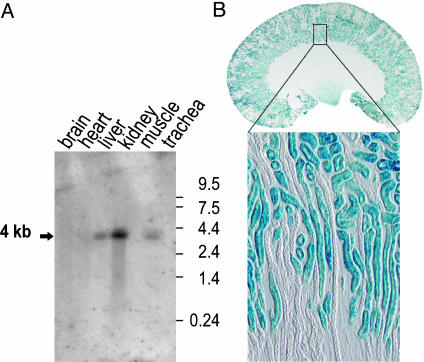
Fig. 1.
Fig. 1.
Mouse TASK2 tissue distribution and localization in kidney. (A) Northern blot analysis of task2 expression in mouse adult tissues. Reprobing the same blot with a β-actin probe indicated the same poly(A)+ RNA content in each lane (not shown). The 4-kb task2 band was totally absent in blots made with RNA samples isolated from task2 –/– mice (data not shown). (B) TASK2 localization along the nephron. X-Gal staining was performed on a 20-μm-thick whole kidney cross section of a task2 +/– mouse. Blue staining was found in convoluted and straight proximal tubules and in papillary collecting ducts. The lower micrograph shows a cortical area at higher magnification (10-μm section).
Fig. 2.
Fig. 2.
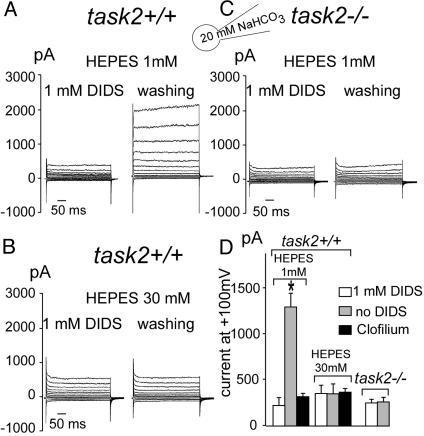
Whole-cell recordings of K+ currents on primary culture from proximal tubule cells from task2 +/+ and –/– mice. A large outward current was elicited upon DIDS washout in low buffered bath solution (A, 1 mM Hepes), which was absent in highly buffered external medium (B) and in task2 –/– cells (C). Solutions bath 1 and pipette 1 as described in Table 1. The membrane potential was held at –50 mV and stepped to test potential values between –100 and +120 mV in 20-mV increments. (D) Histograms of mean current values 200 ms after the onset of a pulse at +100 mV. Each value is the mean ± SEM of eight cells obtained from at least three distinct monolayers.
Fig. 3.
Fig. 3.
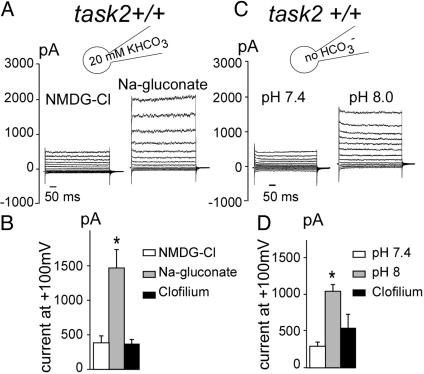
Electrolyte dependency of the K+ current. (A and B) Na+ and Cl substitution experiments. (A) In the absence of Na+ ions (solutions bath 2 and pipette 2 in Table 1), no current was observed: reversal potential Erev =–10 ± 6.8 mV and conductance = 3.1 ± 0.8 nS. Subsequent perfusion of low-Cl solution (Na-gluconate) allowed the development of the K+ conductance within 4 min: Erev =–76.4 ± 5.2 mV and conductance = 24.9 ± 4.9 nS, n = 10. (B) Histograms of mean current values 200 ms after the onset of a pulse at +100 mV. NMDG-Cl, N-methyl-d-glucamine chloride. Each value is the mean ± SEM of 10 cells obtained from at least three distinct monolayers. (C and D) Effect of the absence of cytosolic formula image.(C) When formula image was omitted from the pipette solution (solutions bath 1 and pipette 3 in Table 1), no current was observed: conductance = 3.1 ± 0.7 nS and Erev =–28.3 ± 7.3 mV. Subsequent alkalization by changing external solution (bath 1 at pH 8 in Table 1) produced an increase in K+ conductance, 11.5 ± 0.8 nS and Erev =–79.8 ± 7.3 mV, n = 9. (D) Histograms of mean current values 200 ms after the onset of a pulse at +100 mV. Each value is the mean ± SEM of nine cells obtained from at least three distinct monolayers.
Fig. 4.
Fig. 4.
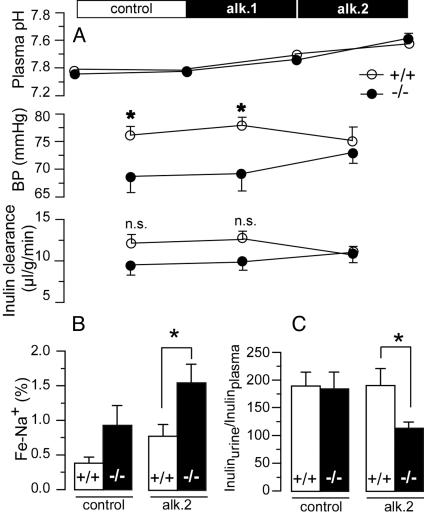
Effect of formula image challenge on renal function. (A) Inulin clearance during alkalosis is shown in Bottom. After a 30-min control period, 1 mol/liter NaHCO3 at 0.045 μl/min per g of body weight was applied i.v. during two periods of 30 min (alk. 1 and alk. 2). n.s., not significant. Top shows the effect of NaHCO3 perfusion on arterial pH and Middle shows the effect on mean arterial blood pressure (art. femoralis). During perfusion with NaHCO3, the blood pressure of task2 –/– increased (n = 7–9 each). (B) Effect of alkalosis on Na+ and water excretion. During control, fractional Na+ excretion (Fe-Na+) was not different between WT +/+ and task2 –/– mice. After 60 min of alkalosis, Fe-Na+ was increased in task2 –/– mice. (C) Under these conditions, concentration of urine (ratio of urinary to plasmatic inulin concentrations) was decreased in task2 –/– but not in WT mice.
Fig. 5.
Fig. 5.
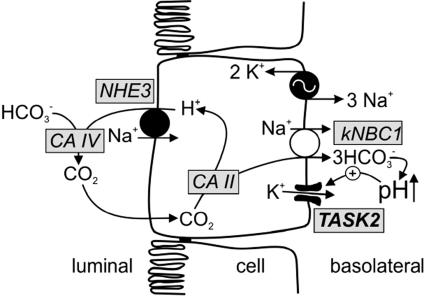
Model of putative TASK2 function in proximal tubule cells. Based on functional studies, TASK2 appears to be located in the basolateral membrane of proximal tubular cells. NaHCO3 reabsorption involves Na+/H+ exchange across the apical membrane. Na+ and formula image ions leave the cell by formula image cotransporter thereby depolarizing the basolateral membrane. In the extracellular space, rise in formula image concentration causes an increase in pH that then activates basolateral TASK2 K+ channels. TASK2 activity recycles K+ accumulated by Na+/K+-ATPase and leads to repolarization of the membrane that is needed as a driving force for ongoing NaHCO3 export. CA, carbonic anhydrase; NHE, Na+/H+ exchanger.

References

    1. Giebisch, G., Hebert, S. C. & Wang, W. H. (2003) Pflügers Arch. 446, 289–297. - PubMed
    1. Vallon, V., Grahammer, F., Richter, K., Bleich, M., Lang, F., Barhanin, J., Völkl, H. & Warth, R. (2001) J. Am. Soc. Nephrol. 12, 2003–2011. - PubMed
    1. Lang, F., Messner, G. & Rehwald, W. (1986) Am. J. Physiol. 250, F953–F962. - PubMed
    1. Giebisch, G. & Wang, W. (2000) Acta Physiol. Scand. 170, 153–173. - PubMed
    1. Beck, J. S., Laprade, R. & Lapointe, J. Y. (1994) Am. J. Physiol. 266, F517–F527. - PubMed

Publication types

MeSH terms