. 2004 Jun;24(11):4791-800.
doi: 10.1128/MCB.24.11.4791-4800.2004.

Role of CTCF binding sites in the Igf2/H19 imprinting control region

Affiliations

Role of CTCF binding sites in the Igf2/H19 imprinting control region

Piroska E Szabó et al. Mol Cell Biol. 2004 Jun.

Abstract

A approximately 2.4-kb imprinting control region (ICR) regulates somatic monoallelic expression of the Igf2 and H19 genes. This is achieved through DNA methylation-dependent chromatin insulator and promoter silencing activities on the maternal and paternal chromosomes, respectively. In somatic cells, the hypomethylated maternally inherited ICR binds the insulator protein CTCF at four sites and blocks activity of the proximal Igf2 promoter by insulating it from its distal enhancers. CTCF binding is thought to play a direct role in inhibiting methylation of the ICR in female germ cells and in somatic cells and, therefore, in establishing and maintaining imprinting of the Igf2/H19 region. Here, we report on the effects of eliminating ICR CTCF binding by severely mutating all four sites in mice. We found that in the female and male germ lines, the mutant ICR remained hypomethylated and hypermethylated, respectively, showing that the CTCF binding sites are dispensable for imprinting establishment. Postfertilization, the maternal mutant ICR acquired methylation, which could be explained by loss of methylation inhibition, which is normally provided by CTCF binding. Adjacent regions in cis-the H19 promoter and gene-also acquired methylation, accompanied by downregulation of H19. This could be the result of a silencing effect of the methylated maternal ICR.


Figures
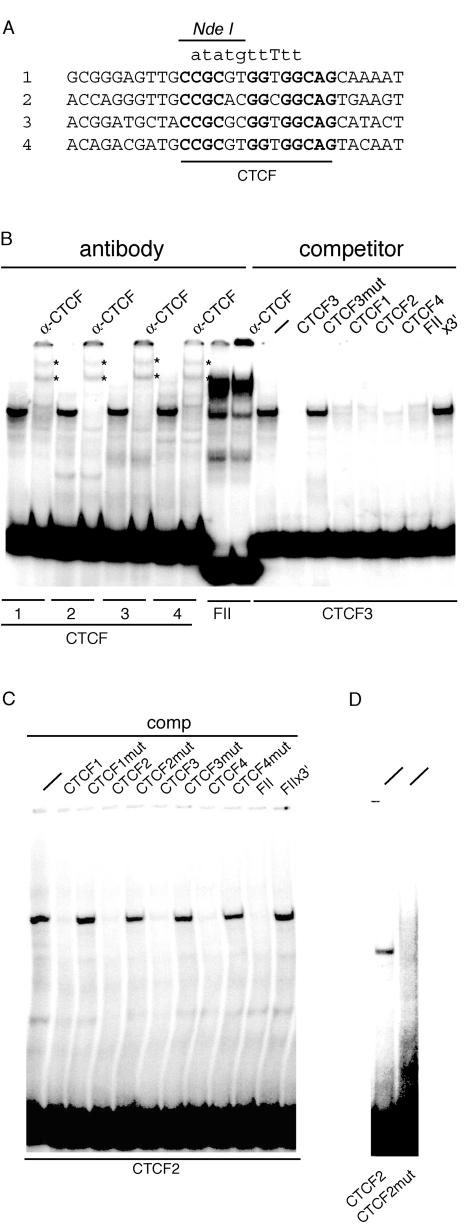
FIG. 1.
FIG. 1.
EMSA analysis of the CTCF site mutations. Radiolabeled oligonucleotide probes derived from the mouse H19/Igf2 ICR (CTCF 1 to 4) or from the chicken β-globin insulator (FII) were incubated with mouse PEF extract. Unlabeled oligonucleotides were included as competitors at 500-fold excess, or anti-CTCF antibody was given to obtain supershifts. (A) Nature of the CTCF site mutations. The DNA sequence spanning CTCF sites 1 to 4 is aligned. CTCF consensus binding sites are marked in bold. The same 10-bp DNA segment wasreplaced in all four CTCF sites by the sequence shown in lowercase letters on top. The NdeI restriction site created to facilitate screening during site-directed mutagenesis is also indicated. (B) Binding of CTCF complexes to the four ICR CTCF sites (left) and competition of CTCF site 3 (right). (C) Competition of CTCF site 2. (D) Lack of gel shift with the mutant CTCF site 2 oligonucleotide. Mutant oligonucleotide was radiolabeled and run next to the wild-type one after incubation with protein extract.
FIG. 2.
FIG. 2.
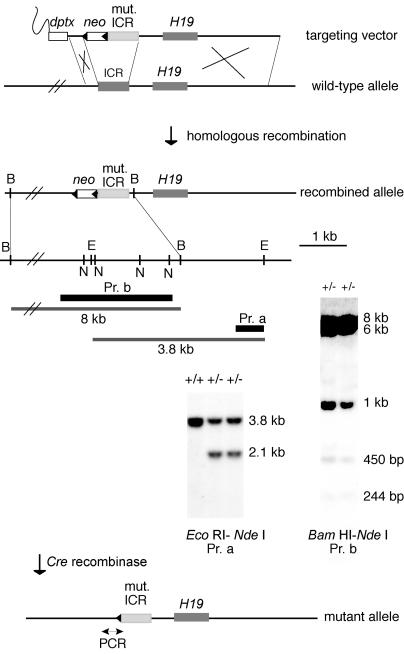
Gene targeting at the H19/Igf2 ICR, as shown by Southern blotting of two ES cell clones that underwent conservative recombination. Dark gray rectangles, wild-type ICR and H19 gene; light gray rectangle, mutant ICR; open rectangles, selection cassettes; black triangles, loxP sites. Probes (black bars): a (Pr. a), 0.6-kb EcoRI-ScaI fragment; b (Pr. b), 2.4-kb BglII ICR fragment. Restriction sites used for analysis: B, BamHI; E, EcoRI; N, NdeI.
FIG. 3.
FIG. 3.
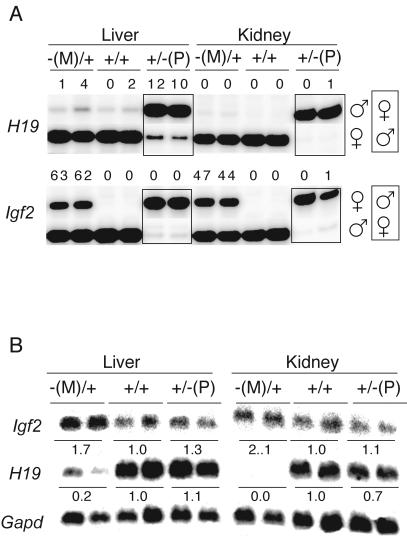
Phenotype of the 17.5-dpc fetuses inheriting the four CTCF site mutations in the H19/Igf2 ICR. (A) Reverse transcription-PCR single-nucleotide primer extension assays. In the −(M)/+ and +/+ lanes, the top row is the presumptive inactive allele. For the +/−(P) lanes (in boxes), these fetuses were obtained from the reciprocal mating, and hence the bottom row is the presumptive inactive allele. Parental origin of alleles is on the right. The value above each band is the amount of RNA contributed by the presumptive inactive allele as a percentage of the total. (B) Northern blotting results. Values under bands are the mean relative amounts of RNA standardized according to Gapd mRNA. Each lane represents an individual embryo. For Igf2 only the shortest transcript is shown, but the value represents the total of all transcripts.
FIG. 4.
FIG. 4.
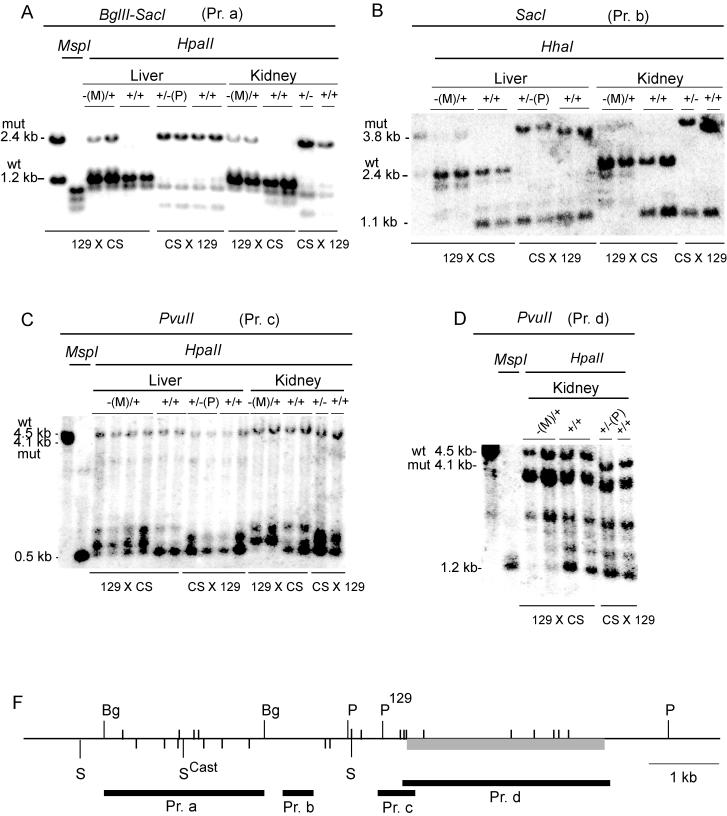
Methylation of H19 regions: Southern blots. Tissues were obtained from 17.5-dpc fetuses. Regions analyzed: ICR (A); region surrounding the G-rich repeat elements (B); H19 promoter (C); body of the H19 gene (D). (F) Map of the analyzed regions. Gray rectangle, H19 gene; black rectangles, probes. Restriction sites are SacI (S), BglII (Bg), PvuII (P), and HpaII and HhaI (small vertical lines above and below horizontal line, respectively) (only the sites analyzed are shown). The SacI and PvuII sites which distinguish between the 129 and CS strains (46) are marked.
FIG. 5.
FIG. 5.
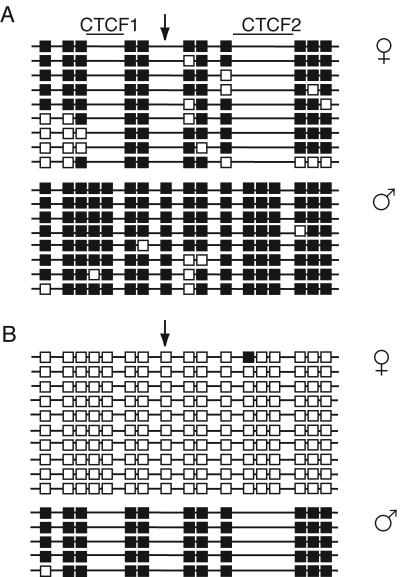
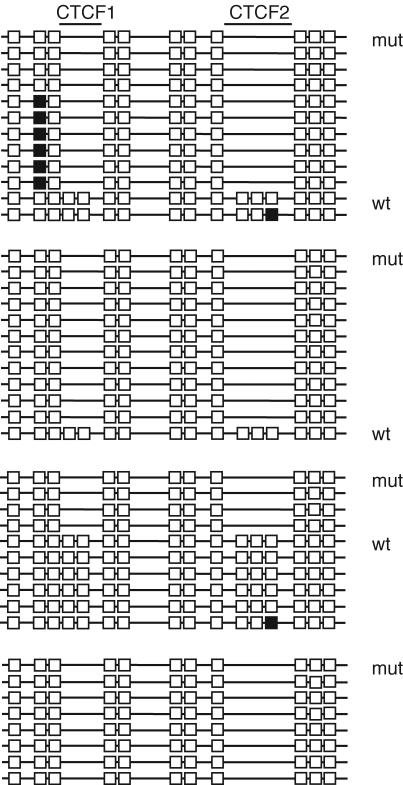
Methylation of the ICR in somatic cells Bisulfite sequencing was performed on DNA isolated from kidneys of 17.5-dpc fetuses derived from reciprocal matings. Data combined from two independent bisulfite conversion reactions are shown. Each horizontal line represents a clone of a separate PCR product. The parental origin of chromosomes is shown on the left. Closed square, methylated CpGs; open squares, unmethylated CpGs. The positions of the five CpGs, removed by mutagenesis, are indicated on the top. Presence of the eighth CpG is specific for CS DNA (arrow). (A) −(M)/+ fetuses; (B) +/−(P) fetuses.
FIG. 6.
FIG. 6.
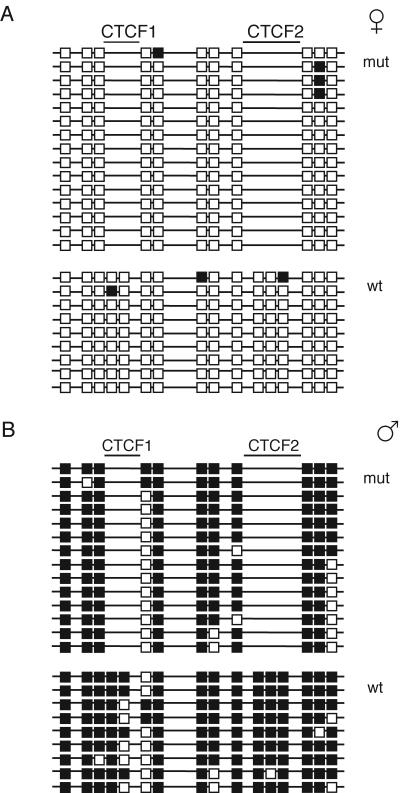
Methylation of the ICR in perinatal germ cells. Bisulfite sequencing was done on pools of 20,000 and 25,000 germ cells. Data combined from two independent bisulfite conversion reactions are shown. Each horizontal line represents a clone of a separate PCR product. (A) Female germ cells; (B) male germ cells.
FIG. 7.
FIG. 7.
Methylation of the ICR in oocytes. Bisulfite sequencing was done on four separate pools of oocytes containing 190, 175, 175, and 150 oocytes. Each horizontal line represents a clone of a separate PCR product.
FIG. 8.
FIG. 8.
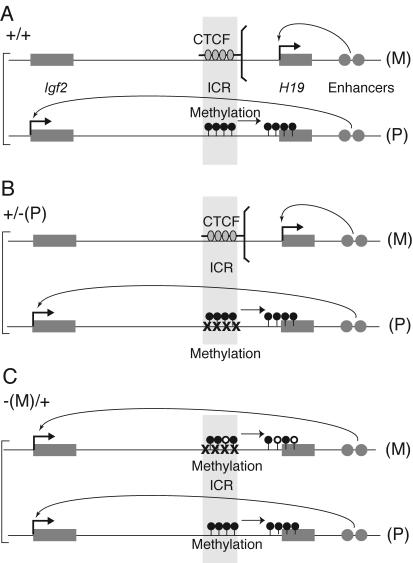
Summary of the results. (A) Wild-type +/+ fetuses; (B) +/−(P) fetuses. Mutation of each of the four CTCF binding sites has no consequences; methylation of the ICR is undisturbed, and allele-specific expression of H19 and Igf2 is the same as in wild type (C) −(M)/+ fetuses. The CTCF mutant ICR does not function as an insulator, the enhancers now activate Igf2 in cis (50% activity), and Igf2 is now biallelically expressed, while H19 expression is dramatically down-regulated (0 to 12%). Methylation accumulates in the maternal ICR, promoter, and body of the H19 gene in somatic cells. M, maternal allele; P, paternal allele. CTCF molecules are indicated by gray ovals.

References

    1. Bartolomei, M. S., and S. M. Tilghman. 1997. Genomic imprinting in mammals. Annu. Rev. Genet. 31:493-525. - PubMed
    1. Bartolomei, M. S., A. L. Webber, M. E. Brunkow, and S. M. Tilghman. 1993. Epigenetic mechanisms underlying the imprinting of the mouse H19 gene. Genes Dev. 7:1663-1673. - PubMed
    1. Bell, A. C., and G. Felsenfeld. 2000. Methylation of a CTCF-dependent boundary controls imprinted expression of the Igf2 gene. Nature 405:482-485. - PubMed
    1. Bird, A. 2002. DNA methylation patterns and epigenetic memory. Genes Dev. 16:6-21. - PubMed
    1. Brandeis, M., D. Frank, I. Keshet, Z. Siegfried, M. Mendelsohn, A. Nemes, V. Temper, A. Razin, and H. Cedar. 1994. Sp1 elements protect a CpG island from de novo methylation. Nature 371:435-438. - PubMed

Publication types