


Review
doi: 10.1172/JCI21748.
Anti-beta(1)-adrenergic receptor antibodies and heart failure: causation, not just correlation
Affiliations
- PMID: 15146232
- PMCID: PMC406535
- DOI: 10.1172/JCI21748
Item in Clipboard
Review
Anti-beta(1)-adrenergic receptor antibodies and heart failure: causation, not just correlation
J Clin Invest.
2004 May.
Abstract
Antibodies specific for the beta(1)-adrenergic receptor are found in patients with chronic heart failure of various etiologies. From work presented in this issue of the JCI, we can now infer that these antibodies actually contribute to the pathogenesis of chronic heart failure. This commentary discusses mechanisms by which these antibodies may engender cardiomyopathy.
Figures
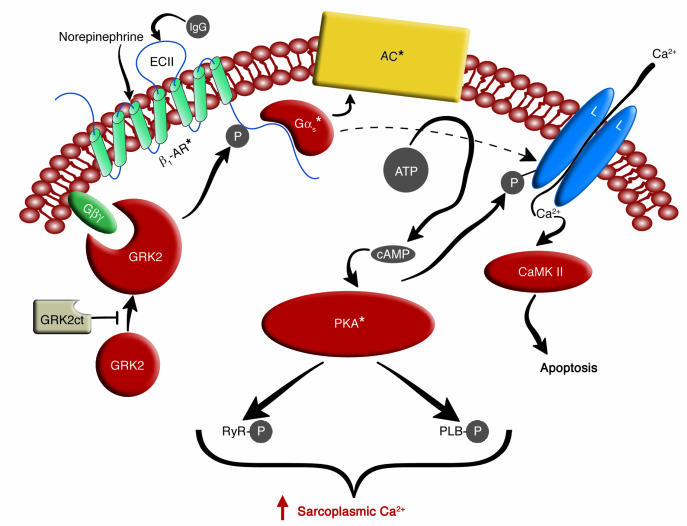
Schema for β1-AR–mediated cardiomyocyte stimulation and β1-AR desensitization. The seven-membrane-spanning β1-AR is stimulated by the physiologic agonist norepinephrine or by IgG specific for the receptor’s second extracellular loop (ECII) (in CHF subjects). The stimulated β1-AR then activates the heterotrimeric Gs, which dissociates into its Gαs* and Gβγ substituents. The Gαs* activates both adenylyl cyclase (AC), which catalyzes cAMP formation, and the L-type calcium channel (L), which then permits Ca2+ to enter the cardiomyocyte. This Ca2+ can both augment contractility and, on a slower time scale, promote cardiomyocyte apoptosis by activating Ca2+/calmodulin kinase II (CaMK II). The cAMP produced by adenylyl cyclase activates PKA, which subsequently phosphorylates (P) numerous substrates important to sarcoplasmic [Ca2+] regulation: the L-type Ca2+ channel, the ryanodine receptor (RyR), and phospholamban (PLB). The net effect of this activity in the short term is to augment sarcoplasmic [Ca2+] and contractility. (In the long term, this activity engenders cardiomyocyte toxicity.) The activated β1-AR is desensitized when it is phosphorylated by PKA (not shown) and by GRK2, the cellular expression of which increases with chronic β1-AR stimulation. Translocation of GRK2 from the sarcoplasm to the sarcolemma requires Gβγ subunits, and this translocation is inhibited when GRK2ct is expressed heterologously in cardiomyocytes. Asterisks denote activated proteins.
Comment on
-
Direct evidence for a beta 1-adrenergic receptor-directed autoimmune attack as a cause of idiopathic dilated cardiomyopathy.J Clin Invest. 2004 May;113(10):1419-29. doi: 10.1172/JCI20149. J Clin Invest. 2004. PMID: 15146239 Free PMC article.
References
-
- Sterin-Borda L, et al. Effect of Chagasic sera on the rat isolated atrial preparation: immunological, morphological and function aspects. Cardiovasc. Res. 1976;10:613–622. - PubMed
-
- Hagar JM, Rahimtoola SH. Chagas’ heart disease. Curr. Probl. Cardiol. 1995;20:825–924. - PubMed
-
- Limas CJ, Goldenberg IF, Limas C. Autoantibodies against beta-adrenoceptors in human idiopathic dilated cardiomyopathy. Circ. Res. 1989;64:97–103. - PubMed
-
- Jahns R, et al. Autoantibodies activating human β1-adrenergic receptors are associated with reduced cardiac function in chronic heart failure. Circulation. 1999;99:649–654. - PubMed
Publication types
MeSH terms
Substances
Grants and funding
LinkOut - more resources
Full Text Sources
Other Literature Sources
Medical
