


Predicting indirect readout effects in protein-DNA interactions
- PMID: 15148366
- PMCID: PMC420395
- DOI: 10.1073/pnas.0402319101
Predicting indirect readout effects in protein-DNA interactions
Abstract
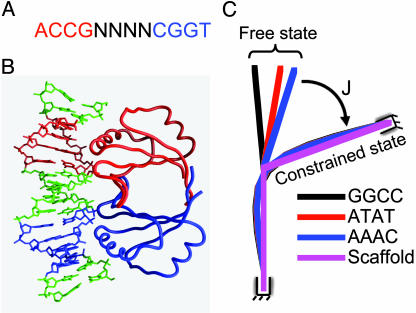
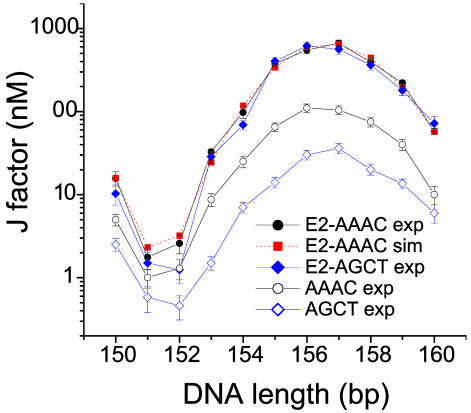
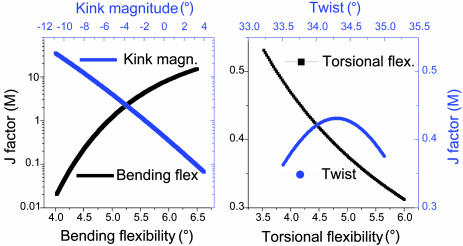
Recognition of DNA by proteins relies on direct interactions with specific DNA-functional groups, along with indirect effects that reflect variable energetics in the response of DNA sequences to twisting and bending distortions induced by proteins. Predicting indirect readout requires knowledge of the variations in DNA curvature and flexibility in the affected region, which we have determined for a series of DNA-binding sites for the E2 regulatory protein by using the cyclization kinetics method. We examined 16 sites containing different noncontacted spacer sequences, which vary by more than three orders of magnitude in binding affinity. For 15 of these sites, the variation in affinity was predicted within a factor of 3, by using experimental curvature and flexibility values and a statistical mechanical theory. The sole exception was traced to differential magnesium ion binding.
Figures
References
-
- Bloomfield, V. A., Crothers, D. M. & Tinoco, I. (1999) Nucleic Acids: Structures, Properties, and Functions (University Science Books, Sausalito, CA).
-
- Drew, H. R. & Travers, A. A. (1985) J. Mol. Biol. 186, 773-790. - PubMed
Publication types
MeSH terms
Substances
Grants and funding
LinkOut - more resources
Full Text Sources
Other Literature Sources
