


The twilight of Heliozoa and rise of Rhizaria, an emerging supergroup of amoeboid eukaryotes
- PMID: 15148395
- PMCID: PMC419558
- DOI: 10.1073/pnas.0308602101
The twilight of Heliozoa and rise of Rhizaria, an emerging supergroup of amoeboid eukaryotes
Abstract
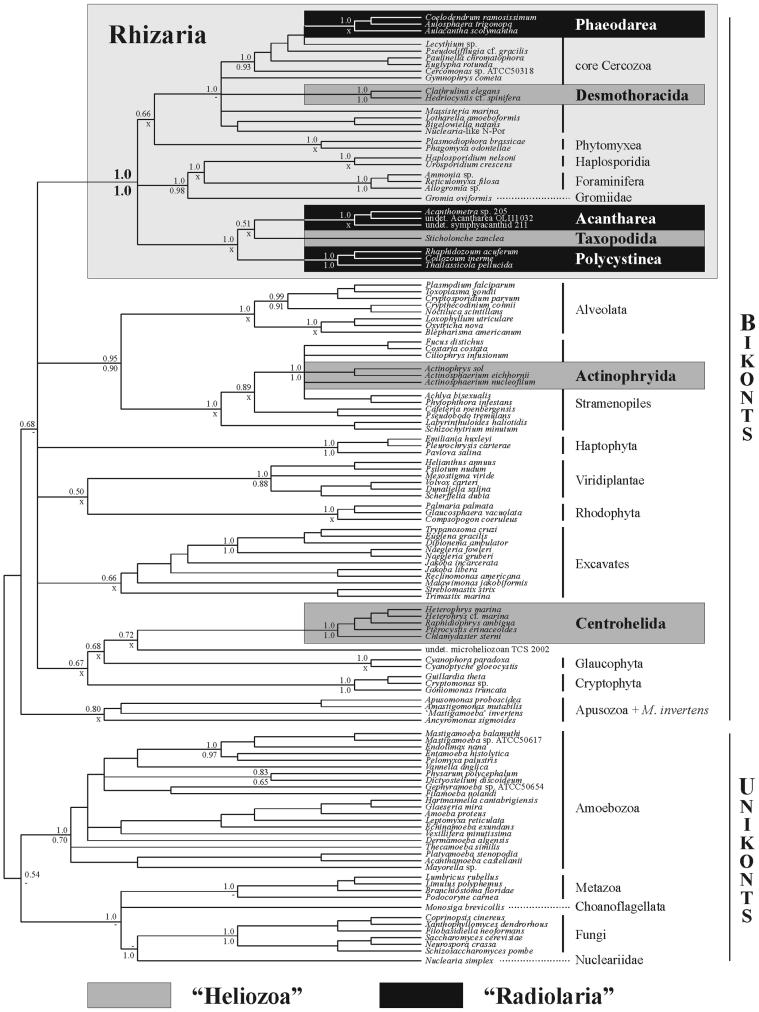
Recent molecular phylogenetic studies revealed the extraordinary diversity of single-celled eukaryotes. However, the proper assessment of this diversity and accurate reconstruction of the eukaryote phylogeny are still impeded by the lack of molecular data for some major groups of easily identifiable and cultivable protists. Among them, amoeboid eukaryotes have been notably absent from molecular phylogenies, despite their diversity, complexity, and abundance. To partly fill this phylogenetic gap, we present here combined small-subunit ribosomal RNA and actin sequence data for the three main groups of "Heliozoa" (Actinophryida, Centrohelida, and Desmothoracida), the heliozoan-like Sticholonche, and the radiolarian group Polycystinea. Phylogenetic analyses of our sequences demonstrate the polyphyly of heliozoans, which branch either as an independent eukaryotic lineage (Centrohelida), within stramenopiles (Actinophryida), or among cercozoans (Desmothoracida), in broad agreement with previous ultrastructure-based studies. Our data also provide solid evidence for the existence of the Rhizaria, an emerging supergroup of mainly amoeboid eukaryotes that includes desmothoracid heliozoans, all radiolarians, Sticholonche, and foraminiferans, as well as various filose and reticulose amoebae and some flagellates.
Figures
References
-
- Simpson, A. G. B. & Roger, A. J. (2002) Curr. Biol. 12, 691–693. - PubMed
-
- Baldauf, S. L. (2003) Science 300, 1703–1706. - PubMed
-
- Moreira, D. & López-García, P. (2002) Trends Microbiol. 10, 31–38. - PubMed
-
- Bolivar, I., Fahrni, J. F., Smirnov, A. & Pawlowski, J. (2001) Mol. Biol. Evol. 18, 2306–2314. - PubMed
Publication types
MeSH terms
Substances
Associated data
- Actions
- Actions
- Actions
- Actions
- Actions
- Actions
- Actions
- Actions
- Actions
- Actions
- Actions
- Actions
- Actions
- Actions
- Actions
- Actions
- Actions
- Actions
- Actions
- Actions
- Actions
- Actions
- Actions
- Actions
- Actions
LinkOut - more resources
Full Text Sources
Other Literature Sources
Molecular Biology Databases
Miscellaneous
