


Functional photoreceptor loss revealed with adaptive optics: an alternate cause of color blindness
- PMID: 15148406
- PMCID: PMC420416
- DOI: 10.1073/pnas.0401440101
Functional photoreceptor loss revealed with adaptive optics: an alternate cause of color blindness
Abstract
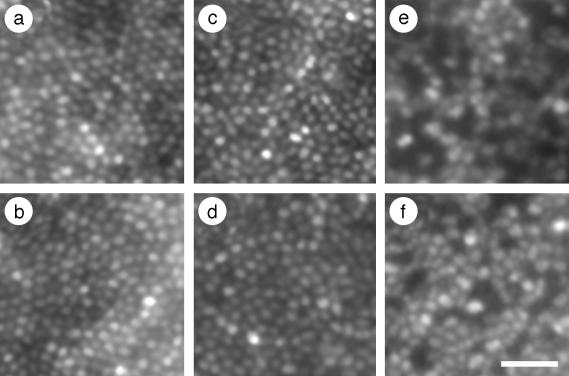
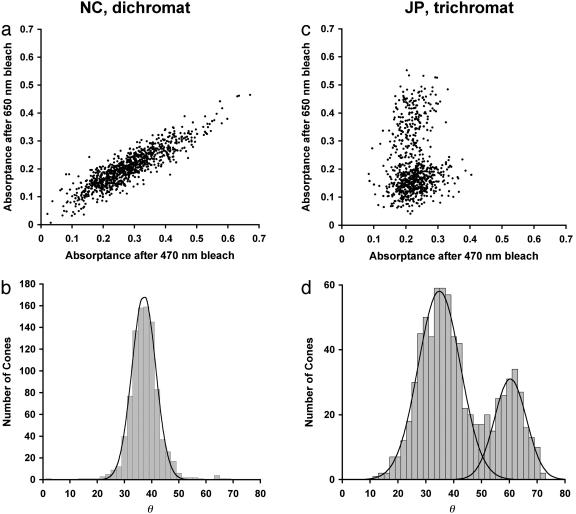
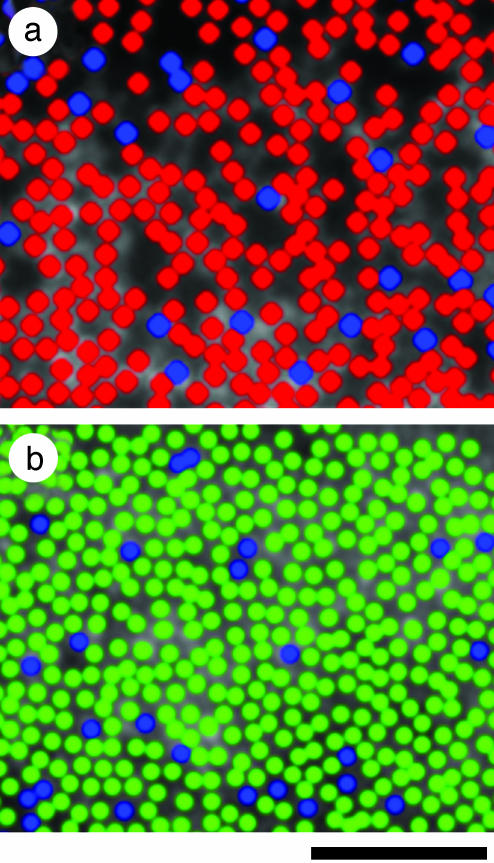
There is enormous variation in the X-linked L/M (long/middle wavelength sensitive) gene array underlying "normal" color vision in humans. This variability has been shown to underlie individual variation in color matching behavior. Recently, red-green color blindness has also been shown to be associated with distinctly different genotypes. This has opened the possibility that there may be important phenotypic differences within classically defined groups of color blind individuals. Here, adaptive optics retinal imaging has revealed a mechanism for producing dichromatic color vision in which the expression of a mutant cone photopigment gene leads to the loss of the entire corresponding class of cone photoreceptor cells. Previously, the theory that common forms of inherited color blindness could be caused by the loss of photoreceptor cells had been discounted. We confirm that remarkably, this loss of one-third of the cones does not impair any aspect of vision other than color.
Figures
References
-
- Cicerone, C. M. & Nerger, J. L. (1989) Vision Res. 29, 1587-1595. - PubMed
-
- Wesner, M. F., Pokorny, J., Shevell, S. K. & Smith, V. C. (1991) Vision Res. 31, 1021-1037. - PubMed
-
- Kremers, J., Usui, T., Scholl, H. P. N. & Sharpe, L. T. (1999) Invest. Ophthalmol. Vis. Sci. 40, 920-930. - PubMed
-
- Nathans, J., Thomas, D. & Hogness, D. S. (1986) Science 232, 193-202. - PubMed
Publication types
MeSH terms
Substances
LinkOut - more resources
Full Text Sources
Other Literature Sources
Medical
