Review
. 2004 Jun;8(3):163-9.
doi: 10.1186/cc2391. Epub 2003 Oct 22.

Clinical review: bedside assessment of alveolar recruitment

Affiliations
Review

Clinical review: bedside assessment of alveolar recruitment

Jean-Christophe Richard et al. Crit Care. 2004 Jun.

Abstract

Recruitment is a dynamic physiological process that refers to the reopening of previously gasless lung units. Cumulating evidence has led to a better understanding of the rules that govern both recruitment and derecruitment during mechanical ventilation of patients with acute respiratory distress syndrome. Therefore not only the positive end-expiratory pressure, but also the tidal volume, the inspired oxygen fraction, repeated tracheal suctioning as well as sedation and paralysis may affect recruitment of acute respiratory distress syndrome lungs that are particularly prone to alveolar instability. In the present article, we review the recently reported data concerning the physiological significance of the pressure-volume curve and its use to assess alveolar recruitment. We also describe alternate techniques that have been proposed to assess recruitment at the bedside. Whether recruitment should be optimized remains an ongoing controversy that warrants further clinical investigation.


Figures
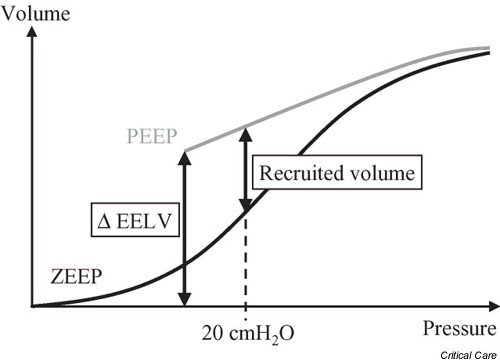
Figure 1
Figure 1
Measurement of positive end-expiratory pressure (PEEP)-induced alveolar recruitment using the pressure–volume (PV) curve. The PV curves of the respiratory system recorded from zero end-expiratory pressure (ZEEP) and from PEEP are superimposed on a common volume axis. '0' volume corresponds to the end-expiratory lung volume (EELV) on ZEEP. The first point of the PEEP PV curve corresponds to the increase in EELV induced by PEEP (Δ EELV). On this example, the recruitment induced by PEEP is measured at a pressure of 20 cmH2O.
Figure 2
Figure 2
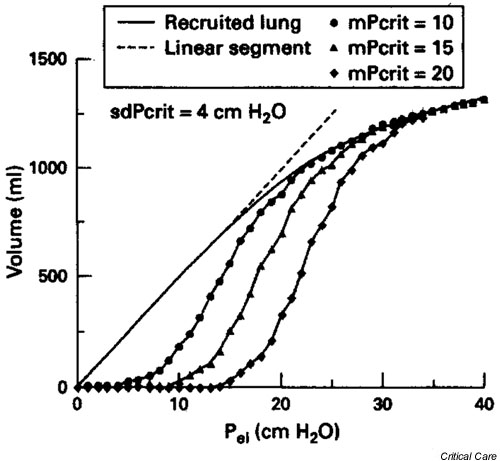
Mathematical model of the pressure–volume (PV) curve. PV curves obtained with a mathematical model simulating a multicompartmental lung model. The continuous PV curve reflects elastic properties of a completely recruited lung. The other curves represent the behavior of the simulated models according to a different mean opening pressure (10 cmH2O, 15 cmH2O and 20 cmH2O). Modified from [17]. Pel, elastic pressure; mPcrit = 10, mean opening pressure of 10 cmH2O; sdPcrit = 4 cmH2O, standard deviation of mPcrit.
Figure 3
Figure 3
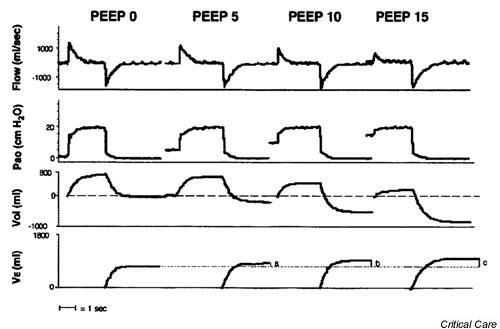
An alternative technique to assess recruitment: the equal pressure technique. Illustration of the technique proposed by Mergoni and colleagues who measured recruitment without performing pressure–volume curves. Recruitment is computed by comparing the volume expired after pressure breaths performed with the same distending pressure but at different positive end-expiratory pressure (PEEP) levels (5–15 cmH2O). (a-c) Difference corresponding to the recruitment related to the different PEEP levels studied. Modified from [25]. Pao, airway pressure; Vol, volume; VE, expired volume.
Figure 4
Figure 4
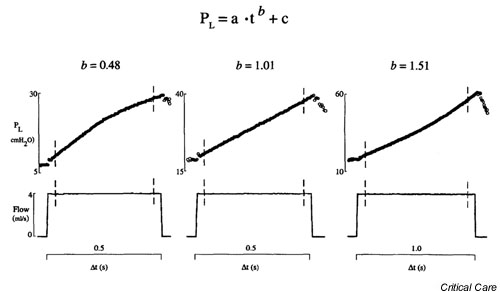
An alternative technique to assess recruitment: automatic analysis of the pressure–time curve. Illustration of the concept proposed by Ranieri and colleagues to monitor recruitment and overdistension during tidal normal breaths. A mathematical equation allows one to analyze the aspect of the inspiratory part of the airway pressure tracing during a breath obtained with a constant inspiratory flow. A concave downward shape of the pressure–time curve reflects continuous recruitment (left panel) while a convex downward shape indicates overdistension (right panel) The straight shape in the middle panel indicates the lack of recruitment and alveolar overdistension. Modified from [27]. PL, airway pressure.

References

    1. Dreyfuss D, Ricard JD, Saumon G. On the physiologic and clinical relevance of lung-borne cytokines during ventilator-induced lung injury. Am J Respir Crit Care Med. 2003;167:1467–1471. doi: 10.1164/rccm.200206-611CP. - DOI - PubMed
    1. Dreyfuss D, Saumon G. Ventilator induced lung injury: lessons from experimental studies. Am J Respir Crit Care Med. 1998;157:294–323. - PubMed
    1. Slutsky AS, Tremblay LN. Multiple system organ failure. Is mechanical ventilation a contributing factor? Am J Respir Crit Care Med. 1998;157:1721–1725. - PubMed
    1. Ranieri VM, Suter PM, Tortorella C, De Tullio R, Dayer JM, Brienza A, Bruno F, Slutsky AS. Effect of mechanical ventilation on inflammatory mediators in patients with acute respiratory distress syndrome: a randomized controlled trial. JAMA. 1999;282:54–61. doi: 10.1001/jama.282.1.54. - DOI - PubMed
    1. Puybasset L, Cluzel P, Chao N, Slutsky A, Coriat P, Rouby JJ, CT Scan ARDS Study Group A computed tomography scan assessment of regional lung volume in acute lung injury. Am J Respir Crit Care Med. 1998;158:1644–1655. - PubMed

MeSH terms

LinkOut - more resources