


Chemically induced increases and decreases in the rate of expansion of a CAG*CTG triplet repeat
- PMID: 15155855
- PMCID: PMC419613
- DOI: 10.1093/nar/gkh612
Chemically induced increases and decreases in the rate of expansion of a CAG*CTG triplet repeat
Abstract
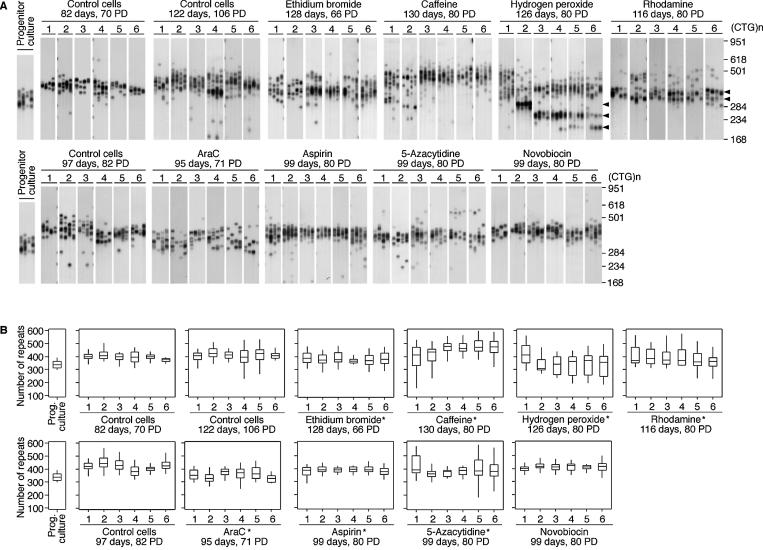
Somatic mosaicism of repeat length is prominent in repeat expansion disorders such as Huntington disease and myotonic dystrophy. Somatic mosaicism is age-dependent, tissue-specific and expansion-biased, and likely contributes toward the tissue-specificity and progressive nature of the symptoms. We propose that therapies targeted at somatic repeat expansion may have general utility in these disorders. Specifically, suppression of somatic expansion would be expected to be therapeutic, whilst reversion of the expanded mutant repeat to within the normal range would be predicted to be curative. However, the effects of genotoxic agents on the mutational properties of specific nuclear genes are notoriously difficult to define. Nonetheless, we have determined that chronic exposure over a three month period to a number of genotoxic agents can alter the rate of triplet repeat expansion in whole populations of mammalian cells. Interestingly, high doses of caffeine increased the rate of expansion by approximately 60%. More importantly, cytosine arabinoside, ethidium bromide, 5-azacytidine and aspirin all significantly reduced the rate of expansion by from 35 to 75%. These data establish that drug induced suppression of somatic expansion is possible. These data also suggest that highly unstable expanded simple sequence repeats may act as sensitive reporters of genotoxic assault in the soma.
Figures
References
-
- Richards R.I. (2001) Dynamic mutations: a decade of unstable expanded repeats in human genetic disease. Hum. Mol. Genet., 10, 2187–2194. - PubMed
-
- Liquori C.L., Ricker,K., Moseley,M.L., Jacobsen,J.F., Kress,W., Naylor,S.L., Day,J.W. and Ranum,L.P. (2001) Myotonic dystrophy type 2 caused by a CCTG expansion in intron 1 of ZNF9. Science, 293, 864–867. - PubMed
-
- Richards R.I. and Sutherland,G.R. (1992) Dynamic mutations: a new class of mutations causing human disease. Cell, 70, 709–713. - PubMed
-
- Monckton D.G., Wong,L.-J.C., Ashizawa,T. and Caskey,C.T. (1995) Somatic mosaicism, germline expansions, germline reversions and intergenerational reductions in myotonic dystrophy males: small pool PCR analyses. Hum. Mol. Genet., 4, 1–8. - PubMed
-
- Kennedy L. and Shelbourne,P.F. (2000) Dramatic mutation instability in HD mouse striatum: does polyglutamine load contribute to cell-specific vulnerability in Huntington’s disease? Hum. Mol. Genet., 9, 2539–2544. - PubMed
Publication types
MeSH terms
Substances
LinkOut - more resources
Full Text Sources
Other Literature Sources
