. 2004 Jun;186(12):3721-9.
doi: 10.1128/JB.186.12.3721-3729.2004.

A homologue of aliB is found in the capsule region of nonencapsulated Streptococcus pneumoniae

Affiliations

A homologue of aliB is found in the capsule region of nonencapsulated Streptococcus pneumoniae

Lucy J Hathaway et al. J Bacteriol. 2004 Jun.

Abstract

The epidemiology, phylogeny, and biology of nonencapsulated Streptococcus pneumoniae are largely unknown. Increased colonization capacity and transformability are, however, intriguing features of these pneumococci and play an important role. Twenty-seven nonencapsulated pneumococci were identified in a nationwide collection of 1,980 nasopharyngeal samples and 215 blood samples obtained between 1998 and 2002. On the basis of multilocus sequence typing and capsule region analysis we divided the nonencapsulated pneumococci into two groups. Group I was closely related to encapsulated strains. Group II had a clonal population structure, including two geographically widespread clones able to cause epidemic conjunctivitis and invasive diseases. Group II strains also carried a 1,959-bp homologue of aliB (aliB-like ORF 2) in the capsule region, which was highly homologous to a sequence in the capsule region of Streptococcus mitis. In addition, strains of the two major clones in group II had an additional sequence, aliB-like ORF 1 (1,968 to 2,004 bp), upstream of aliB-like ORF 2. Expression of aliB-like ORF 1 was detected by reverse transcription-PCR, and the corresponding RNA was visualized by Northern blotting. A gene fragment homologous to capN of serotypes 33 and 37 suggests that group II strains were derived from encapsulated pneumococci some time ago. Therefore, loss of capsule expression in vivo was found to be associated with the importation of one or two aliB homologues in some nonencapsulated pneumococci.


Figures
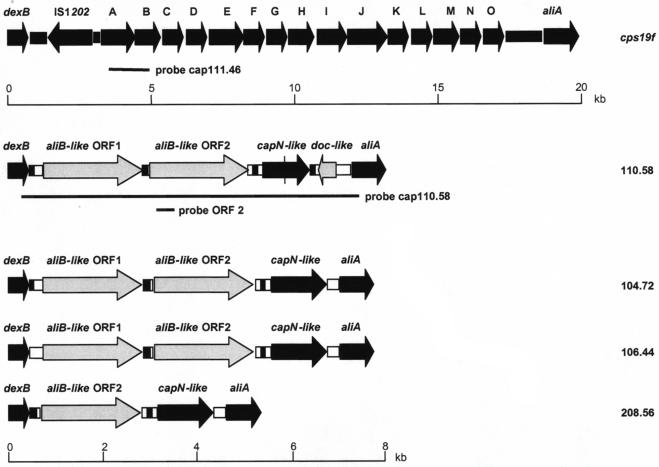
FIG. 1.
FIG. 1.
Schematic representation of cap regions of nonencapsulated S. pneumoniae strains. Cap regions (i.e., the DNA sequence between the dexB and aliA genes) were sequenced and analyzed for nonencapsulated S. pneumoniae strains 110.58, 104.72 106.44, and 208.56. For comparison, the cap region of a serotype 19F strain is shown at the top (9). Regions and ORFs found in nonencapsulated strains exhibiting high levels of homology to the cap region (including dexB and aliA) of encapsulated S. pneumoniae strains are indicated by black arrows (ORF) or boxes. The capN-like ORF of strain 110.58 contains a premature stop codon within the ORF represented by a vertical line. The aliB-like ORF 1 and aliB-like ORF 2, as well as the doc-like ORF found in the cap region of the nonencapsulated strains, are indicated by gray arrows. Regions with no homology to database entries are indicated by open boxes. The black boxes indicate complete and incomplete BOX elements found between dexB and aliB-like ORF 1 (strains 110.58 and 104.72), between aliB-like ORF 2 and a capN-like ORF (all nonencapsulated strains), and between a capN-like ORF and aliA (strain 110.58). Probes cap111.46 and cap110.58 and the aliB-like ORF 2 probe used for Southern blot analysis are indicated by lines. The cps19f gene (9) and the cap region of nonencapsulated strains are drawn to different scales; scale bars are indicated beneath the corresponding regions.
FIG.2.
FIG.2.
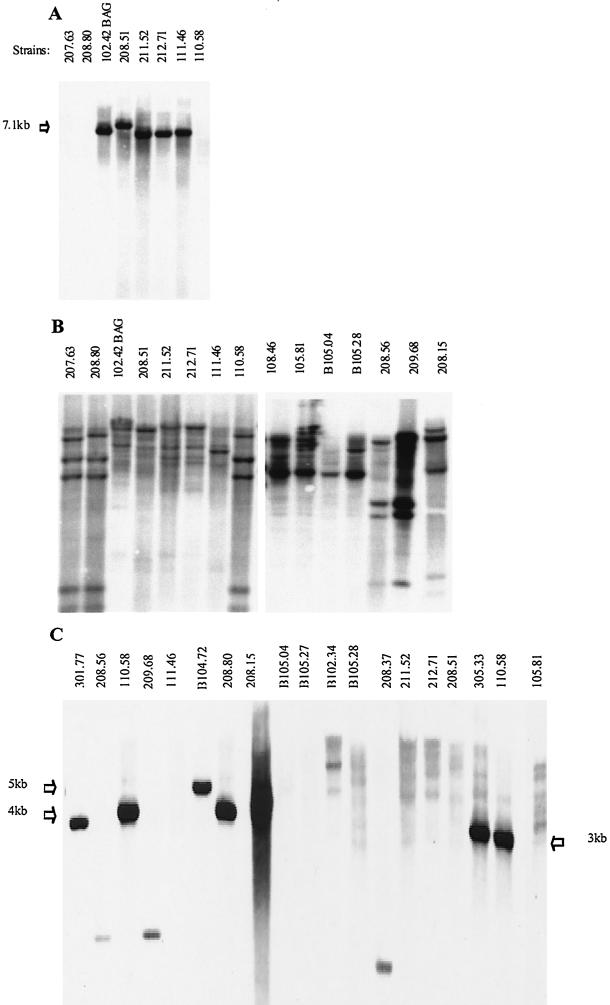
(A) Southern blot probed with cap111.46 bound with a single band to DNA of encapsulated pneumococcal isolates (strains 102.42 BAG, 208.51, 211.52, 212.71, and 111.46) but not to DNA of nonencapsulated isolates (strains 207.63, 208.80, and 110.58). (B) Probe cap110.58, representing the capsule region of a nonencapsulated clone A strain, bound to DNA from all strains with several bands. The banding pattern for the nonencapsulated strains belonging to the clone A complex (strains 207.63, 208.80, and 110.58) is identical or very similar. The banding patterns for the five encapsulated strains (strains 102.42 BAG, 208.51, 211.52, 212.71, and 111.46) represented four different hybridization patterns, in accordance with the expected polymorphism of the cap operon in these strains. The banding patterns for nonencapsulated strains representing clone B (strain 208.15) and clone C (strains 108.46 and 105.81) and for strains not belonging to a clone (strains B105.04, B105.28, 208.56, and 209.68) are also shown. (C) Probe specific for aliB-like ORF 2 bound to some of the nonencapsulated strains (strains 301.77, 208.56, 110.58, 209.68, B104.72, 208.80, 208.15, 208.37, 305.33, and 110.58) but not to nonencapsulated strains B105.04, B105.27, B102.34, B105.28, and 105.81 or to encapsulated strains (strains 111.46, 211.52, 212.71, and 208.51). Molecular weights were determined by using a standard run on the gel, which was visualized before blotting.
FIG. 3.
FIG. 3.
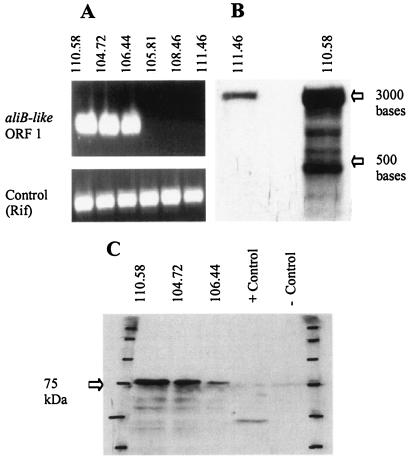
(A) RT-PCR detected aliB-like ORF 1 expression in nonencapsulated clone A isolates (strains 110.58, 104.72, and 106.44) but not in the nonencapsulated clone C isolates (strains 105.81 and 108.46) or the encapsulated serotype 19F control strain (strain 111.46). The lower panel shows the results for a positive control for RT-PCR performed with equal amounts of PCR product produced for all strains with Rif primers binding to cDNA of rpoB. (B) Northern blot showing expression of RNA recognized by the aliB-like ORF 1 probe in nonencapsulated clone A strain 110.58. There is a weak band for encapsulated serotype 19F control strain 111.46, which may have been due to a cross-reaction. Molecular weights were determined by using a standard run on the gel, which was visualized before blotting. (C) In vitro translation produced a protein from the aliB-like ORF 1 region for all three nonencapsulated clone A strains tested (strains 110.58, 104.72, and 106.44). The position of the protein standard was marked on the blot (first and last lanes); positive and negative controls were produced according to the instructions of the kit manufacturer.

References

    1. Adamou, J. E., T. M. Wizemann, P. Barren, and S. Langermann. 1998. Adherence of Streptococcus pneumoniae to human bronchial epithelial cells (BEAS-2B). Infect. Immun. 66:820-822. - PMC - PubMed
    1. Alloing, G., P. de Philip, and J. P. Claverys. 1994. Three highly homologous membrane-bound lipoproteins participate in oligopeptide transport by the Ami system of the gram-positive Streptococcus pneumoniae. J. Mol. Biol. 241:44-58. - PubMed
    1. Arrecubieta, C., R. Lopez, and E. Garcia. 1994. Molecular characterization of cap3A, a gene from the operon required for the synthesis of the capsule of Streptococcus pneumoniae type 3: sequencing of mutations responsible for the unencapsulated phenotype and localization of the capsular cluster on the pneumococcal chromosome. J. Bacteriol. 176:6375-6383. - PMC - PubMed
    1. Claverys, J.-P., B. Grossiord, and G. Alloing. 2000. Is the Ami-AliA/B oligopeptide permease of Streptococcus pneumoniae involved in sensing environmental conditions? Res. Microbiol. 151:457-463. - PubMed
    1. Cundell, D. R., B. J. Pearce, J. Sandros, A. M. Naughton, and H. R. Masure. 1995. Peptide permeases from Streptococcus pneumoniae affect adherence to eucaryotic cells. Infect. Immun. 63:2493-2498. - PMC - PubMed

Publication types

MeSH terms

LinkOut - more resources