. 2004 Jun;135(2):1020-6.
doi: 10.1104/pp.104.044495. Epub 2004 Jun 4.

AtCAND1, a HEAT-repeat protein that participates in auxin signaling in Arabidopsis

Affiliations

AtCAND1, a HEAT-repeat protein that participates in auxin signaling in Arabidopsis

Youfa Cheng et al. Plant Physiol. 2004 Jun.

Abstract

Auxin affects many aspects of plant growth and development. We previously used chemical genetics to dissect auxin-signaling mechanisms and identified a small molecule, sirtinol, that constitutively activated auxin signaling (Y. Zhao et al. [2003], Science 301: 1107-1110). Here we describe the isolation, characterization, and cloning of an Arabidopsis mutant Atcand1-1 that emerged from a genetic screen for mutants insensitive to sirtinol. Loss-of-function mutants of AtCAND1 were resistant to sirtinol and auxin, but not to gibberellins or brassinolide. Atcand1 displayed developmental phenotypes similar to those of axr1, namely, short petioles, downwardly curling leaves, short inflorescence, and reduced fertility. AtCAND1 is homologous to human CAND1, a protein that is composed almost entirely of HEAT-repeat units and has been implicated in regulating the assembly and disassembly of the SCF protein degradation machinery. Taken together with previous biochemical studies, this work helps to elucidate the roles of AtCAND1 in protein degradation and auxin signaling.


Figures
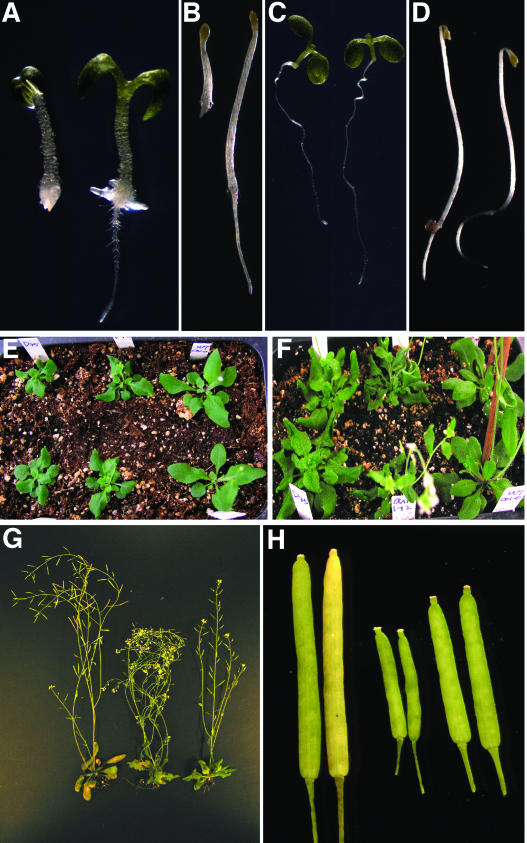
Figure 1.
Figure 1.
Distinct phenotypes of a sirtinol-resistant mutant Atcand1-1. A, Atcand1-1 had an elongated primary root (right), whereas the wild-type control (left) had essentially no primary roots when grown on 10 μm sirtinol under white light for 5 d. B, Atcand1-1 was also resistant to sirtinol in the dark. Atcand1-1 grown on 5 μm sirtinol in total darkness for 3 d developed normal hypocotyls and roots (right). C, Atcand1-1 (right) and wild type (left) grown on 0.5× MS in light for 7 d. D, Atcand1-1 (right) and wild type grown on 0.5× MS for 3 d in the dark. E and F, Adult Atcand1-1 plants grown in a greenhouse. Left, Atcand1-1; middle, axr1-12; and right, wild type. G, Inflorescences and a mature plant of Atcand1-1. Left, wild type; middle, axr1-12; and right, Atcand1-1. H, Siliques of Atcand1-1. Left, wild type; middle, axr1-12, and right, Atcand1-1.
Figure 2.
Figure 2.
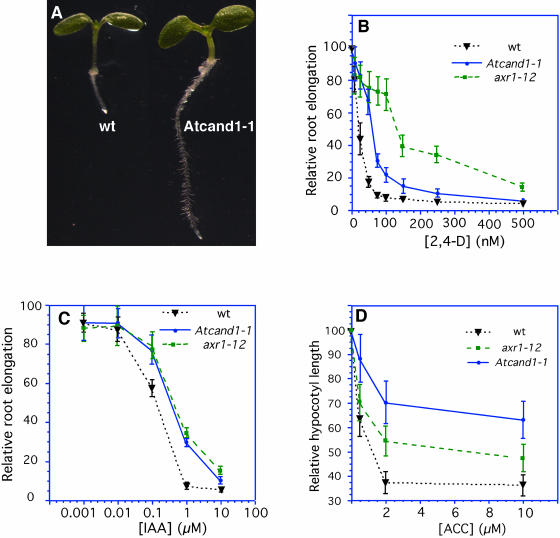
Atcand1-1 is resistant to exogenous auxin in root elongation assays. A, Seedlings were germinated and grown on 100 nm 2,4-D under white light for 5 d. Atcand1-1 (right) displayed elongated primary roots. B, Effects of 2,4-D on root elongation. Both axr1-12 and Atcand1-1 displayed decreased sensitivities to exogenous auxin. C, Effects of IAA on root elongation. Note that the x axis is in log scale. D, Effects of ethylene biosynthetic precursor ACC on hypocotyl elongation in the dark.
Figure 3.
Figure 3.
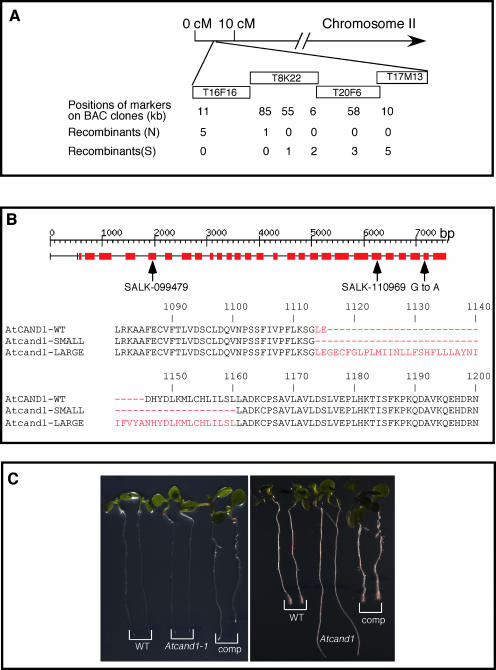
Cloning of Atcand1-1 mutant. A, Cloning of Atcand1-1 by map-based cloning. cM, Centimorgan; BAC, bacterial artificial chromosome. B, The nature and molecular consequences of Atcand1 mutations. The intron/exon diagram shown here was downloaded from TIGR database (www.tigr.org). The SALK numbers represent T-DNA insertion lines and the insertion locations were indicated. The G-to-A conversion occurred in Atcand1-1. C, Complementation of Atcand1-1 with a genomic fragment of At2g02560 plus its regulatory sequences. Left, Seedlings were just transferred to media containing 100 nm 2,4-D; right, plants shown at left grown on 2,4-D for 3 d.
Figure 4.
Figure 4.
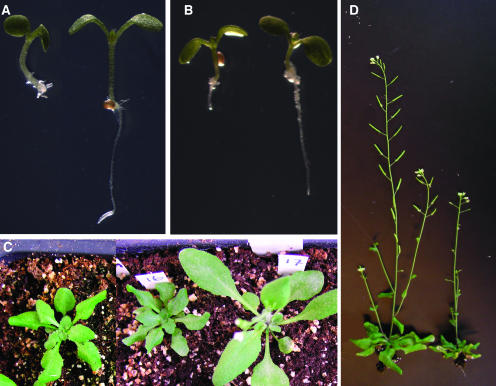
Analysis of T-DNA insertion alleles of Atcand1. A, Atcand1-2 (right) and wild type grown on 10 μm sirtinol for 6 d. B, Atcand1-2 (right) grown on 100 nm 2,4-D for 7 d. C, Adult plants of Atcand1 mutants. Left, Atcand1-1; middle, Atcand1-2; and right, wild type. Both Atcand1-2 and Atcand1-1 had short petiole and curly leaves, but Atcand1-2 had stronger phenotypes. D, Mature plants of Atcand1 mutants. Left, Atcand1-1; and right, Atcand1-2. Atcand1-2 was essentially sterile.

References

    1. Abel S, Oeller PW, Theologis A (1994) Early auxin-induced genes encode short-lived nuclear proteins. Proc Natl Acad Sci USA 91: 326–330 - PMC - PubMed
    1. Ballas N, Wong LM, Theologis A (1993) Identification of the auxin-responsive element, AuxRE, in the primary indoleacetic acid-inducible gene, PS-IAA4/5, of pea (Pisum sativum). J Mol Biol 233: 580–596 - PubMed
    1. Blackwell HE, Zhao Y (2003) Chemical genetic approaches to plant biology. Plant Physiol 133: 448–455 - PMC - PubMed
    1. Clough SJ, Bent AF (1998) Floral dip: a simplified method for Agrobacterium-mediated transformation of Arabidopsis thaliana. Plant J 16: 735–743 - PubMed
    1. Cope GA, Deshaies RJ (2003) COP9 signalosome: a multifunctional regulator of SCF and other cullin-based ubiquitin ligases. Cell 114: 663–671 - PubMed

Publication types

MeSH terms