. 2004 Jun 22;101(25):9417-22.
doi: 10.1073/pnas.0402340101. Epub 2004 Jun 10.

Identification of an outer membrane protein required for the transport of lipopolysaccharide to the bacterial cell surface

Affiliations

Identification of an outer membrane protein required for the transport of lipopolysaccharide to the bacterial cell surface

Martine P Bos et al. Proc Natl Acad Sci U S A. .

Abstract

Lipopolysaccharide (LPS), also known as endotoxin due to its severe pathophysiological effects in infected subjects, is an essential component of the outer membrane (OM) of most Gram-negative bacteria. LPS is synthesized in the bacterial inner membrane, a process that is now well understood. In contrast, the mechanism of its transport to the outer leaflet of the OM has remained enigmatic. We demonstrate here that the OM protein, known as increased membrane permeability (Imp) or organic solvent tolerance protein, is involved in this process. An Imp-deficient mutant of Neisseria meningitidis was viable and produced severely reduced amounts of LPS. The limited amount of LPS that was still produced was not accessible to LPS-modifying enzymes expressed in the OM or added to the extracellular medium. We conclude therefore that Imp mediates the transport of LPS to the cell surface. The role of Imp in LPS biogenesis and its high conservation among Gram-negative bacteria make it an excellent target for the development of novel antibacterial compounds.


Figures
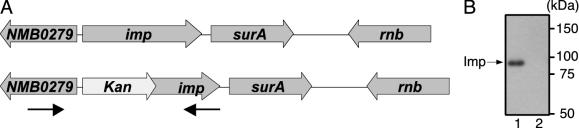
Fig. 1.
Fig. 1.
Construction of an imp mutant strain. (A) Genomic organization of the imp locus in the wild-type and imp mutant. NMB0279 is annotated as a conserved hypothetical protein in the MC58 database (www.tigr.org). The survival protein A (surA) gene encodes a periplasmic chaperone involved in OMP biogenesis. rnb, ribonuclease II. Arrows delineate the DNA fragment used for transformation to obtain the mutant. (B) Immunoblot of cell envelopes of wild-type (lane 1) and imp mutant (lane 2) separated by SDS/PAGE and probed with anti-Imp antibodies. Molecular size markers are indicated in kDa.
Fig. 2.
Fig. 2.
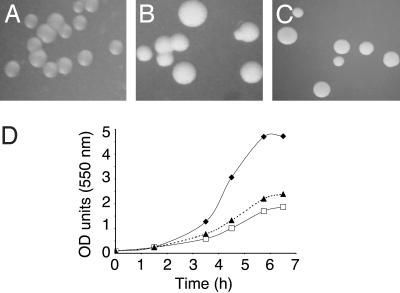
Characteristics of an N. meningitidis imp mutant. (A–C) Colony morphology of wild-type (A), imp mutant (B), and lpxA mutant (C) bacteria. Colonies were observed with a binocular microscope by using the shiny side of a flexible mirror. (D) Growth curve of wild-type (♦), imp mutant (□), and lpxA mutant (▴) bacteria in tryptic soy broth.
Fig. 3.
Fig. 3.
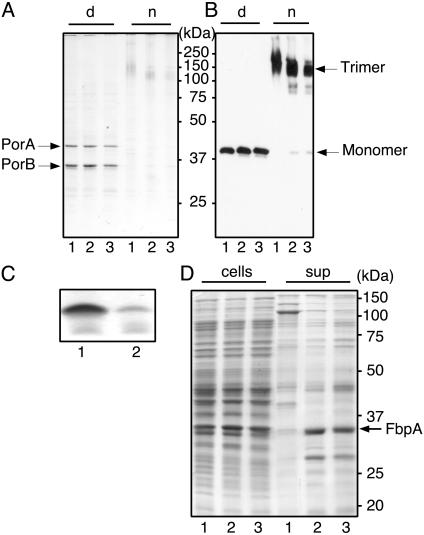
Protein and LPS profiles of wild-type (lanes 1), imp mutant (lanes 2), and lpxA mutant (lanes 3) bacteria. (A and B) Cell envelopes were analyzed by SDS/PAGE in denaturing (d) or seminative (n) conditions. Gels were stained with Coomassie blue (A) or were blotted and probed with anti-PorA antibody (B). (C) Equal amounts of proteinase K-treated cell lysates were subjected to Tricine-SDS/PAGE and stained with silver to visualize LPS. (D) Lanes labeled “cells” contain equal numbers of bacteria, based on OD. Lanes labeled “sup” contain equal volumes of culture supernatants precipitated with trichloroacetic acid. Samples were subjected to SDS/PAGE and were stained with Coomassie blue. Molecular size markers (in kDa) are indicated.
Fig. 4.
Fig. 4.
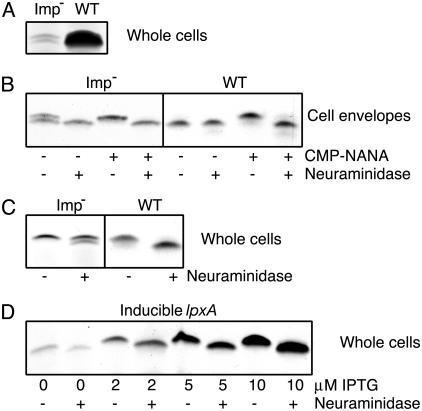
Surface accessibility of LPS. Shown are silver-stained Tricine-SDS/PAGE gels containing samples treated with proteinase K before loading. (A) Equal amounts of proteinase K-treated cell lysates of the indicated strains were loaded on the same gel. (B) Cell envelopes of bacteria grown the presence or absence of CMP-NANA. Where indicated, the cell envelopes were treated with neuraminidase before electrophoresis. (C) Intact bacteria grown in the presence of CMP-NANA were treated with neuraminidase and subsequently processed for Tricine-SDS/PAGE. In B and C, five times as much material of the imp mutant samples, based on protein content or OD, was loaded compared with wild-type samples. Gels containing the imp mutant samples were developed longer to obtain optimal visibility of the LPS bands. (D) The inducible lpxA mutant was grown in the presence of the IPTG concentrations indicated plus CMP-NANA. Intact cells were treated with neuraminidase as indicated. Equal amounts of cell lysates, based on OD, were analyzed on the same gel.
Fig. 5.
Fig. 5.
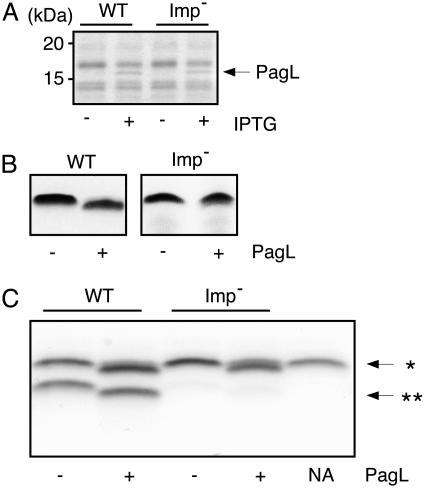
PagL-mediated LPS modification in wild-type and imp mutant strains expressing pagL of B. bronchiseptica. PagL expression was induced (+)ornot induced (-) by IPTG. (A) Cell envelopes were analyzed by SDS/PAGE and Coomassie staining. Only the relevant portion of the gel is shown. (B) Tricine-SDS/PAGE analysis of proteinase K-treated cell lysates. Five times as much proteinase K-treated cell lysate, based on OD, was loaded of the imp mutant samples compared with the wild-type samples. The gel containing the imp mutant samples was developed longer to obtain optimal visibility of the LPS bands. (C) Silver-stained Tricine-SDS/PAGE gels showing in vitro PagL activity. Purified L3-LPS (*) was incubated in a detergent-containing buffer for 18 h at 37°C with L8-LPS (**)-containing cell envelopes prepared from wild-type and imp mutant strains, containing pagL on a plasmid. Similar amounts of assay mixes were loaded in all lanes. NA, no cell envelopes were added.

References

    1. Raetz, C. R. H. & Whitfield, C. (2002) Annu. Rev. Biochem. 71, 635-700. - PMC - PubMed
    1. Gronow, S. & Brade, H. (2001) J. Endotoxin Res. 7, 3-23. - PubMed
    1. Zhou, Z., White, K. A., Polissi, A., Georgopoulos, C. & Raetz, C. R. H. (1998) J. Biol. Chem. 273, 12466-12475. - PubMed
    1. Genevrois, S., Steeghs, L., Roholl, P., Letesson, J.-J. & van der Ley, P. (2003) EMBO J. 22, 1780-1789. - PMC - PubMed
    1. Voulhoux, R., Bos, M. P., Geurtsen, J., Mols, M. & Tommassen, J. (2003) Science 299, 262-265. - PubMed

Publication types

MeSH terms