


Statin therapy is associated with improved patency of autogenous infrainguinal bypass grafts
- PMID: 15192555
- PMCID: PMC2643376
- DOI: 10.1016/j.jvs.2003.12.027
Statin therapy is associated with improved patency of autogenous infrainguinal bypass grafts
Abstract
Objective: HMG-CoA reductase inhibitors (statins) broadly reduce cardiovascular events, effects that are only partly related to cholesterol lowering. Recent studies suggest important anti-inflammatory and antiproliferative properties of these drugs. The purpose of this study was to determine the influence of statin therapy on graft patency after autogenous infrainguinal arterial reconstructions.
Methods: A retrospective analysis of consecutive patients (1999-2001) who underwent primary autogenous infrainguinal reconstructions with a single segment of greater saphenous vein was performed. Patients were categorized according to concurrent use of a statin. Graft lesions (identified by duplex surveillance) and interventions were tabulated. Comparisons between groups were made by using the Fisher exact test for categorical variables and the Student t test for continuous variables. Patency, limb salvage, and survival were compared by log rank test. A stepwise Cox proportional hazards analysis was then employed to ascertain the relative importance of factors influencing graft patency.
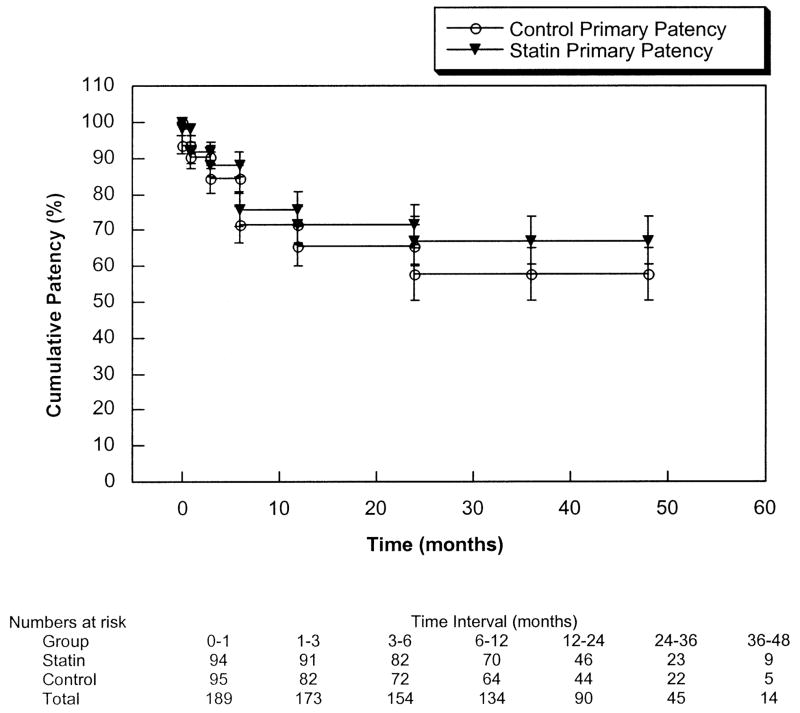
Results: A total of 172 patients underwent 189 primary autogenous infrainguinal arterial reconstructions (94 statin, 95 control) during the study period. The groups were well matched for age, indication, and atherosclerotic risk factors. Procedures were performed primarily for limb salvage (92%), with 65% to an infrapopliteal target. Perioperative mortality (2.6%) and major morbidity (3.2%) were not different between groups. There was no difference in primary patency (74% +/- 5% vs 69% +/- 6%; P =.25), limb salvage (92% +/- 3% vs 90% +/- 4%; P =.37), or survival (69% +/- 5% vs 63% +/- 5%; P =.20) at 2 years. However, patients on statins had higher primary-revised (94% +/- 2% vs 83% +/- 5%; P <.02) and secondary (97% +/- 2% vs 87% +/- 4%; P <.02) graft patency rates at 2 years. Of all factors studied by univariate analysis, only statin use was associated with improved secondary patency (P =.03) at 2 years. This was confirmed by multivariate analysis. The risk of graft failure was 3.2-fold higher (95% confidence interval, 1.04-10.04) for the control group. Perioperative cholesterol levels (available in 47% of patients) were not statistically different between groups.
Conclusions: Statin therapy is associated with improved graft patency after infrainguinal bypass grafting with saphenous vein.
Figures

References
-
- Taylor LM, Jr, Edwards JM, Porter JM. Present status of reversed vein bypass grafting: five-year results of a modern series. J Vasc Surg. 1990;11:193–206. - PubMed
-
- Belkin M, Conte MS, Donaldson MC, Mannick JA, Whittemore AD. The impact of gender on the results of arterial bypass with in-situ greater saphenous vein. Am J Surg. 1995;170:97–102. - PubMed
-
- Sacks FM, Pfeffer MA, Moye LA, Rouleau JL, Rutherford JD, Cole TG, et al. Cholesterol and Recurrent Events Trial investigators The effect of pravastatin on coronary events after myocardial infarction in patients with average cholesterol levels. N Engl J Med. 1996;335:1001–9. - PubMed
-
- Randomised trial of cholesterol lowering in 4444 patients with coronary heart disease: the Scandinavian Simvastatin Survival Study (4S) Lancet. 1994;344:1383–9. - PubMed
Publication types
MeSH terms
Substances
Grants and funding
LinkOut - more resources
Full Text Sources
Medical
