Serotonin and vasoactive intestinal peptide antagonists attenuate rotavirus diarrhoea
- PMID: 15194642
- PMCID: PMC1774112
- DOI: 10.1136/gut.2003.033563
Serotonin and vasoactive intestinal peptide antagonists attenuate rotavirus diarrhoea
Abstract
Background and aims: The mechanisms underlying intestinal secretion in rotavirus diarrhoea remain to be established. We previously reported that rotavirus evokes intestinal fluid and electrolyte secretion by activation of the enteric nervous system. We now report that antagonists for the 5-hydroxytryptamine 3 receptor (5-HT(3)) and vasoactive intestinal peptide (VIP) receptor, but not antagonists for 5-hydroxytryptamine 4 receptor or the muscarinic receptor, attenuate rotavirus induced diarrhoea.
Methods: Neurotransmitter antagonists were administered to wild-type or neurokinin 1 receptor knockout mice infected with homologous (EDIM) or heterologous (RRV) rotavirus.
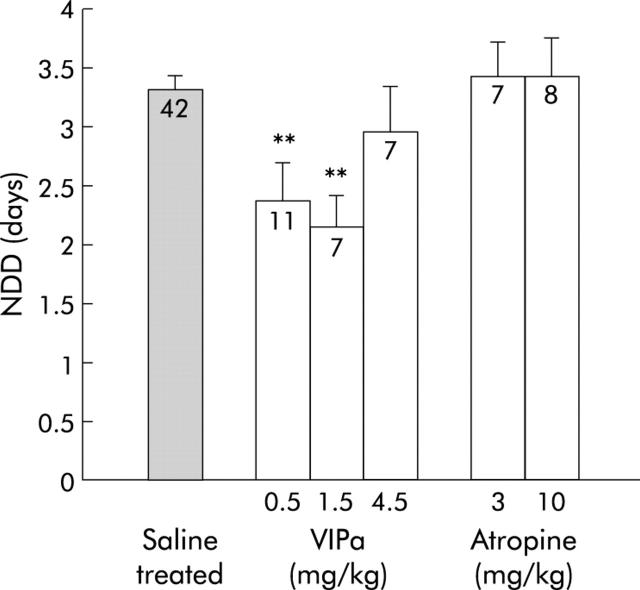
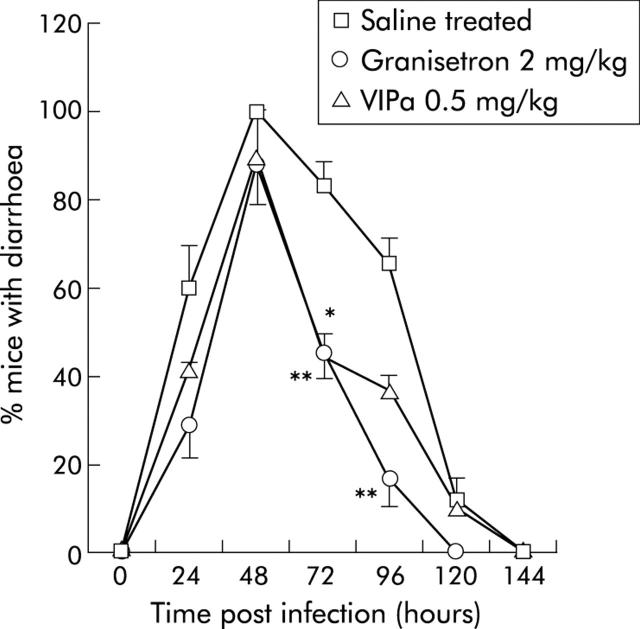
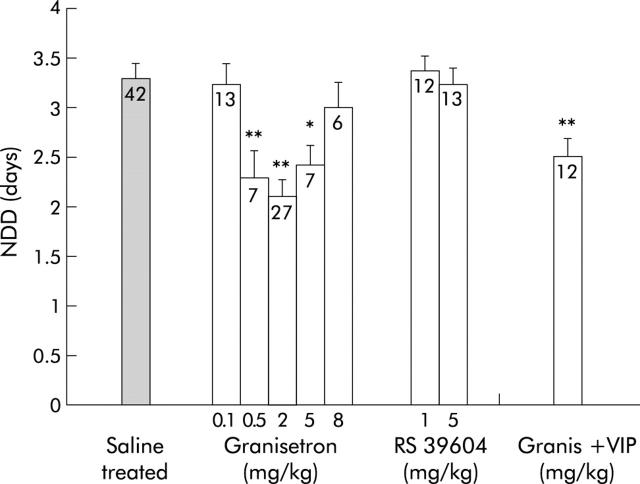
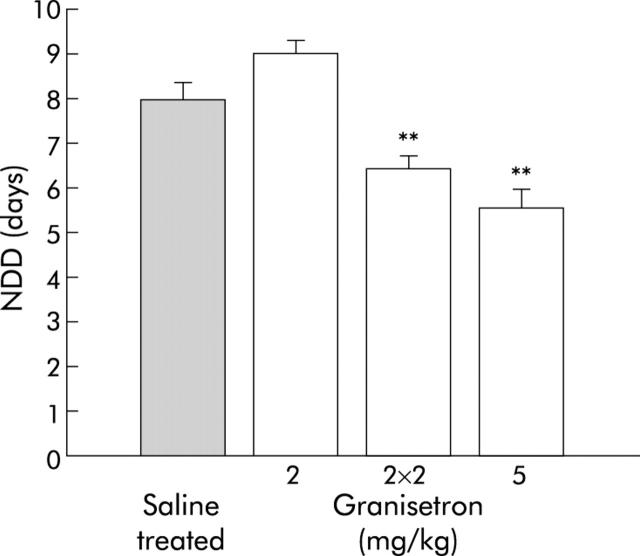
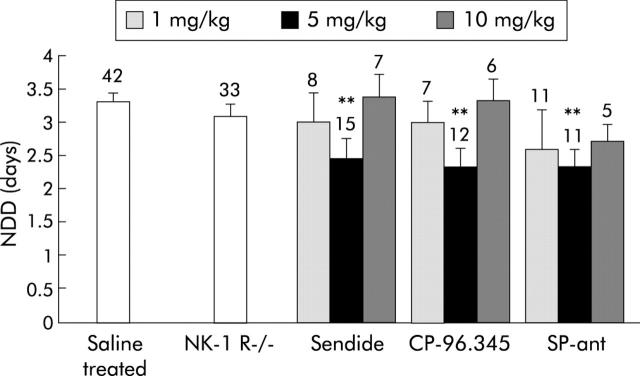
Results: While RRV infected mice had diarrhoea for 3.3 (0.2) days (95% confidence interval (CI) 3.04-3.56), the 5-HT(3) receptor antagonist (granisetron) and the VIP receptor antagonist (4Cl-D-Phe(6),Leu(17))-VIP both reduced the total number of days of RRV induced diarrhoea to 2.1 (0.3) (95% CI 1.31-2.9) (p<0.01). EDIM infected mice treated with granisetron had a significantly shorter duration of diarrhoea (5.6 (0.4) days) compared with untreated mice (8.0 (0.4) days; p<0.01). Experiments with neurokinin 1 receptor antagonists suggest that this receptor may possibly be involved in the secretory response to rotavirus. On the other hand, rotavirus diarrhoea was not attenuated in the neurokinin 1 receptor knockout mice.
Conclusions: Our results suggest that the neurotransmitters serotonin and VIP are involved in rotavirus diarrhoea; observations that could imply new principles for treatment of this disease with significant global impact.
Figures
References
-
- Estes MK, Morris AP. A viral enterotoxin. A new mechanism of virus-induced pathogenesis. Adv Exp Med Biol 1999;473:73–82. - PubMed
-
- Estes MK. The rotavirus NSP4 enterotoxin: current status and challenges. In: Desselberger U, Gray J, eds. Viral gastroenteritis. Perspectives in medical virology, vol 9 2003:207–224.
-
- Cooke HJ. “Enteric tears”: chloride secretion and its neural regulation. News Physiol Sci 1998;13:269–74. - PubMed
-
- Jodal M , Lundgren O. Neural reflex modulation of intestinal epithelial transport. In: Gaginella TS, ed. Regulatory mechanisms in gastrointestinal function. B. oca Raton: CRC Press, 1995:99–144.
Publication types
MeSH terms
Substances
LinkOut - more resources
Full Text Sources
Other Literature Sources
Medical