. 2004 Jul 1;18(13):1553-64.
doi: 10.1101/gad.299904. Epub 2004 Jun 15.

Mouse limb deformity mutations disrupt a global control region within the large regulatory landscape required for Gremlin expression

Affiliations

Mouse limb deformity mutations disrupt a global control region within the large regulatory landscape required for Gremlin expression

Aimée Zuniga et al. Genes Dev. .

Abstract

The mouse limb deformity (ld) mutations cause limb malformations by disrupting epithelial-mesenchymal signaling between the polarizing region and the apical ectodermal ridge. Formin was proposed as the relevant gene because three of the five ld alleles disrupt its C-terminal domain. In contrast, our studies establish that the two other ld alleles directly disrupt the neighboring Gremlin gene, corroborating the requirement of this BMP antagonist for limb morphogenesis. Further doubts concerning an involvement of Formin in the ld limb phenotype are cast, as a targeted mutation removing the C-terminal Formin domain by frame shift does not affect embryogenesis. In contrast, the deletion of the corresponding genomic region reproduces the ld limb phenotype and is allelic to mutations in Gremlin. We resolve these conflicting results by identifying a cis-regulatory region within the deletion that is required for Gremlin activation in the limb bud mesenchyme. This distant cis-regulatory region within Formin is also altered by three of the ld mutations. Therefore, the ld limb bud patterning defects are not caused by disruption of Formin, but by alteration of a global control region (GCR) required for Gremlin transcription. Our studies reveal the large genomic landscape harboring this GCR, which is required for tissue-specific coexpression of two structurally and functionally unrelated genes.


Figures
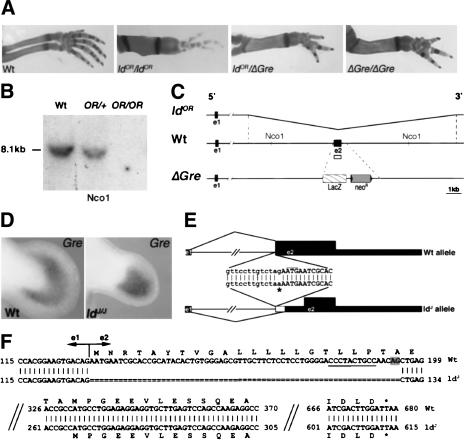
Figure 1.
Figure 1.
The ldOR and ldJ mutations are Gremlin loss-of-function alleles. (A) The ldOR mutation is allelic to a Gremlin null allele (ΔGre) generated by gene targeting (Michos et al. 2004). (B) Southern blot analysis reveals that the Gremlin ORF encoded by exon 2 is deleted in the ldOR mutation. Genomic DNA isolated from embryos was digested by Nco1 and probed with a Gremlin exon 2 probe (open box in scheme, C). (Wt) Wild-type littermate; (OR/+) heterozygous embryo; (OR/OR) homozygous embryo. (C) Schematic representation of the Gremlin locus on chromosome 2 in the ldOR allele, wild-type, and ΔGre mutation. (ldOR) Kinked line indicates the 12.7-kb region deleted in the ldOR mutation. (Wt) Open box indicates the probe used for the Southern blot analysis shown in B. (ΔGre) LacZ and the NeoR replace coding exon 2 in the Gremlin null allele generated by gene targeting. (e1) Exon 1; (e2) exon 2. (D) Gremlin remains expressed in ldJ homozygous embryos. Shown are limb buds of a wild-type (Wt) and ldJ homozygous (ldJ/J) mouse embryo at E11.5. (E) The G-to-A mutation at the intron–exon 2 junction of the Gremlin gene in the ldJ allele (indicated by an asterisk) disrupts splicing. Lowercase indicate intronic, uppercase indicate exonic sequences. Thick black boxes indicate the Gremlin ORF, thin boxes indicate the 5′ and 3′ noncoding regions. The thin white box indicates the deletion of mRNA due to aberrant splicing. Thin black lines indicate intronic sequences and splices. (F) Aberrant pre-mRNA splicing deletes the first 65 bases of the Gremlin ORF. Shown is an alignment of the cDNA sequences of wild-type (Wt) and ldJ alleles with the respective ORFs. The truncated ldJ Gremlin transcript could potentially encode a Gremlin protein of 117 amino acids (instead of 184) lacking the signal peptide (Avsian-Kretchmer and Hsueh 2003). The AG dinucleotide used for splicing in the ldJ allele is shaded gray. The required upstream poly-pyrimidine tract is underlined (Faustino and Cooper 2003).
Figure 2.
Figure 2.
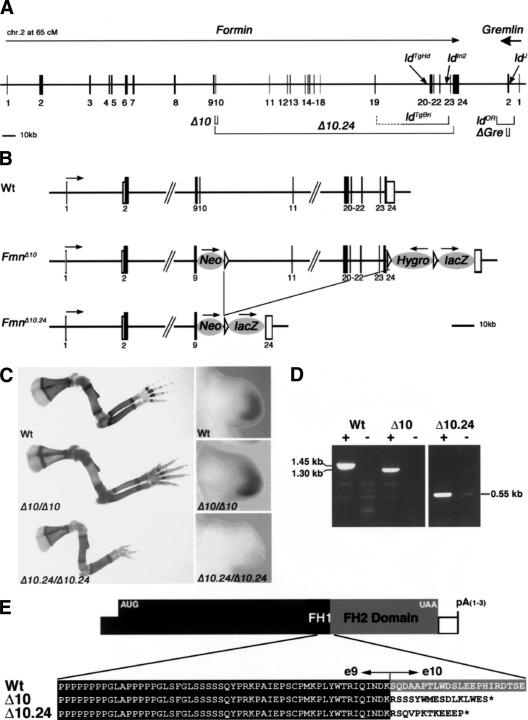
Not disruption of the Formin FH2 domain, but deletion of the corresponding genomic region causes the ld limb phenotype. (A) Schematic representation of the ld complementation group consisting of Formin and Gremlin loci. The Formin gene is encoded by at least 24 exons (transcriptional direction indicated by arrow; Wang et al. 1997), whereas the Gre gene is transcribed in reverse orientation (bold arrow) and contains only two exons. The intergenic region separating the two genes is ∼38 kb. The Formin FH2 domain is encoded by exons 10–24 and is present in all Formin protein isoforms (Wang et al. 1997). The following genetically engineered mutations are indicated: (Δ10) FmnΔ10 allele; (Δ10.24) FmnΔ10.24 allele; (ΔGre) GreΔORF null allele (Michos et al. 2004). The spontaneous ld alleles are indicated: (ldTgBri) transgene induced deletion of genomic region between exons 19 and 23 (Vogt et al. 1992); (ldTgHd) transgene insertional mutagenesis (Woychik et al. 1985); (ldIn2) 40-Mb inversion involving Formin and Agouti loci (Woychik et al. 1990); (ldOR) deletion of the Gre ORF; (ldJ) point mutation disrupting Gre pre-mRNA splicing. (B) Schematic representation of the genetically engineered FmnΔ10 and FmnΔ10.24 alleles. (Neo) PGK-NeoR gene used to select ES-cell clones (first round of gene targeting); (Hygro) PGK-HygroR gene used to select ES-cell clones (second round of gene targeting); (lacZ) IRES-LacZ gene used to tag Fmn transcripts. Arrows indicate direction of transcription. Formin exons are numbered as in A. (C, left panels) Limb skeletal phenotypes of wild-type and homozygous mice. Genotypes are indicated in the panels. (Right panels) Gremlin expression in limb buds of wild-type and homozygous embryos (E10.75). For nomenclature see the legend for A. (D) RT–PCR of Formin transcripts isolated from wild-type (Wt), FmnΔ10 (Δ10) and FmnΔ10.24 (Δ10.24) homozygous embryos. Wild-type and FmnΔ10 mRNAs extending downstream from exon 9 were detected using primers in exons 9 and 23, FmnΔ10.24 mRNAs extending downstream from exon 9 were detected using primers in exon 9 and the IRES-LacZ tag (see Materials and Methods). (+) Reverse transcriptase included; (-) reverse transcriptase omitted (control). Note that the difference in size between wild-type (Wt) and FmnΔ10 transcripts is 150 bases, as expected. (E) Amino acid sequence deduced from the sequences of the Formin transcripts arising from wild-type, FmnΔ10 and FmnΔ10.24 alleles.
Figure 3.
Figure 3.
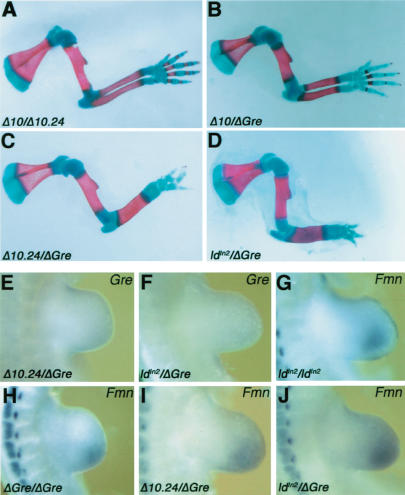
The FmnΔ10.24 and ldIn2 mutations are allelic to GreΔORF by disrupting cis regulation of Gremlin in the limb bud mesenchyme. (AD) Forelimb skeletal phenotypes of compound heterozygous mice. (E,F) Gremlin is no longer expressed in the limb bud mesenchyme of FmnΔ10.24/+; GreΔORF/+ (E) and ldIn2/+; GreΔORF/+ (F) compound heterozygous embryos. (GJ) Formin remains expressed in the limb bud mesenchyme of ldIn2/In2 (G), GreΔORF/ΔORF (H), FmnΔ10.24/+; GreΔORF/+ (I), and ldIn2/+; GreΔORF/+ (J) compound heterozygous embryos. Note: Samples GJ were pretreated prior to whole mount in situ hybridization for optimal detection of Formin transcripts in the mesenchyme. Such pretreatment results in loss of the AER. Genotypes are indicated as defined in the legend for Figure 2A.
Figure 4.
Figure 4.
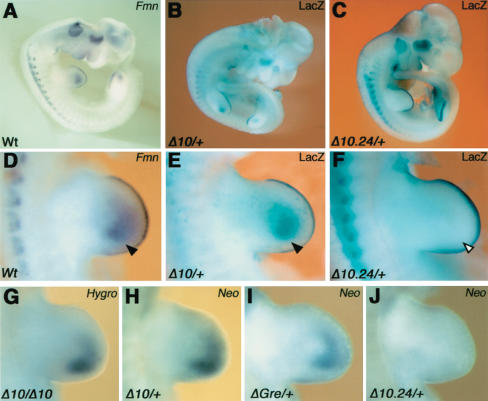
The Formin genomic region 10.24 regulates expression of endogenous and exogenous transcription units inserted into the ld locus. (A) Formin transcript distribution in a wild-type embryo around gestational day 10.5 (hemisection). (B) LacZ recapitulates the Formin transcript distribution in the FmnΔ10 allele. (C) Limb bud mesenchymal LacZ is specifically lost in the FmnΔ10.24 allele. (DF) Forelimb buds of the embryos shown in AC. Black arrowheads indicate Fmn/LacZ distribution in the mesenchyme and open arrowhead indicates the loss of LacZ in the FmnΔ10.24 allele. (GJ) Limb bud mesenchyme-specific expression of the HygroR (G) and NeoR (HJ) genes inserted into the ld locus. Genotypes are indicated as defined in the legend for Figure 2A.
Figure 5.
Figure 5.
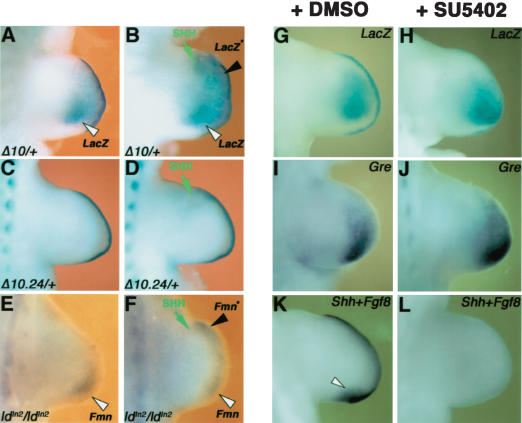
The limb bud regulatory region 10.24 is responsive to SHH signaling. SHH-expressing cells were grafted to the anterior limb bud mesenchyme (E10.25, 32–34 somites) and trunks cultured for 16–20 h prior to analysis. (A) Nongrafted limb bud of an FmnΔ10 heterozygous embryo (control). (B) Ectopic LacZ in the contralateral limb bud having received an anterior graft of SHH expressing cells. (C) Control FmnΔ10.24 heterozygous limb bud. (D) Failure to induce LacZ expression in response to SHH-expressing cells in an FmnΔ10.24 heterozygous limb bud. (E) Control limb bud of an ldIn2 homozygous embryo. (F) Induction of Fmn expression in response to ectopic SHH signaling in an ldIn2 homozygous embryo. In AF, a green arrow indicates the position of SHH expressing cells, a black arrowhead and an asterisk indicate ectopic gene expression, and an open arrowhead indicates endogenous expression. (GL) Gremlin and Formin expression are maintained in limb buds in which FGF signaling transduction has been blocked by the inhibitor SU5402. Forelimb buds of FmnΔ10/Δ10 embryos (E10.0, 29–32 somites) were cultured in the presence of 10 μM SU5402 (+SU5402; stock dissolved in DMSO) for 14–16 h prior to analysis. Controls were cultured in the presence of an equal concentration of DMSO (+DMSO; 0.03% final concentration in medium). (G) LacZ detection in an untreated limb bud. (H) LacZ remains in a limb bud cultured in the presence of SU5402. Note the down-regulation of LacZ in the AER due to flattening in the absence of FGF signal transduction. (I) Gremlin expression in an untreated limb bud. (J) Gremlin remains in a limb bud cultured in the presence of SU5402. (K) Detection of Shh (arrowhead) and Fgf8 transcripts (AER) in an untreated limb bud. (L) Loss of both Shh and Fgf8 expression in a limb bud cultured in the presence of SU5402.
Figure 7.
Figure 7.
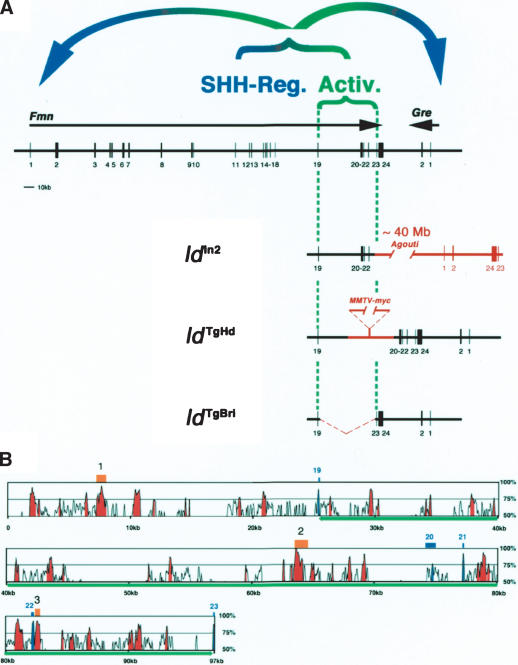
The large regulatory landscape required for activation of Gremlin expression in the limb bud mesenchyme. (A) Region 19.23 is disrupted by all relevant ld alleles. (Activ.) A global control region (GCR) located in the genomic region encompassing Formin exons 19–23 is required in cis for activation of Gremlin and Formin expression in the posterior limb bud mesenchyme. This region is disrupted in the ldIn2, ldTgHd, and ldTgBri alleles. (SHH-Reg.) The region necessary for SHH-mediated regulation of Gremlin and Formin (see Fig. 5A–F) is most likely located upstream of Formin exon 19. Schemes show how the ldIn2, ldTgHd, and ldTgBri mutations disrupt the activator GCR. (B) Alignment of the orthologous region 19.23 from the mouse and human genome using the mVISTA program (window size, 100 bases; homology threshold, 65%; Mayor et al. 2000). This alignment reveals multiple blocks of intronic sequences highly conserved between the two species. Exons 19–23 are indicated in blue and the parts of intronic sequences conserved more than 75% are marked as red peaks. The green line indicates the genomic sequences driving LacZ expression in BAC construct C (see Fig. 6C). The chicken genomic region 19.23 is only partially available, with some gaps in the regions containing the blocks of sequence conserved between mouse and human genome that precluded complete analysis. However, three regions (indicated in orange) highly conserved among all three species have been identified. Region 1 (upstream of exon 19): 77.4% identity over 243 bases. Region 2 (upstream of exon 20): 85.1% over 329 bases. Region 3 (just downstream from exon 22): 81% over 352 bases. The human, mouse, and chicken genomic sequences were obtained from the Ensembl Genome Browser (http://www.ensembl.org) using genome assembly releases v19.34b, v19.32.2, and prerelease1, respectively.
Figure 6.
Figure 6.
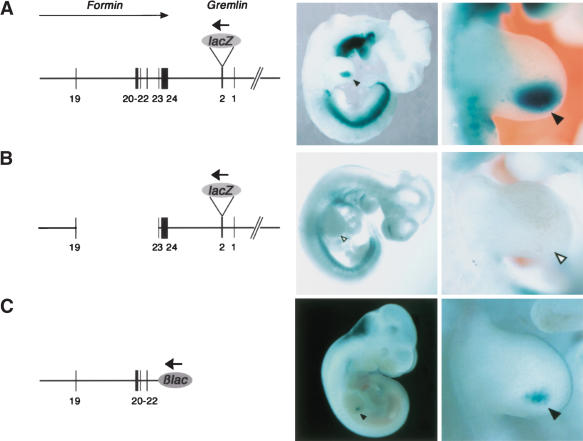
The Fmn locus encodes a regulatory region sufficient to activate Gremlin transcription in the limb bud mesenchyme. (A) Construct A was generated by in frame insertion of a LacZ gene 30 bases downstream from the Gremlin ATG (exon 2) into BAC #113H17. This BAC encodes Fmn exons 19–24, the intergenic region, entire Gremlin gene and extends ∼150 kb upstream of Gremlin exon 1. Note that Gremlin (bold arrow) is transcribed in reverse orientation to Formin (arrow). (B) Construct B was generated by deleting the genomic region delimited by exons 19–23 from construct A. (C) Construct C was generated by replacing Fmn exon 23 and all downstream sequences with the β-lac reporter gene in BAC #113H17. Note that the β-lac reporter gene inserted in construct C is transcribed like Gremlin, that is, in reverse orientation (bold arrow) to Formin; exons are numbered as in Figure 2A. For all constructs, the LacZ distribution is shown in founder embryos around gestational day 10.5. Left panels show whole embryo views and right panels show forelimb buds. Note that different embryos are shown in the left and right panels. Black arrowheads point to the LacZ expression domains in the limb bud. Open arrowheads indicate the lack of LacZ expression in the limb bud of an embryo transgenic for construct B.

References

    1. Avsian-Kretchmer O. and Hsueh, A.J. 2003. Comparative genomic analysis of the eight-membered-ring cystine-knot-containing bone morphogenetic protein (BMP) antagonists. Mol. Endocrinol. 18: 1-12. - PubMed
    1. Bacchelli C., Goodman, F.R., Scambler, P.J., and Winter, R.M. 2001. Cenani-Lenz syndrome with renal hypoplasia is not linked to FORMIN or GREMLIN. Clin. Genet. 59: 203-205. - PubMed
    1. Chao C.W., Chan, D.C., Kuo, A., and Leder, P. 1998. The mouse formin (Fmn) gene: Abundant circular RNA transcripts and gene-targeted deletion analysis. Mol. Med. 4: 614-628. - PMC - PubMed
    1. Evangelista M., Zigmond, S., and Boone, C. 2003. Formins: Signaling effectors for assembly and polarization of actin filaments. J. Cell Sci. 116: 2603-2611. - PubMed
    1. Faustino N.A. and Cooper, T.A. 2003. Pre-mRNA splicing and human disease. Genes & Dev. 17: 419-437. - PubMed

Publication types

MeSH terms