. 2004 Jul;16(7):1883-97.
doi: 10.1105/tpc.021923. Epub 2004 Jun 18.

Arabidopsis ETA2, an apparent ortholog of the human cullin-interacting protein CAND1, is required for auxin responses mediated by the SCF(TIR1) ubiquitin ligase

Affiliations

Arabidopsis ETA2, an apparent ortholog of the human cullin-interacting protein CAND1, is required for auxin responses mediated by the SCF(TIR1) ubiquitin ligase

Huey-wen Chuang et al. Plant Cell. 2004 Jul.

Abstract

Auxin response in Arabidopsis thaliana requires the SCF(TIR1) ubiquitin ligase. In response to the hormone, SCF(TIR1) targets members of the auxin/indoleacetic acid (Aux/IAA) family of transcriptional regulators for ubiquitin-mediated proteolysis. To identify additional regulators of SCF(TIR1) activity, we conducted a genetic screen to isolate enhancers of the tir1-1 auxin response defect. Here, we report our analysis of the eta2 mutant. Mutations in ETA2 confer several phenotypes consistent with reduced auxin response. ETA2 encodes the Arabidopsis ortholog of human Cullin Associated and Neddylation-Dissociated (CAND1)/TIP120A, a protein recently identified as a cullin-interacting factor. Previous biochemical studies of CAND1 have suggested that it specifically binds to unmodified CUL1 to negatively regulate SCF assembly. By contrast, we find that ETA2 positively regulates SCF(TIR1) because Aux/IAA protein stability is significantly increased in eta2 mutants. Modification of CUL1 by the RUB1/NEDD8 ubiquitin-like protein has been proposed to free CUL1 from CAND1 and promote SCF assembly. We present double mutant analyses of eta2 axr1 plants indicating that liberating CUL1 from ETA2/CAND1 is not the primary role of the RUB modification pathway in the regulation of SCF activity. Our genetic and molecular analysis of SCF(TIR1) function in eta2 mutants provides novel insight into the role of CAND1 in the regulation of SCF ubiquitin-ligase activity.


Figures
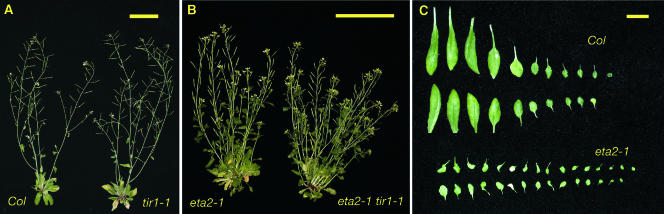
Figure 1.
Figure 1.
The Arabidopsis eta2-1 Mutant. (A) and (B) Adult phenotype of Col, tir1-1, eta2-1, and eta2-1 tir1-1 plants. Bars = 5 cm. (C) Rosette leaves from 30-d-old Col and eta2-1 plants. Bar = 1 cm.
Figure 2.
Figure 2.
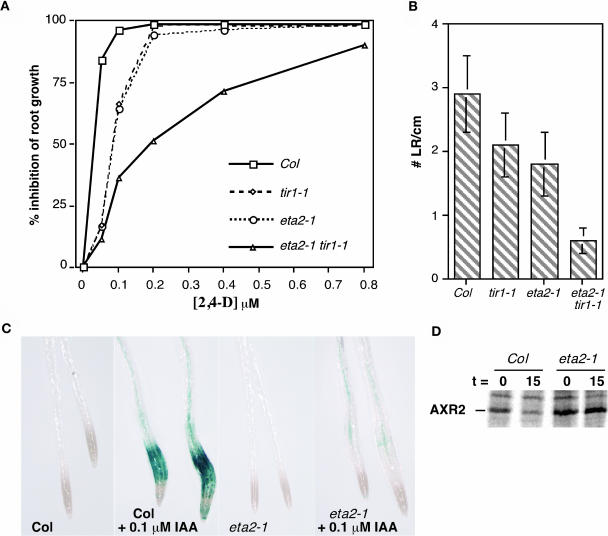
eta2-1 Exhibits Reduced Auxin Response. (A) Inhibition of root elongation by increasing concentrations of the synthetic auxin 2,4-D. Seedlings were grown for 4 d on unsupplemented media and then transferred to media containing 2,4-D and grown an additional 4 d. Data points are from the averages of 12 seedlings, and standard deviations for all data points were <10% of the mean. (B) Lateral root (LR) initiation was assessed in 10-d-old seedlings grown on unsupplemented nutrient medium (n = 12). (C) Transgenic Col and eta2-1 seedlings carrying the PS-IAA4/5-GUS reporter BA3. Eight-day-old seedlings were induced with 0.1 μM IAA for 12 h before histochemical staining. (D) AXR2 pulse-chase assay. AXR2 protein was immunoprecipitated from 7-d-old wild-type (Col) or eta2-1 seedlings labeled with 35S-Met. Precipitations were performed immediately after labeling (t = 0) or after a 15-min chase with medium containing unlabeled Met and cycloheximide (t = 15).
Figure 3.
Figure 3.
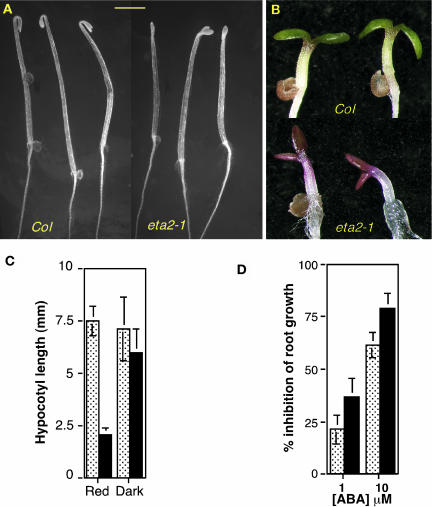
Additional Phenotypes Associated with eta2-1. (A) Four-day-old dark-grown Col and eta2-1 seedlings. Bar = 2 mm. (B) Four-day-old light-grown Col and eta2-1 seedlings. (C) Hypocotyl lengths of 4-d-old Col (speckled bars) and eta2-1 (black bars) seedlings grown under 10 μM/m2/s constant red light or total darkness. (D) Root growth assay on medium containing abscisic acid. Five-day-old Col (speckled) and eta2-1 (black) seedlings were transferred to media containing 0, 1, or 10 μM abscisic acid and grown for an additional 5 d. Error bars in (C) and (D) indicate standard deviation from the mean.
Figure 4.
Figure 4.
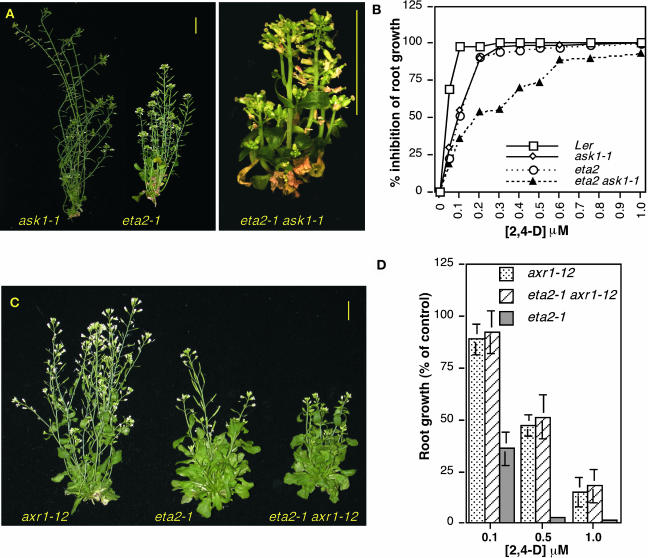
Genetic Interactions with ask1-1 and axr1-12. (A) Adult phenotypes of ask1-1, eta2-1, and eta2-1 ask1-1 double mutants. (B) Root growth assay on medium containing the synthetic auxin 2,4-D. Standard deviations for all data points were ≤10% of the mean. (C) Adult phenotypes of axr1-12, eta2-1, and double mutant plants. Bars in (A) and (C) = 1 cm. (D) Inhibition of root growth by 2,4-D. Root growth assays shown in (B) and (D) were performed by transferring 4-d-old seedlings to media containing 2,4-D and measuring root growth after an additional 4 d. Error bars indicate standard deviation from the mean (n = 12).
Figure 5.
Figure 5.
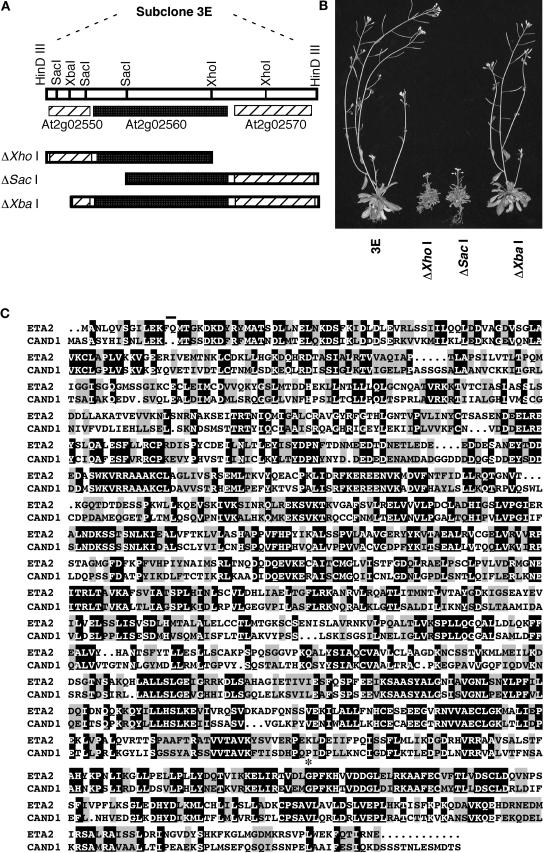
ETA2 Encodes CAND1. (A) Restriction map of the complementing 3E subclone from BAC T8K22. The positions of the three genes contained in this subclone are indicated as well as the deletion derivatives used in the complementation analysis. (B) eta2-1 plants transformed with the various subclones. (C) Sequence alignment of the ETA2 (At2g02560) and human CAND1 proteins. Amino acids 13 and 14 of the ETA2 sequence, which were missing from some of our ETA2 cDNA clones, have a line above them. The site of the eta2-1 Gly → Asp missense mutation is indicated by an asterisk.
Figure 6.
Figure 6.
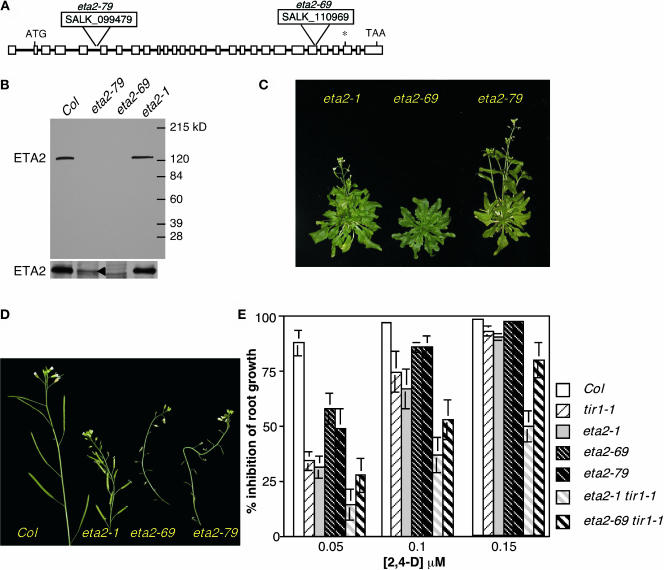
Analysis of T-DNA Alleles of ETA2. (A) Position of the SALK_099479 and SALK_110969 T-DNA insertions within the ETA2 gene. Exons are indicated as boxes, and introns are indicated by lines. The asterisk indicates the position of the eta2-1 mutation. (B) α-ETA2 protein gel blot analysis of floral extracts. Bottom panel shows a longer exposure of the region containing the ETA2 protein. A small amount of ETA2 is detectable in eta2-79 extracts (arrowhead). (C) Thirty-eight-day-old eta2-1, eta2-69, and eta2-79 plants. (D) Influorescences of wild-type and eta2 mutant plants. (E) Inhibition of root growth by the synthetic auxin 2,4-D. Four-day-old seedlings were transferred to media containing 2,4-D and grown an additional 4 d.
Figure 7.
Figure 7.
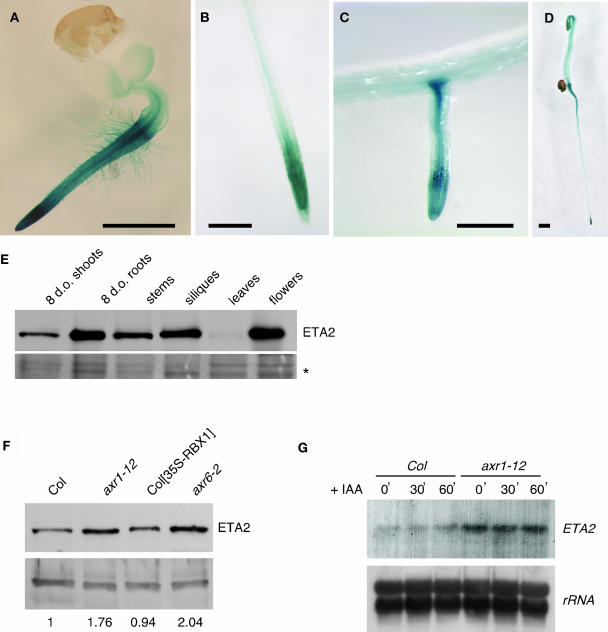
Analysis of ETA2 Expression. (A) to (D) Col seedlings carrying a PETA2-GUS reporter gene. Bars = 1 mm. (A) Three-day-old seedling. (B) Root tip of a 10-d-old seedling. (C) Lateral root from a 10-d-old seedling. (D) Four-day-old dark-grown seedling. (E) α-ETA2 protein gel blot with 25 μg of crude extracts prepared from the indicated tissues. A portion of the Ponceau S-stained blot is shown as a loading control (asterisk). (F) α-ETA2 protein gel blot of 6-d-old cotyledon extracts prepared from different genetic backgrounds. Band in the bottom panel is a cross-reacting protein used as a loading control. The relative abundance of ETA2 to the cross-reacting protein is indicated below the lanes. (G) ETA2 RNA gel blot of Col and axr1-12 seedlings treated with 10 μM IAA for 0, 30, or 60 min.
Figure 8.
Figure 8.
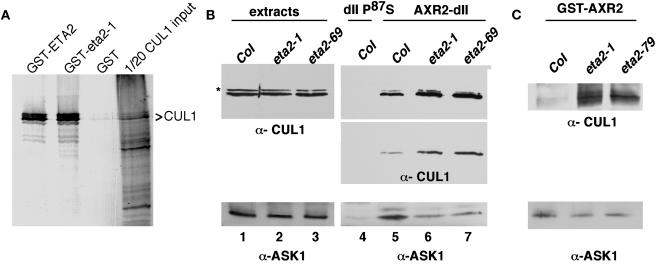
ETA2 Interacts with CUL1 and Modulates SCF Assembly. (A) One microgram of GST, GST-ETA2, or a GST-eta2-1 fusion protein was added to a reticulocyte lysate expressing CUL1. 35S-labeled CUL1 was visualized by autoradiography. (B) AXR2-dII pull-down assay. One microgram of a 6xHis fusion protein containing the AXR2 domain II degron (amino acids 71 to 100) was incubated with, and subsequently purified from, 2 mg of 7-d-old seedling extracts supplemented with 50 μM IAA. A derivative containing the axr2-1 mutation (dII-P87S), which abolishes TIR1 binding, was used as a negative control. Pull downs were immunoblotted with antisera against CUL1 and ASK1. The top two panels are different exposures of the same α-CUL1 blot. CUL1-RUB is indicated with an asterisk. (C) GST-AXR2 pull-down assay as in (B), with the exception that a full-length GST-AXR2 fusion protein was used as the bait.

References

    1. Alonso, J.M., et al. (2003). Genome-wide insertional mutagenesis of Arabidopsis thaliana. Science 301, 653–657. - PubMed
    1. Cope, G.A., and Deshaies, R.J. (2003). COP9 signalosome: A multifunctional regulator of SCF and other cullin-based ubiquitin ligases. Cell 114, 663–671. - PubMed
    1. Cope, G.A., Suh, G.S., Aravind, L., Schwarz, S.E., Zipursky, S.L., Koonin, E.V., and Deshaies, R.J. (2002). Role of predicted metalloprotease motif of Jab1/Csn5 in cleavage of Nedd8 from Cul1. Science 298, 608–611. - PubMed
    1. del Pozo, J.C., Dharmasiri, S., Hellmann, H., Walker, L., Gray, W.M., and Estelle, M. (2002). AXR1-ECR1-dependent conjugation of RUB1 to the Arabidopsis cullin AtCUL1 is required for auxin response. Plant Cell 14, 421–433. - PMC - PubMed
    1. del Pozo, J.C., and Estelle, M. (1999). The Arabidopsis cullin AtCUL1 is modified by the ubiquitin-related protein RUB1. Proc. Natl. Acad. Sci. USA 96, 15342–15347. - PMC - PubMed

Publication types

MeSH terms