. 2004 Jun 29;101(26):9792-7.
doi: 10.1073/pnas.0403423101. Epub 2004 Jun 21.

Identification of tandem duplicate regulatory small RNAs in Pseudomonas aeruginosa involved in iron homeostasis

Affiliations

Identification of tandem duplicate regulatory small RNAs in Pseudomonas aeruginosa involved in iron homeostasis

Paula J Wilderman et al. Proc Natl Acad Sci U S A. .

Abstract

In many bacteria, iron homeostasis is controlled primarily by the ferric uptake regulator (Fur), a transcriptional repressor. However, some genes, including those involved in iron storage, are positively regulated by Fur. A Fur-repressed regulatory small RNA (sRNA), RyhB, has been identified in Escherichia coli, and it has been demonstrated that negative regulation of genes by this sRNA is responsible for the positive regulation of some genes by Fur. No RyhB sequence homologs were found in Pseudomonas aeruginosa, despite the identification of genes positively regulated by its Fur homolog. A bioinformatics approach identified two tandem sRNAs in P. aeruginosa that were candidates for functional homologs of RyhB. These sRNAs (PrrF1 and PrrF2) are >95% identical to each other, and a functional Fur box precedes each. Their expression is induced under iron limitation. Deletion of both sRNAs is required to affect the iron-dependent regulation of an array of genes, including those involved in resistance to oxidative stress, iron storage, and intermediary metabolism. As in E. coli, induction of the PrrF sRNAs leads to the rapid loss of mRNAs for sodB (superoxide dismutase), sdh (succinate dehydrogenase), and a gene encoding a bacterioferritin. Thus, the PrrF sRNAs are the functional homologs of RyhB sRNA. At least one gene, bfrB, is positively regulated by Fur and Fe(2+), even in the absence of the PrrF sRNAs. This work suggests that the role of sRNAs in bacterial iron homeostasis may be broad, and approaches similar to those described here may identify these sRNAs in other organisms.


Figures
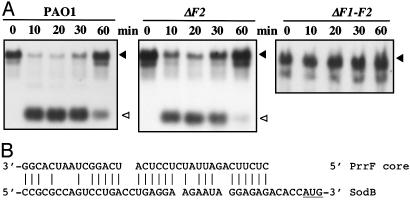
Fig. 3.
Fig. 3.
Regulation of sodB by PrrF sRNAs. (A) PAO1, ΔprrF2 (ΔF2), and ΔprrF1-F2F1-F2) were grown in LB and 2,2′-dipyridyl added to a final concentration of 300 μM; samples were taken at the times indicated and probed for sodB transcripts as described in Materials and Methods. ▴, sodB transcript; ▵, PrrF. (B) A possible pairing of the PrrF core sequence to the sodB ribosome-binding site is shown. The starting AUG is underlined.
Fig. 1.
Fig. 1.
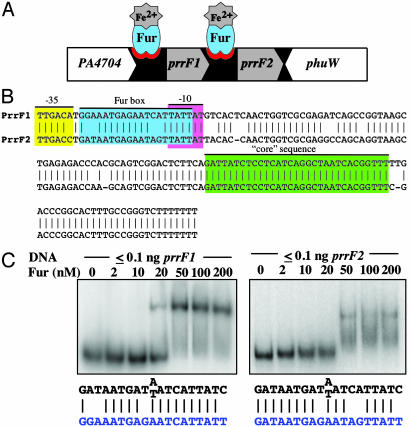
Genetic organization of Prrf sRNAs. (A) Genetic organization of the locus encoding prrF1 and prrF2 showing the Fur-binding sites. The arrow indicates gene orientation. (B) Alignment of the prrF1 and prrF2 including promoters. The Fur-binding site is in blue. Sequence conserved in all Pseudomonas PrrF sequences identified thus far is in green. The predicted -35 and -10 regions are indicated in yellow and pink, respectively. (C) Gel mobility-shift assays were performed as described in Materials and Methods. Consensus binding sites for Fur are shown in black, and the Fur box present in the PrrF sequence is shown in blue.
Fig. 2.
Fig. 2.
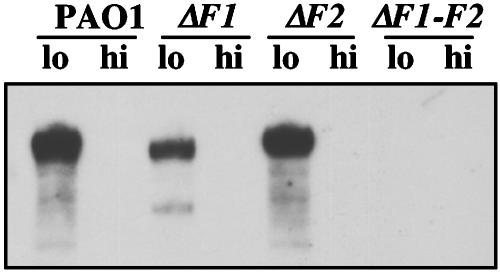
Northern blotting of PAO1 ΔprrF1F1), ΔprrF2F2), and ΔprrF1-F2F1-F2). Cells were grown overnight in dialyzed tryptic soy broth in the presence or absence of added FeCl3 (50 μg/ml). RNA was isolated and probed for PrrF1-F2 sequences. Probe sequences are given in Materials and Methods.
Fig. 4.
Fig. 4.
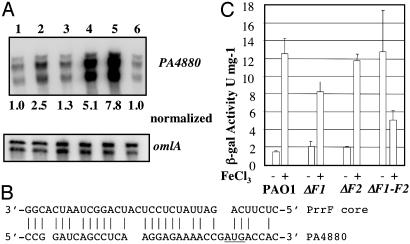
Regulation of PA4880 by Prrf sRNAs. (A) RNase protection assay. PAO1 was grown in dialyzed tryptic soy broth without added FeCl3. PA4880 transcript levels were measured in RNA from PAO1 (lane 1), ΔprrF1 (lane 2), ΔprrF2 (lane 3), ΔprrF1-F2 (lane 4), ΔprrF1-F2, pVLT (lane 5), and ΔprrF1-F2, pVLT-prrF1-F2 (lane 6). Additionally, the presence of transcripts from omlA, a constitutively expressed gene, was analyzed to verify the integrity of the RNA sample. Numbers given as normalized values are from comparison with omlA. (B) Possible complementarity between core sequence of PrrF RNAs and the ribosome-binding-site region of PA4880. (C) β-galactosidase assays in strains containing pPZ-PA4880. PAO1, ΔprrF1F1), ΔprrF2F2), and ΔprrF1-F2F1-F2) strains were grown in 0 and 300 μM FeCl3 and analyzed for β-galactosidase activity. The data represent the mean ± SE of three different experiments.
Fig. 5.
Fig. 5.
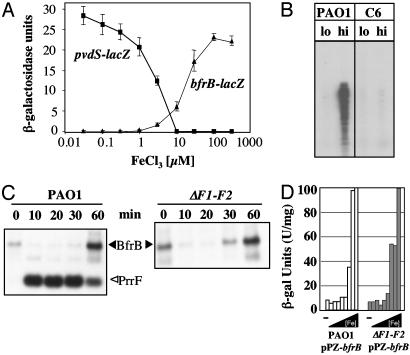
Regulation of bfrB. (A) P. aeruginosa PAO1 expressing pvdS-lacZ or bfrB-lacZ was cultured for 12 h in dialyzed tryptic soy broth supplemented with various concentrations (0-300 μM) of iron. Protein extracts were collected, and β-galactosidase activity was measured. (B) RNase protection assay. PAO1 and the C6 fur- mutant were grown in iron-limiting and iron-replete media. RNA was isolated and probed with a bfrB-specific probe. (C) Northern blot for BfrB and PrrF RNA isolated from PAO1 and ΔF1-F2 after addition of 2,2′-dipyridyl as for Fig. 3. (D) P. aeruginosa PAO1 (white) and ΔF1-F2 (gray) containing pPZ-bfrB (BfrB::LacZ translational fusion) were grown in various concentrations of iron (0-300 μM) and analyzed for β-galactosidase activity.

References

    1. Touati, D. (2000) Arch. Biochem. Biophys. 373, 1-6. - PubMed
    1. Dubrac, S. & Touati, D. (2000) J. Bacteriol. 182, 3802-3808. - PMC - PubMed
    1. Niederhoffer, E. C., Naranjo, C. M., Bradley, K. L. & Fee, J. A. (1990) J. Bacteriol. 172, 1930-1938. - PMC - PubMed
    1. Massé, E. & Gottesman, S. (2002) Proc. Natl. Acad. Sci. USA 99, 4620-4625. - PMC - PubMed
    1. Massé, E., Escorcia, F. E. & Gottesman, S. (2003) Genes Dev. 17, 2374-2383. - PMC - PubMed

Publication types

MeSH terms

Associated data