. 2004 Jul;72(7):3783-92.
doi: 10.1128/IAI.72.7.3783-3792.2004.

Isolation of a chromosomal region of Klebsiella pneumoniae associated with allantoin metabolism and liver infection

Affiliations

Isolation of a chromosomal region of Klebsiella pneumoniae associated with allantoin metabolism and liver infection

Huei-Chi Chou et al. Infect Immun. 2004 Jul.

Abstract

Klebsiella pneumoniae liver abscess with metastatic complications is an emerging infectious disease in Taiwan. To identify genes associated with liver infection, we used a DNA microarray to compare the transcriptional profiles of three strains causing liver abscess and three strains not associated with liver infection. There were 13 clones that showed higher RNA expression levels in the three liver infection strains, and 3 of these 13 clones contained a region that was absent in MGH 78578. Sequencing of the clones revealed the replacement of 149 bp of MGH 78578 with a 21,745-bp fragment in a liver infection strain, NTUH-K2044. This 21,745-bp fragment contained 19 open reading frames, 14 of which were proven to be associated with allantoin metabolism. The K2044 (DeltaallS) mutant showed a significant decrease of virulence in intragastric inoculation of BALB/c mice, and the prevalence of this chromosomal region was significantly higher in strains associated with liver abscess than in those that were not (19 or 32 versus 2 of 94; P = 0.0001 [chi(2) test]). Therefore, the 22-kb region may play a role in K. pneumoniae liver infection and serve as a marker for rapid identification.


Figures
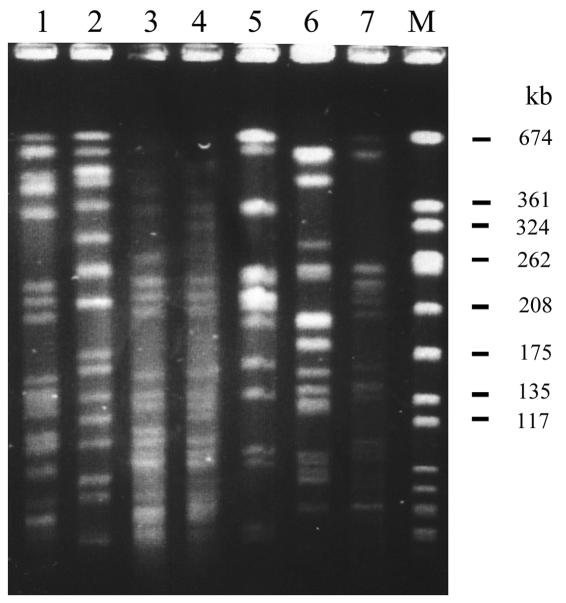
FIG. 1.
FIG. 1.
Pulsed-field gel electrophoresis of K. pneumoniae isolates digested with XbaI. Lanes 1 to 4, four liver infection strains (NTUH-K2044, A1208, A3021, and A5011, respectively). Three of these four liver infection strains (excluding A1208) were chosen for microarray hybridization. Lanes 5 to 7, three non-liver infection strains (N3423, N3529, and N5322, respectively), which were chosen for microarray hybridization. Lane M, molecular size marker.
FIG. 2.
FIG. 2.
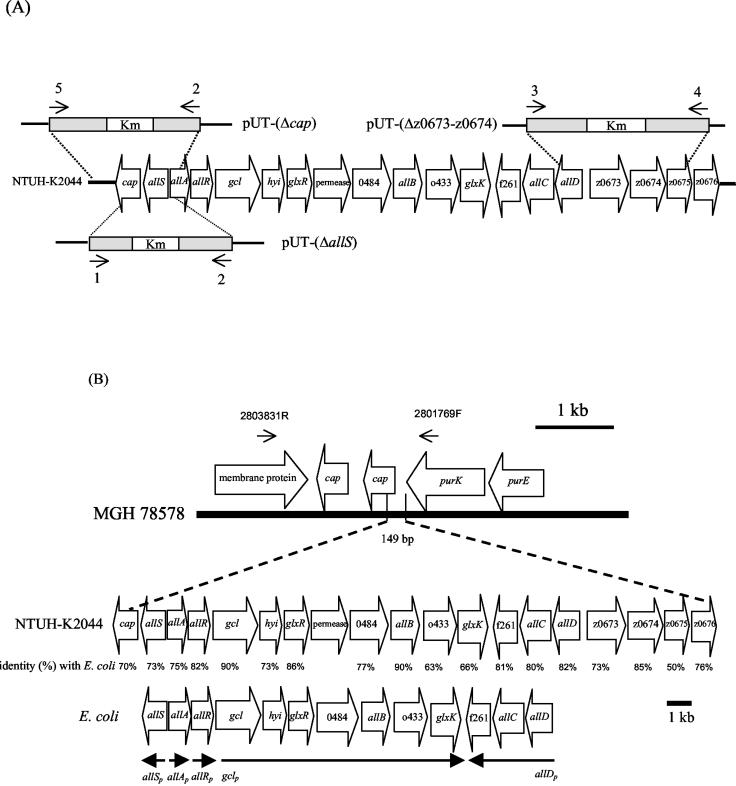
Organization of genes in the 22-kb chromosomal region. (A) Schematic diagram of deletion constructs. The primers (also shown in Table 2) are indicated by arrows: 1, 616R; 2, R1-14F; 3, E2F; 4, G2; 5, 2803749R. The deletion region was replaced with a kanamycin cassette. (B) The 149-bp chromosome in MGH 78578 was replaced by a 21,745-bp fragment in NTUH-K2044. The boldface line at the top represents a genomic fragment of MGH 78578. Alignment of the gene cluster between the 22-kb region of NTUH-K2044 and E. coli is shown, and the amino acid identity is shown below the gene. The extents and directions of the genes are indicated by open arrows, and designations are according to those proposed for E. coli (10, 35). Arrows on the top represent primer locations outside the 22-kb region for PCR confirmation of strains without a 22-kb region. The lines at the bottom show the transcriptional units in E. coli.
FIG. 3.
FIG. 3.
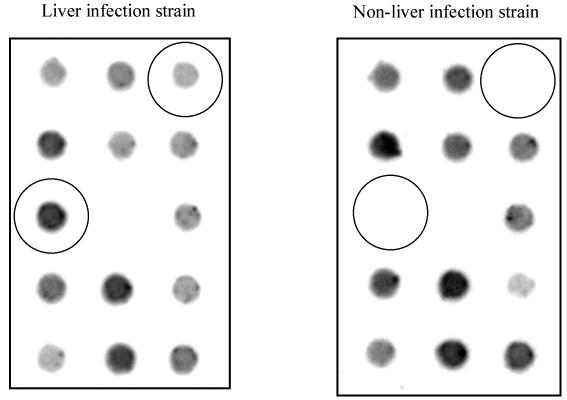
Colorimetric detection of total K. pneumoniae RNA expression on a microarray. The dots showing increased RNA expression levels in the liver infection strain are circled.
FIG. 4.
FIG. 4.
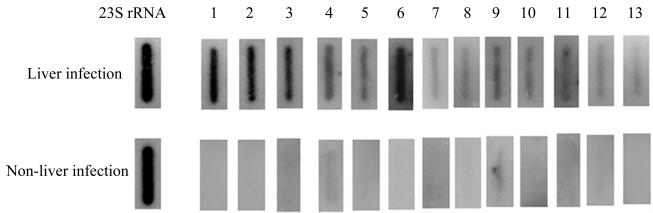
RNA expression levels of the 13 clones (Table 3) by slot blot hybridization. Blots 1 to 13, hybridization with PCR products from clones 1 to 13, respectively. Biotin-labeled cDNA probes were from either a liver infection strain or a non-liver infection strain. The 23S rRNA was used as an internal control.
FIG. 5.
FIG. 5.
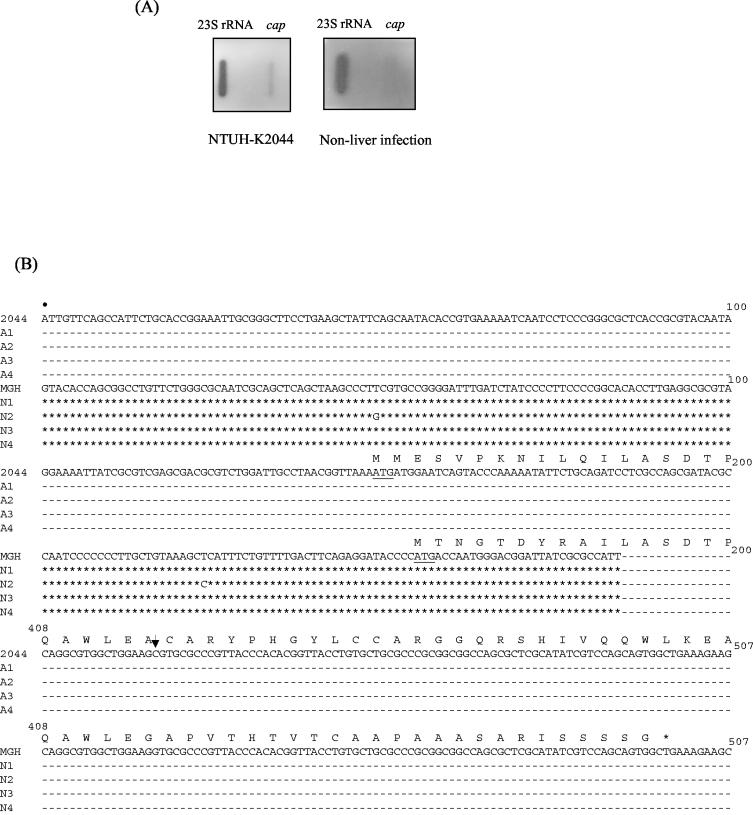
(A) RNA expression levels of cap determined by slot blot hybridization. The 23S rRNA served as an internal control. Probes were derived from NTUH-K2044 and from a non-liver infection strain. (B) Comparison of the putative promoter regions of cap in liver infection and non-liver infection strains. Dashes represent 100% sequence identity with NTUH-K2044, and asterisks represent 100% sequence identity with MGH 78578. The first nucleotide (marked by a dot) corresponds to contig 3591 nt 2362637 in MGH 78578 and nt 184 in the 22-kb fragment of NTUH-K2044. The putative start codon is underlined. Translated amino acids are shown above the DNA sequence. nt 201 to 407 are omitted because the sequences were same in all investigated strains. The arrow represents a deoxycytidine deletion in MGH 78578, and thus a stop codon (asterisk) occurred in MGH 78578. MGH, MGH 78578; N1 to N4, four non-liver infection strains; 2044, NTUH-K2044; A1 to A4, four liver infection strains.
FIG. 6.
FIG. 6.
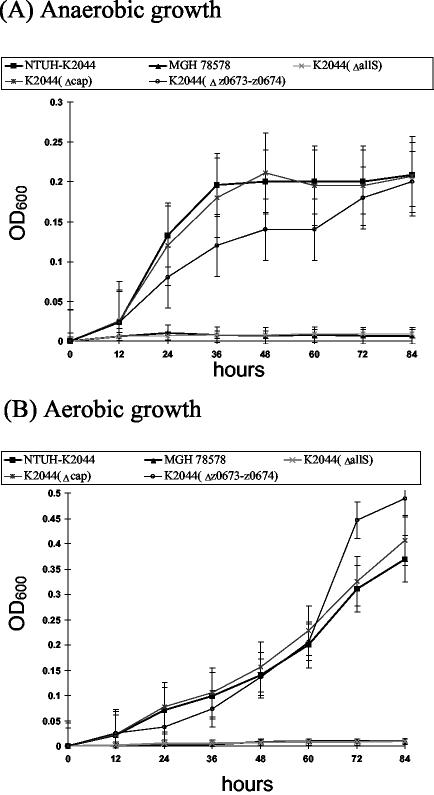
Growth study of wild-type K. pneumoniae and mutant strains in allantoin minimal medium. (A) Bacteria were grown under anaerobic conditions. (B) Bacteria were grown under aerobic conditions. The experiments were repeated three times and error bars indicate standard deviations.
FIG. 7.
FIG. 7.
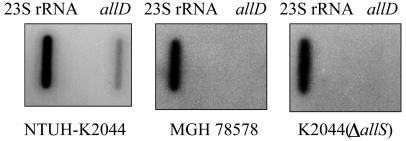
RNA expression levels of allD determined by slot blot hybridization. The 23S rRNA served as an internal control for each membrane. Probes were derived from NTUH-K2044, MHG 78578, and K2044(ΔallS).
FIG. 8.
FIG. 8.
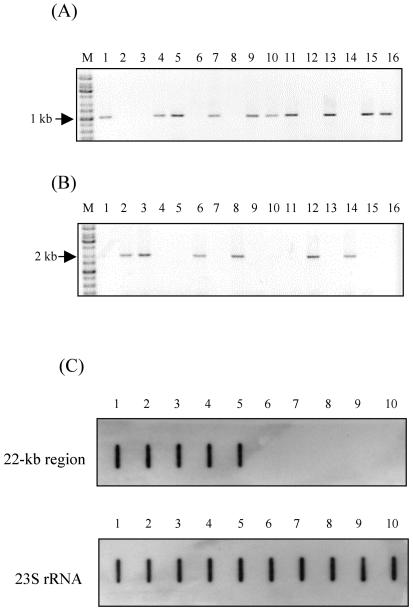
PCR and slot blot hybridization for determination of 22-kb prevalence. (A and B) The PCR was performed for 16 liver infection strains with primers included in the 22-kb region (A) or outside the 22-kb region (B). All of the PCR results that are negative in panel A are positive in panel B. Lanes M, molecular size markers. (C) Slot blot hybridization with a probe located in the 22-kb region. The 23S rRNA gene served as a control. Lanes 1 to 5, five liver infection strains; lanes 6 to 10, five non-liver infection strains.

References

    1. Abbott, S. 1999. Klebsiella, Enterobacter, Citrobacter, and Serratia. p. 475-482. In P. R. Murray, E. J. Baron, M. A. Pfaller, F. C. Tenover, and R. H. Yolken (ed.), Manual of clinical microbiology, 7th ed. American Society for Microbiology, Washington, D.C.
    1. Ang, S., C. Z. Lee, K. Peck, M. Sindici, U. Matrubutham, M. A. Gleeson, and J. T. Wang. 2001. Acid-induced gene expression in Helicobacter pylori: study in genomic scale by microarray. Infect. Immun. 69:1679-1686. - PMC - PubMed
    1. Benzie, I. F. F., Chung, W. Y., and B. Tomlinson. 1999. Simultaneous measurement of allantoin and urate in plasma: analytical evaluation and potential clinical application in oxidant:antioxidant balance studies. Clin. Chem. 45:901-904. - PubMed
    1. Boronat, A., and J. Aguilar. 1979. Rhamnose-induced propanediol oxidoreductase in Escherichia coli: purification, properties, and comparison with the fucose-induced enzyme. J. Bacteriol. 140:320-326. - PMC - PubMed
    1. Chang, S. C., C. T. Fang, P. R. Hsueh, Y. C. Chen, and K. T. Luh. 2000. Klebsiella pneumoniae isolates causing liver abscess in Taiwan. Diagn. Microbiol. Infect. Dis. 37:279-284. - PubMed

Publication types

LinkOut - more resources