


Identification of the Entamoeba histolytica galactose-inhibitable lectin epitopes recognized by human immunoglobulin A antibodies following cure of amebic liver abscess
- PMID: 15213142
- PMCID: PMC427464
- DOI: 10.1128/IAI.72.7.3974-3980.2004
Identification of the Entamoeba histolytica galactose-inhibitable lectin epitopes recognized by human immunoglobulin A antibodies following cure of amebic liver abscess
Abstract
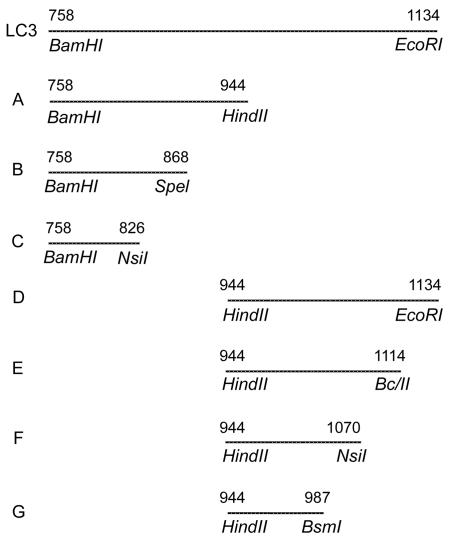
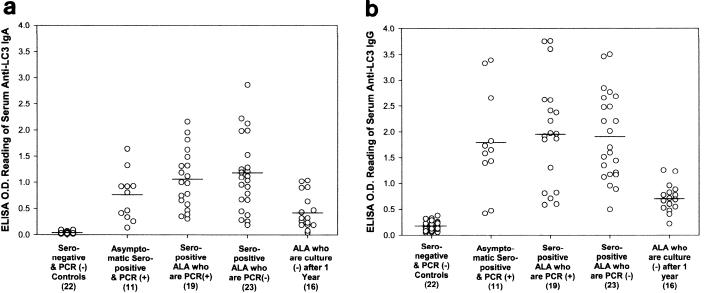
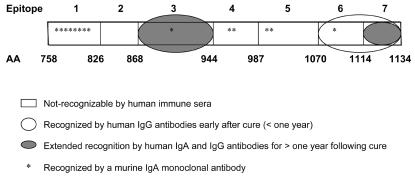
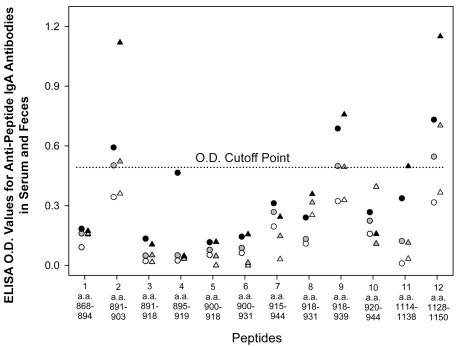
Immunity to Entamoeba species intestinal infection is associated with the presence of intestinal IgA antibodies against the parasite's galactose-inhibitable adherence lectin. We determined the epitope specificity of serum and intestinal antilectin IgA antibodies by enzyme-linked immunosorbent assay using overlapping fragments of a recombinant portion of the lectin heavy subunit, designated LC3. These findings were correlated with the effects of epitope-specific murine antilectin immunoglobulin A (IgA) monoclonal antibodies (MAbs) on amebic in vitro galactose-specific adherence. LC3 is a highly antigenic and immunogenic cysteine-rich protein (amino acids [aa] 758 to 1150) that includes the lectin's carbohydrate binding domain. The study subjects, from Durban, South Africa, were recently cured of amebic liver abscess (ALA) with or without concurrent Entamoeba histolytica intestinal infection or were infection free 1 year after cure. We also studied seropositive subjects that were infected with E. histolytica, disease free, and asymptomatic. Serum anti-LC3 IgA antibodies from all study groups exclusively recognized the third (aa 868 to 944) and the seventh (aa 1114 to 1134) LC3 epitopes regardless of clinical status; epitope 6 (aa 1070 to 1114) was also recognized by serum anti-LC3 IgG antibodies. However, IgG antibody recognition of epitope 6 but not 3 or 7 was lost 1 year following cure of ALA. We produced 14 murine anti-LC3 IgA MAbs which collectively recognized five of the seven LC3 epitopes. The majority of the murine MAbs recognized the first epitope (aa 758 to 826), which was not recognized by human IgA antibodies. Interestingly, adherence of E. histolytica trophozoites to CHO cells was inhibited by MAbs against epitopes 1, 3, 4 (aa 944 to 987), and 6 (P < 0.01). The LC3 epitopes recognized by human IgA antibodies (3 and 7) were further characterized by use of overlapping synthetic peptides. We identified four peptides (aa 891 to 903, 918 to 936, 1114 to 1134, and 1128 to 1150) that in linear or cyclized form were recognized by pooled intestinal IgA antibodies and serum IgG antibodies from subjects with ALA and asymptomatic, seropositive infected subjects. This study identifies the lectin epitopes to be studied in an amebiasis subunit vaccine designed to elicit mucosal immunity mimicking that of humans cured of ALA.
Figures
References
-
- Abd-Alla, M. D., and J. I. Ravdin. 2004. Mucosal immune response to parasitic infections p. 2096-2099. In J. Mestecky (ed.), Mucosal immunology, 3rd ed. Elsevier, London, United Kingdom.
-
- Abd-Alla, M. D., A. A. Wahib, and J. I. Ravdin. 2000. Comparison of antigen capture ELISA to stool culture in detection for asymptomatic Entamoeba species infection in Kafer Daoud, Egypt. Am. J. Trop. Med. Hyg. 65:579-582. - PubMed
-
- Abd-Alla, M. D., and J. I. Ravdin. 2002. Diagnosis of amebic colitis by antigen capture ELISA in patients presenting with acute amebic diarrhea in Cairo, Egypt. Trop. Med. Intern. Health 7:365-370. - PubMed
-
- Abou-E1-Magd, I., C. J. Soong, A. M. El-Hawey, and J. I. Ravdin. 1996. Humoral and mucosal IgA antibody response to a recombinant 52-kDa cysteine-rich portion of the Entamoeba histolytica galactose-inhibitable lectin correlates with detection of native 170-kDa lectin antigen in serum of patients with amebic colitis. J. Infect. Dis. 174:157-162. - PubMed
-
- Atherton, E., H. Fox, C. Harkiss, R. C. Sheppard, and J. Williams. 1978. A mild procedure for solid phase peptide synthesis: use of fluorenylmerhoxy carbonyl amino acids. J. Chem. Soc. Chem. Commun. 13:537-543.
Publication types
MeSH terms
Substances
Grants and funding
LinkOut - more resources
Full Text Sources
Other Literature Sources
Miscellaneous
