. 2004 Jul;72(7):4081-9.
doi: 10.1128/IAI.72.7.4081-4089.2004.

Inducible nitric oxide synthase is not essential for control of Trypanosoma cruzi infection in mice

Affiliations

Inducible nitric oxide synthase is not essential for control of Trypanosoma cruzi infection in mice

Kara L Cummings et al. Infect Immun. 2004 Jul.

Abstract

Immune control of many intracellular pathogens, including Trypanosoma cruzi, is reported to be dependent on the production of nitric oxide. In this study, we show that mice deficient in inducible nitric oxide synthase (iNOS or NOS2) exhibit resistance to T. cruzi infection that is comparable to that of wild-type mice. This is the case for two iNOS-deficient mouse strains, Nos2(tm1Lau) and Nos2 N5, infected with the Brazil or Tulahuen strain of T. cruzi. In all cases, blood parasitemia, tissue parasite load, and survival rates are similar between wild-type and iNOS-deficient mice. In contrast, both wild-type and Nos2(tm1Lau) mice died within 32 days postinfection when treated with the nitric oxide synthase inhibitor aminoguanidine. Increased transcription of NOS1 or NOS3 is not found in iNOS-knockout (KO) mice, indicating that the absence of nitric oxide production through iNOS is not compensated for by increased production of other NOS isoforms. However, Nos2(tm1Lau) mice exhibit enhanced expression of tumor necrosis factor alpha, interleukin-1, and macrophage inflammatory protein 1alpha compared to that of wild-type mice, and these alterations may in part compensate for the lack of iNOS. These results clearly show that iNOS is not required for control of T. cruzi infection in mice.


Figures
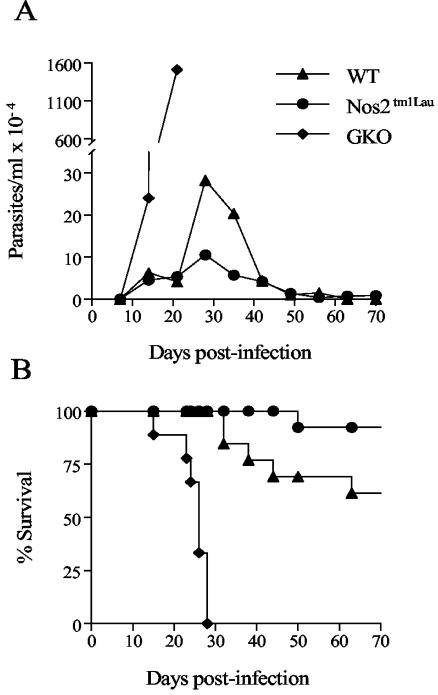
FIG. 1.
FIG. 1.
Parasitemia and survival of Nos2tm1Lau mice infected with T. cruzi. C57BL/6J (WT), Nos2tm1Lau, and GKO mice were infected with 103 BFT of the Brazil strain of T. cruzi, and parasitemia (A) and survival (B) were observed. Results were pooled from three experiments with a total of 15 to 20 mice per group.
FIG. 2.
FIG. 2.
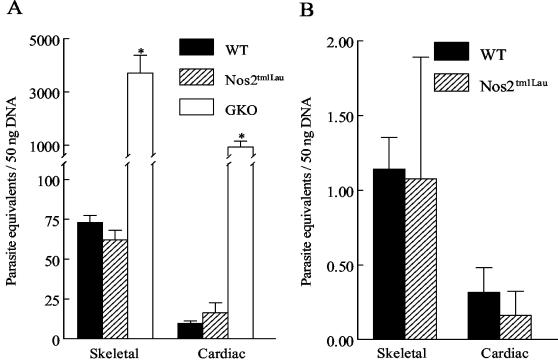
Tissue parasite burden of Nos2tm1Lau mice infected with T. cruzi. C57BL/6J (WT), Nos2tm1Lau, and GKO mice were infected with 103 BFT of the Brazil strain of T. cruzi. Tissue parasite burden was determined as stated in Materials and Methods at 28 (A) and 150 (B) dpi. *, P < 0.05.
FIG. 3.
FIG. 3.
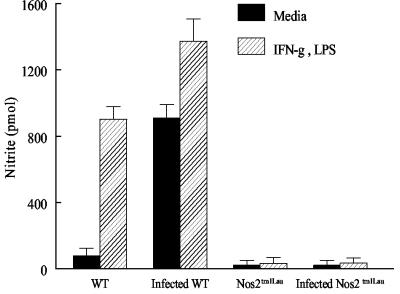
NO is not produced by stimulated cells from infected iNOS-KO mice. Peritoneal exudate cells from naïve and infected (108 dpi) C57BL/6J (WT) and Nos2tm1Lau mice were cultured in medium alone or medium containing 100 U of IFN-γ/ml and 10 ng of LPS/ml. After 48 h supernatants were collected and assayed for nitrite levels with the Griess reaction.
FIG. 4.
FIG. 4.
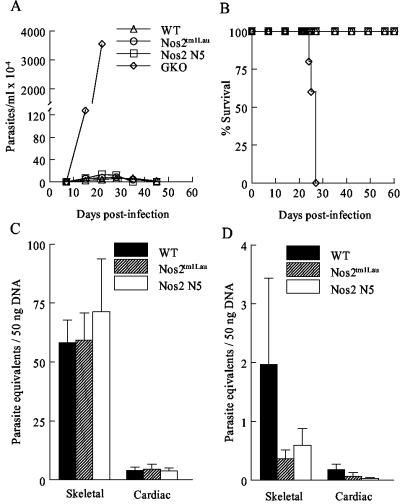
Response of Nos2 N5 mice to T. cruzi infection. C57BL/6J (WT), Nos2tm1Lau, Nos2 N5, and GKO mice were infected with 104 BFT of the Brazil strain of T. cruzi, and the parasitemia (A) and survival (B) were observed. Tissue parasite burden was determined as stated in Materials and Methods at 28 (C) and 150 (D) dpi. *, P < 0.05.
FIG. 5.
FIG. 5.
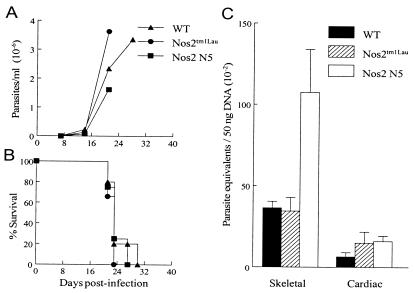
Response of iNOS-KO mice to the Tulahuen strain of T. cruzi. C57BL/6J (WT), Nos2tm1Lau, and Nos2 N5 mice were infected with 15 BFT of the Tulahuen strain of T. cruzi, and parasitemia (A) and survival (B) were observed. Tissue parasite burden (C) was determined as stated in Materials and Methods at 21 dpi.
FIG. 6.
FIG. 6.
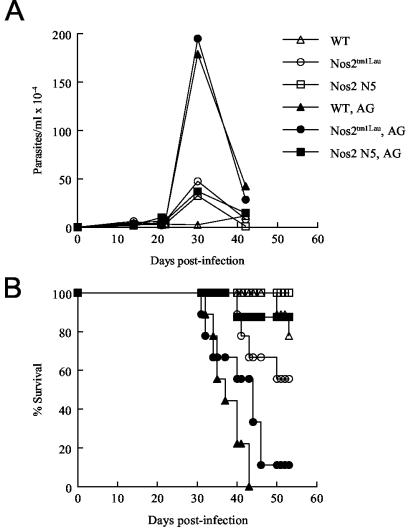
Treatment of infected iNOS-KO mice with an NOS inhibitor. C57BL/6J (WT), Nos2tm1Lau, and Nos2 N5 mice were infected with 103 BFT of the Brazil strain of T. cruzi. Two days after infection drinking water with 1% AG (filled symbols) was administered. Parasitemia (A) and survival (B) were monitored.
FIG. 7.
FIG. 7.
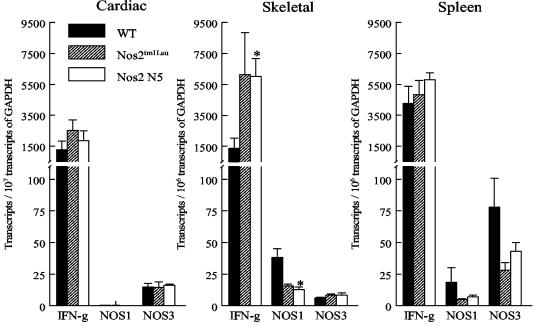
iNOS-KO mice do not compensate by increasing NOS1 or NOS3 expression. C57BL/6J (WT), Nos2tm1Lau, and Nos2 N5 mice were infected with 103 BFT of the Brazil strain of T. cruzi. At 21 dpi, RNAs from cardiac muscle, skeletal muscle, and spleen were extracted, and first-strand cDNA was synthesized. IFN-γ, nNOS, eNOS, and GAPDH transcript levels were quantified by real-time PCR. *, P < 0.05.
FIG. 8.
FIG. 8.
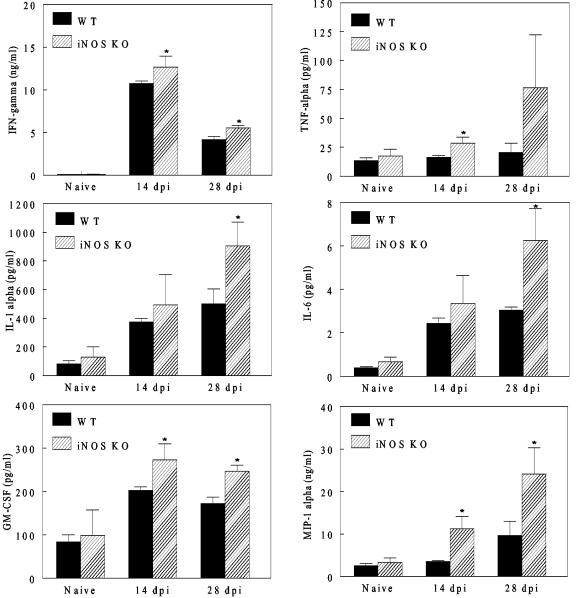
Increased cytokine production by cells from iNOS-KO mice upon stimulation with T. cruzi lysate. C57BL/6J (WT) and Nos2tm1Lau mice were infected with 103 BFT of the Brazil strain of T. cruzi. At 14 and 28 dpi splenocytes were harvested and stimulated with medium, T. cruzi-specific peptides, or T. cruzi lysate. Culture supernatants were assayed in triplicate for cytokines with a Bio-Plex cytokine assay. * (P < 0.05) designates a significant increase in cytokine production by Nos2tm1Lau cells relative to WT cells.

References

    1. Abrahamsohn, I. A., and R. L. Coffman. 1995. Cytokine and nitric oxide regulation of the immunosuppression in Trypanosoma cruzi infection. J. Immunol. 155:3955-3963. - PubMed
    1. Adams, L. B., J. B. Hibbs, Jr., R. R. Taintor, and J. L. Krahenbuhl. 1990. Microbiostatic effect of murine-activated macrophages for Toxoplasma gondii. Role for synthesis of inorganic nitrogen oxides from l-arginine. J. Immunol. 144:2725-2729. - PubMed
    1. Alderton, W. K., C. E. Cooper, and R. G. Knowles. 2001. Nitric oxide synthases: structure, function and inhibition. Biochem. J. 357:593-615. - PMC - PubMed
    1. Aliberti, J. C., J. T. Souto, A. P. Marino, J. Lannes-Vieira, M. M. Teixeira, J. Farber, R. T. Gazzinelli, and J. S. Silva. 2001. Modulation of chemokine production and inflammatory responses in interferon-gamma- and tumor necrosis factor-R1-deficient mice during Trypanosoma cruzi infection. Am. J. Pathol. 158:1433-1440. - PMC - PubMed
    1. Barna, M., T. Komatsu, and C. S. Reiss. 1996. Activation of type III nitric oxide synthase in astrocytes following a neurotropic viral infection. Virology 223:331-343. - PubMed

Publication types