. 2004 Jul;72(7):4217-23.
doi: 10.1128/IAI.72.7.4217-4223.2004.

NadA diversity and carriage in Neisseria meningitidis

Affiliations

NadA diversity and carriage in Neisseria meningitidis

Maurizio Comanducci et al. Infect Immun. 2004 Jul.

Abstract

NadA is a novel vaccine candidate recently identified in Neisseria meningitidis and involved in adhesion to host tissues. The nadA gene has been found in approximately 50% of the strains isolated from patients and in three of the four hypervirulent lineages of non-serogroup A strains. Here we investigated the presence of the nadA gene in 154 meningococcal strains isolated from healthy people (carrier strains). Only 25 (16.2%) of the 154 carrier isolates harbored the nadA gene. The commensal species Neisseria lactamica was also found not to have the nadA gene. Eighteen of the carrier strains belonged to the ET-5 and ET-37 hypervirulent clusters, indicating that only the 5.1% of the genuine carrier population actually harbored nadA (7 of 136 strains). Five of the seven strains harbored a novel allele of the nadA gene that was designated nadA4. The NadA4 protein was present on the bacterial surface as heat-stable high-molecular-weight oligomers. Antibodies against the recombinant NadA4 protein were bactericidal against homologous strains, whereas the activity against other NadA alleles was weak. In conclusion, the nadA gene segregates differently in the population of strains isolated from healthy individuals and in the population of strains isolated from patients. The presence of NadA can therefore be used as a tool to study the dynamics of meningococcal infections and understand why this bacterium, which is mostly a commensal, can become a severe pathogen.


Figures
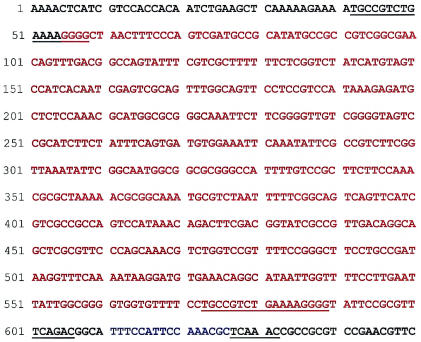
FIG. 1.
FIG. 1.
Nucleotide sequence of the nadA locus of the four N. lactamica strains, showing the 542-bp insertion. The insertion sequence is indicated by red type. The sequences located upstream and downstream of the insertion site of nadA gene and found in all meningococcal strains are indicated by black type. Blue type indicates the 16 bp present in all N. lactamica strains and in the N. meningitidis strains lacking nadA. When the nadA gene is present in a meningococcus, it always replaces these 16 bp. The direct repeats of the N. lactamica insertion and the 6-nucleotide direct repeats found in all meningococcal strains are underlined.
FIG. 2.
FIG. 2.
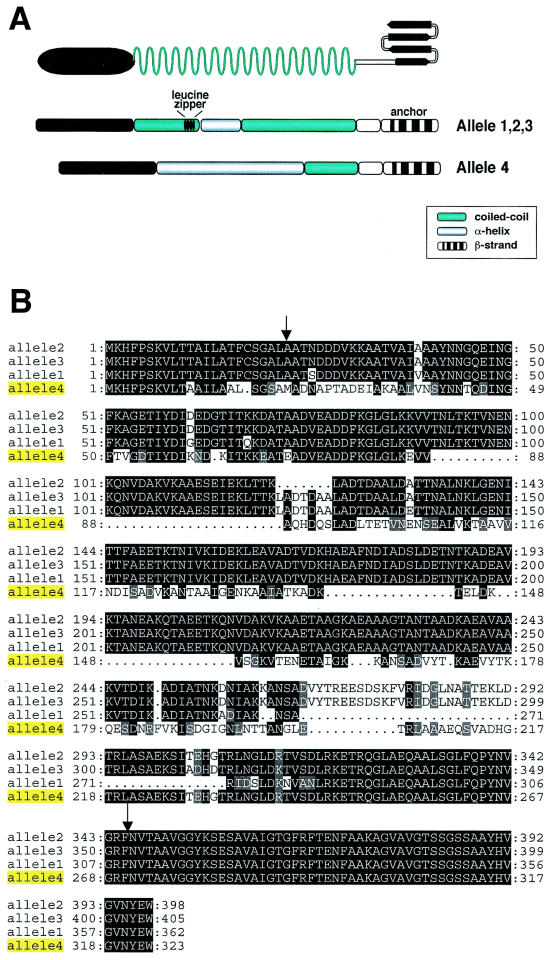
(A) Predicted topology of NadA and comparison of the secondary structures of NadA4 and other NadA forms. (B) Alignment of the four nadA-encoded peptide sequences. The arrows indicate the end of the leader peptide and the first amino acid of the membrane anchoring domain.
FIG. 3.
FIG. 3.
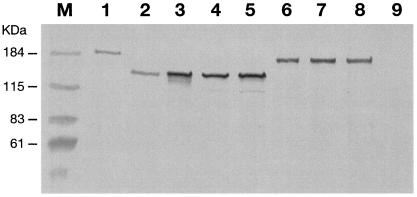
Evaluation of the presence and stability of the NadA4 protein. Unless indicated otherwise, all samples were loaded on the gel after addition of sample buffer and boiling for 10 min. Lane 1, strain 2996 (NadA3) total protein; lane 2, strain 65/96 (NadA4) total protein;lanes 3, 4, and 5, strain 65/96 (NadA4) OMVs boiled for 30 min, resuspended in 2% Triton X-100, and resuspended in 2% SDS, respectively; lanes 6, 7, and 8, strain 2996 (NadA3) OMVs boiled for 30 min, resuspended in 2% Triton X-100, and resuspended in 2% SDS, respectively; lane 9, strain NGH38 OMVs (negative control).
FIG. 4.
FIG. 4.
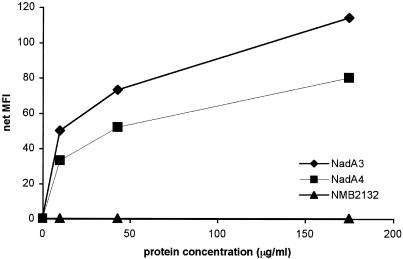
Fluorescence-activated cell sorting analysis to compare the binding ability of NadA4 with the binding ability of NadA3. Chang epithelial cells were incubated with medium alone or with three concentrations of the recombinant proteins. MFI, mean fluorescence intensity.

References

    1. Ala'Aldeen, D. A., K. R. Neal, K. Ait-Tahar, J. S. Nguyen-Van-Tam, A. English, T. J. Falla, P. M. Hawkey, and R. C. Slack. 2000. Dynamics of meningococcal long-term carriage among students and their implications for mass vaccination. J. Clin. Microbiol. 38:2311-2316. - PMC - PubMed
    1. Cartwright, K. A. (ed.). 1995. Meningococcal carriage and disease, p. 114-146. John Wiley and Sons, Chichester, United Kingdom.
    1. Caugant, D. A., E. A. Høiby, E. Rosenqvist, L. O. Froholm, and R. K. Selander. 1992. Transmission of Neisseria meningitidis among asymptomatic military recruits and antibody analysis. Epidemiol. Infect. 109:241-253. - PMC - PubMed
    1. Caugant, D. A., K. Bøvre, P. Gaustad, K. Bryn, E. Holten, E. A. Hoiby, and L. O. Froholm. 1986. Multilocus genotypes determined by enzyme electrophoresis of Neisseria meningitidis isolated from patients with systemic disease and from healthy carriers. J. Gen. Microbiol. 132:641-652. - PubMed
    1. Caugant, D. A., E. A. Hoiby, P. Magnus, O. Scheel, T. Hoel, G. Bjune, E. Wedege, J. Eng, and L. O. Froholm. 1994. Asymptomatic carriage of Neisseria meningitidis in a randomly sampled population. J. Clin. Microbiol. 32:323-330. - PMC - PubMed

Publication types

LinkOut - more resources