


Comparative morbidity of axillary lymph node dissection and the sentinel lymph node technique: implications for patients with breast cancer
- PMID: 15213610
- PMCID: PMC1356366
- DOI: 10.1097/01.sla.0000129358.80798.62
Comparative morbidity of axillary lymph node dissection and the sentinel lymph node technique: implications for patients with breast cancer
Abstract
Objective: To assess our long-term complications from complete axillary lymph node dissection (AXLND) in patients with breast cancer.
Summary background data: Complete AXLND as part of the surgical therapy for breast cancer has come under increased scrutiny due the use of the sentinel lymph node (SLN) biopsy technique to assess the status of the axillary nodes. As the enthusiasm for the SLN technique has increased, our impression has been that the perceived complication rate from AXLND has increased dramatically while the negative aspects of the SLN technique have been underemphasized.
Methods: Female patients seen in routine follow-up over a 1-year period were eligible for our retrospective study of the long-term complications from AXLND if they were a minimum of 1 year out from all primary therapy; ie, surgery, radiation, and/or chemotherapy. All patients had previously undergone either a modified radical mastectomy (MRM) or a segmental mastectomy with axillary dissection and postoperative radiation (SegAx/XRT). All patients had a Level I-III dissection. Objective measurements, including upper and lower arm circumferences and body mass index (BMI), were obtained, and a subjective evaluation from the patients was conducted.
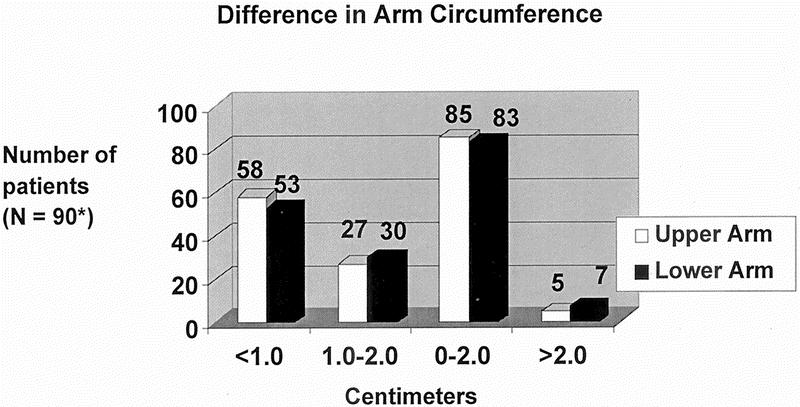
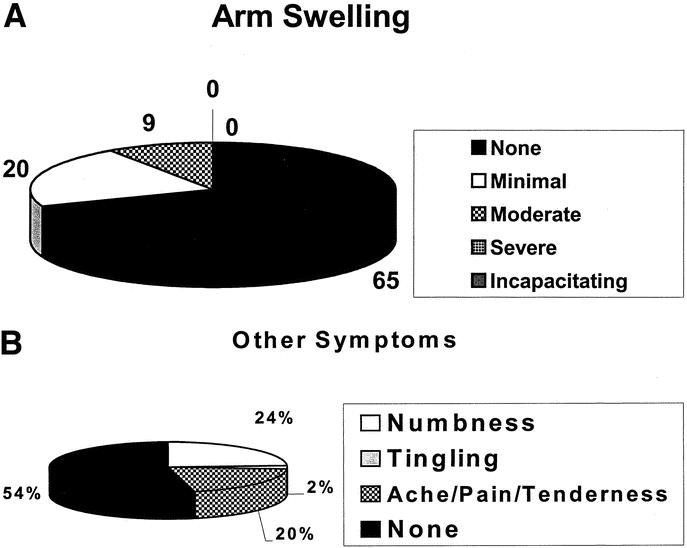
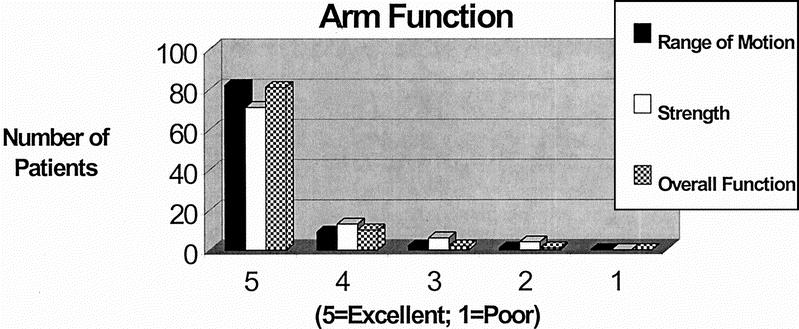
Results: Ninety-four patients were eligible for our study; 44 had undergone MRM, and 50 had undergone SegAx/XRT. The average number of nodes removed was 25.6 (standard deviation, 8). Thirty-three percent of the patients had positive nodal disease, 95% of the patients had an upper arm circumference within 2 cm of the unaffected side, and 93.3% had a lower arm circumference within 2 cm of the unaffected side. Subjectively, 90.4% of the patients had either no or minimal arm swelling, and 96.8% of the patients had "good" or "excellent" overall arm function. The most common long-term symptom was numbness involving the upper, inner aspect of the affected arm (25.5%).
Conclusions: Our data indicate that a complete AXLND can be performed with minimal long-term morbidity. The lower the morbidity of AXLND, the less acceptable are the unique complications of the SLN technique.
Figures
Comment in
-
Axillary lymph node dissection versus the sentinel lymph node technique in breast cancer.Ann Surg. 2004 Jul;240(1):7-8. doi: 10.1097/01.sla.0000132567.28613.a7. Ann Surg. 2004. PMID: 15213611 Free PMC article. No abstract available.
References
-
- Wong SL, Abell TD, Chao C, et al. Optimal use of sentinel node biopsy versus axillary node dissection in patients with breast carcinoma: a decision analysis. Cancer. 2002;95:478–487. - PubMed
-
- Singletary SE. Current status of axillary node dissection. Contemp Surg. 2002;58:334–340.
-
- Petrek JA, Senie RT, Peters M, et al. Lymphedema in a cohort of breast carcinoma survivors 20 years after diagnosis. Cancer. 2001;92:1368–1377. - PubMed
-
- Werner RS, McCormick B, Petrek JA, et al. Arm edema in conservatively managed breast cancer: obesity is a major predictive factor. Radiology. 1991;180:177–184. - PubMed
Publication types
MeSH terms
LinkOut - more resources
Full Text Sources
Medical
Research Materials
