


The diminishing role of surgery in the treatment of gastric lymphoma
- PMID: 15213615
- PMCID: PMC1356371
- DOI: 10.1097/01.sla.0000129356.81281.0c
The diminishing role of surgery in the treatment of gastric lymphoma
Abstract
Objective: This article reviews the pathogenesis, diagnosis, and treatment of patients with primary gastric lymphoma, with special attention to the changing role of surgery.
Summary background data: Primary gastric lymphomas are non-Hodgkin lymphomas that originate in the stomach and are divided into low-grade (or indolent) and high-grade (or aggressive) types. Low-grade lesions nearly always arise from mucosa-associated lymphoid tissue (MALT) secondary to chronic Helicobacter pylori (H. pylori) infection and disseminate slowly. High-grade lesions may arise from a low grade-MALT component or arise de novo and can spread to lymph nodes, adjacent organs and tissues, or distant sites.
Methods: A review of the relevant English-language articles was performed on the basis of a MEDLINE search from January 1984 to August 2003.
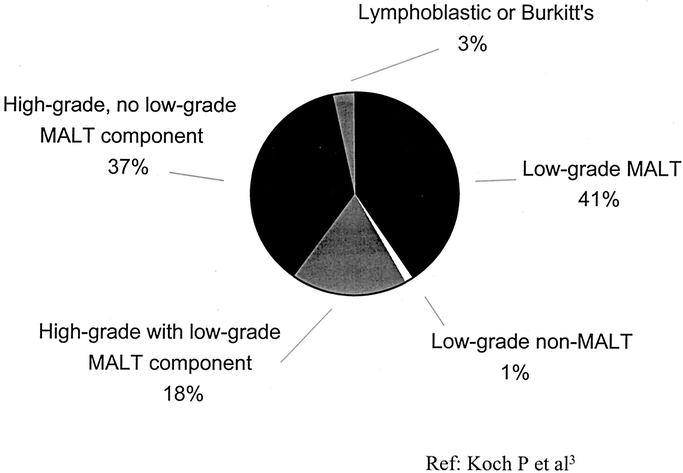
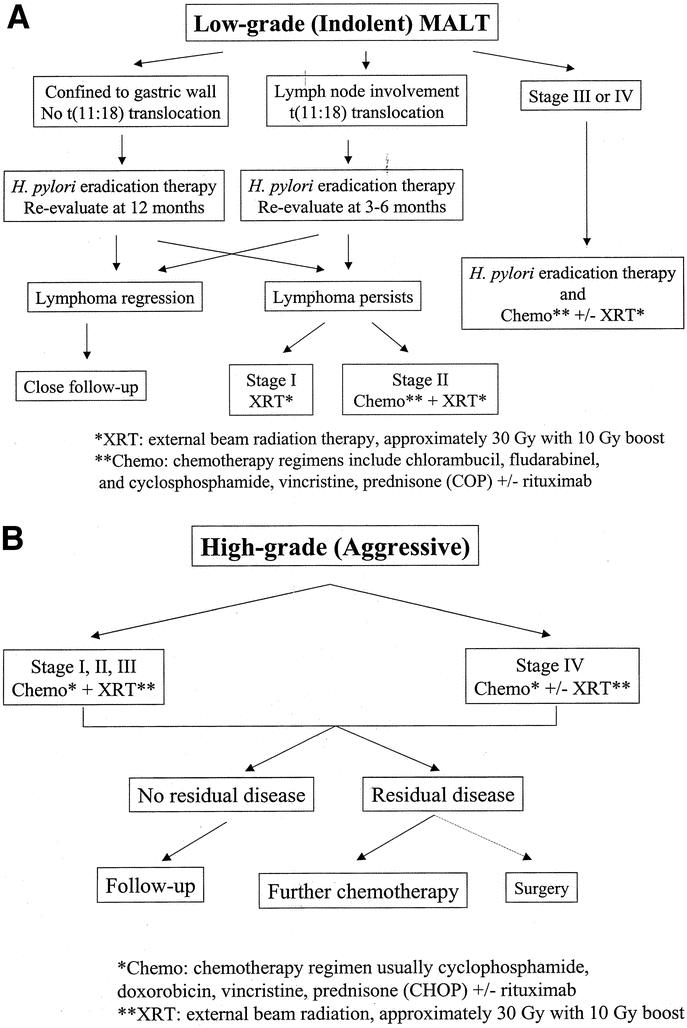
Results: About 40% of gastric lymphomas are low-grade, and nearly all these low-grade lesions are classified as MALT lymphomas. For low-grade MALT lymphomas confined to the gastric wall and without certain negative prognostic factors, H. pylori eradication is highly successful in causing lymphoma regression. More advanced low-grade lymphomas or those that do not regress with antibiotic therapy can be treated with combinations of H. pylori eradication, radiation therapy, and chemotherapy. Nearly 60% of gastric lymphomas are high-grade lesions with or without a low-grade MALT component. These lymphomas can be treated with chemotherapy and radiation therapy according to the extent of disease. Surgery for gastric lymphoma is now often reserved for patients with localized, residual disease after nonsurgical therapy or for rare patients with complications.
Conclusion: The treatment of gastric lymphoma continues to evolve, and surgical resection is now uncommonly a part of the initial management strategy.
Figures
References
-
- Stolte M. Helicobacter pylori gastritis and gastric MALT-lymphoma. Lancet. 1992;339:745–746. - PubMed
-
- Schechter NR, Portlock CS, Yahalom J. Treatment of mucosa-associated lymphoid tissue lymphoma of the stomach with radiation alone. J Clin Oncol. 1998;16:1916–1921. - PubMed
-
- Koch P, del Valle F, Berdel WE, et al. Primary gastrointestinal non-Hodgkin's lymphoma: II. Combined surgical and conservative or conservative management only in localized gastric lymphoma–results of the prospective German Multicenter Study GIT NHL 01/92. J Clin Oncol. 2001;19:3874–3883. - PubMed
-
- Jemal A, Thomas A, Murray T, et al. Cancer statistics, 2002. CA Cancer J Clin. 2002;52:23–47. - PubMed
-
- D'Amore F, Brincker H, Gronbaek K, et al. Non-Hodgkin's lymphoma of the gastrointestinal tract: a population-based analysis of incidence, geographic distribution, clinicopathologic presentation features, and prognosis. Danish Lymphoma Study Group. J Clin Oncol. 1994;12:1673–1684. - PubMed
Publication types
MeSH terms
LinkOut - more resources
Full Text Sources
Medical
