


Quantitative c-erbB-2 but not c-erbB-1 mRNA expression is a promising marker to predict minor histopathologic response to neoadjuvant radiochemotherapy in oesophageal cancer
- PMID: 15213712
- PMCID: PMC2364782
- DOI: 10.1038/sj.bjc.6601976
Quantitative c-erbB-2 but not c-erbB-1 mRNA expression is a promising marker to predict minor histopathologic response to neoadjuvant radiochemotherapy in oesophageal cancer
Abstract
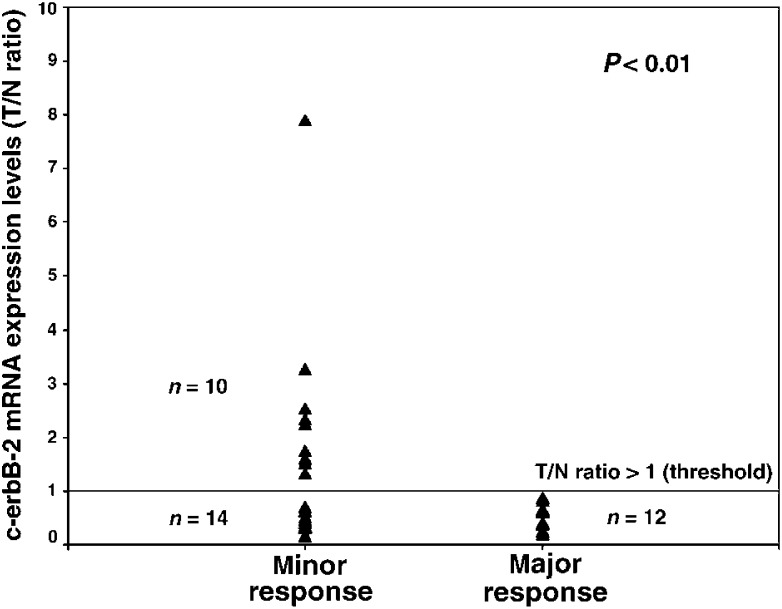
We examined the potential of quantitative epidermal growth factor receptor (EGFR, synonym: c-erbB-1) and c-erbB-2 (synonym: HER2/neu) mRNA expression to predict minor or major histopathologic response to neoadjuvant radiochemotherapy (cis-platinum, 5-FU, 36 Gy), followed by radical surgical resection, in patients with oesophageal cancer. Tissue samples were collected by endoscopic biopsy prior to treatment. RNA was isolated from biopsies and quantitative real-time reverse transcriptase-polymerase chain reaction assays were performed to determine c-erbB-1 and c-erbB-2 mRNA expression. Relative expression (tumour/paired normal tissue ratio standardised for beta-actin) was calculated for EGFR and c-erbB-2 mRNA. Expression levels were correlated with the objective histopathologic response in resected specimens. Histomorphologic regression was defined as major response when resected specimens contained less than 10% of residual vital tumour cells, or in case a pathologically complete response was achieved. Expression of c-erbB-1 mRNA was not associated with the degree of histomorphological response. In contrast, the relative expression levels of c-erbB-2 mRNA >1 were not associated with major histopathologic responses (sensitivity 41.6%, specificity 100%), and 10 out of 36 (28%) patients could be unequivocally identified, whose tumours did not respond well to the delivered neoadjuvant radiochemotherapy (P<0.01). Quantitative expression levels of c-erbB-2, but not c-erbB-1 mRNA, in pretreatment biopsies appear to predict minor histopathologic response to our neoadjuvant radiochemotherapy protocol. This test could be used to prevent expensive, non effective and potentially harmful therapies in approximately one-fourth of our patients, and leads to a more individualised type of combined modality treatment.
Figures
References
-
- Adelstein DJ, Rice TW, Becker M, Larto MA, Kirby TJ, Koka A, Tefft M, Zuccaro G (1997) Use of concurrent chemotherapy, accelerated fractionation radiation, and surgery for patients with esophageal carcinoma. Cancer 80: 1011–1020 - PubMed
-
- Allred DC, Clark GM, Tandon AK, Moliand R, Tormey DC, Osborne CK, Gilchrist KW, Mansour EG, Abeloff M, Eudey L (1992) HER-2/neu in node-negative breast cancer: prognostic significance of overexpression influenced by the presence of in situ carcinoma. J Clin Oncol 10: 599–605 - PubMed
-
- Anderson MR, Jankowski JA (2003) The role of receptor tyrosine kinase inhibition in treating gastrointestinal malignancy. Expert Opin Investig Drugs 12: 577–592 - PubMed
-
- Baekelandt M, Kristensen GB, Trope CG, Nesland JM, Holm R (1999) Epidermal growth factor receptor expression has no independent prognostic significance in advanced ovarian cancer. Anticancer Res 19: 4469–4474 - PubMed
-
- Benz CC, Scott GK, Sarup JC, Johnson RM, Tripathy D, Coronado E, Shepard HM, Osborne CK (1993) Estrogen-dependent, tamoxifen-resistant tumorigenic growth of MCF-7 cells transfected with HER2/neu. Breast Cancer Res Treat 24: 85–95 - PubMed
Publication types
MeSH terms
Substances
LinkOut - more resources
Full Text Sources
Other Literature Sources
Medical
Research Materials
Miscellaneous
