Trends in Prescribing of Selective Serotonin Reuptake Inhibitors and Other Newer Antidepressant Agents in Adult Primary Care
- PMID: 15213776
- PMCID: PMC419384
- DOI: 10.4088/pcc.v05n0402
Trends in Prescribing of Selective Serotonin Reuptake Inhibitors and Other Newer Antidepressant Agents in Adult Primary Care
Abstract
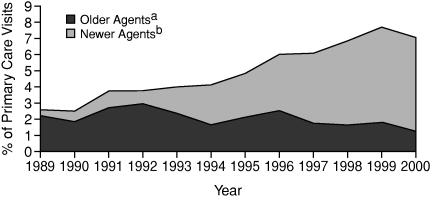
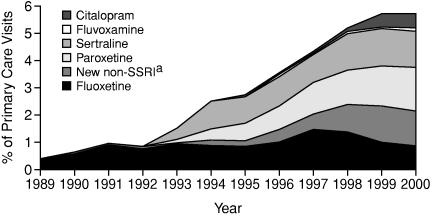
BACKGROUND: The introduction of selective serotonin reuptake inhibitors (SSRIs) represented a breakthrough in depression treatment due to their safety and ease of use. The purpose of this study was to extend previous work on trends in antidepressant use to include recent data and to provide more detailed analysis of prescribing trends for SSRIs and newer non-SSRI antidepressants, specifically in adult primary care practice. METHOD: Adult primary care visits from the National Ambulatory Medical Care Survey (NAMCS) between 1989 and 2000 were analyzed. Chi-square tests for trend and multivariable logistic regression models were utilized to examine patterns of antidepressant use over time. SSRIs (citalopram, fluoxetine, fluvoxamine, paroxetine, sertraline) and newer non-SSRI antidepressants (bupropion, mirtazapine, nefazodone, venlafaxine) were classified as newer agents. RESULTS: 89,424 adult primary care visits were recorded in the NAMCS during the period studied. Antidepressant use increased in primary care from 2.6% ( approximately 6 million visits) in 1989 to 7.1% ( approximately 20.5 million) in 2000 (p <.001). SSRI and newer non-SSRI use increased linearly from 1989 to 2000 (p <.001), with an adjusted odds ratio for use of 1.27 per year (95% confidence interval = 1.25 to 1.29). The increase in antidepressant use was due to these newer agents (13.5% of all antidepressant use in 1989 to 82.3% in 2000) with each new agent adding to a stable base of previously introduced newer antidepressant agents. CONCLUSIONS: The prevalence of antidepressant use in adult primary care has risen dramatically since 1989, largely reflecting use of newer agents. The detailed pattern of increased use of these medications is striking, with each new agent adding to aggregate use without concomitant decrease in previously introduced newer agents. Such trends reflect more widespread pharmacologic treatment of depressed primary care patients.
Figures
References
-
- Pincus HA, Tanielian TL, and Marcus SC. et al. Prescribing trends in psychotropic medications: primary care, psychiatry, and other medical specialties. JAMA. 1998 279:526–531. - PubMed
-
- Sclar DA, Robison LM, and Skaer TL. et al. Trends in prescribing of antidepressant pharmacotherapy: office-based visits, 1990–1995. Clin Ther. 1998 20:871–884. - PubMed
-
- Olfson M, Marcus SC, and Druss B. et al. National trends in the outpatient treatment of depression. JAMA. 2002 287:203–209. - PubMed
-
- Coyne JC, Fechner-Bates S, Schwenk TL.. Prevalence, nature, and comorbidity of depressive disorders in primary care. Gen Hosp Psychiatry. 1994;16:267–276. - PubMed
LinkOut - more resources
Full Text Sources