


The novel marker, DOG1, is expressed ubiquitously in gastrointestinal stromal tumors irrespective of KIT or PDGFRA mutation status
- PMID: 15215166
- PMCID: PMC1618538
- DOI: 10.1016/S0002-9440(10)63279-8
The novel marker, DOG1, is expressed ubiquitously in gastrointestinal stromal tumors irrespective of KIT or PDGFRA mutation status
Abstract
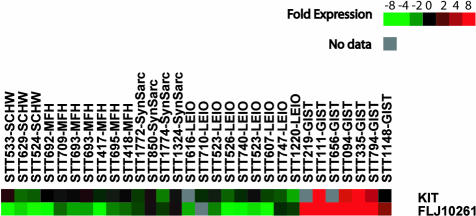
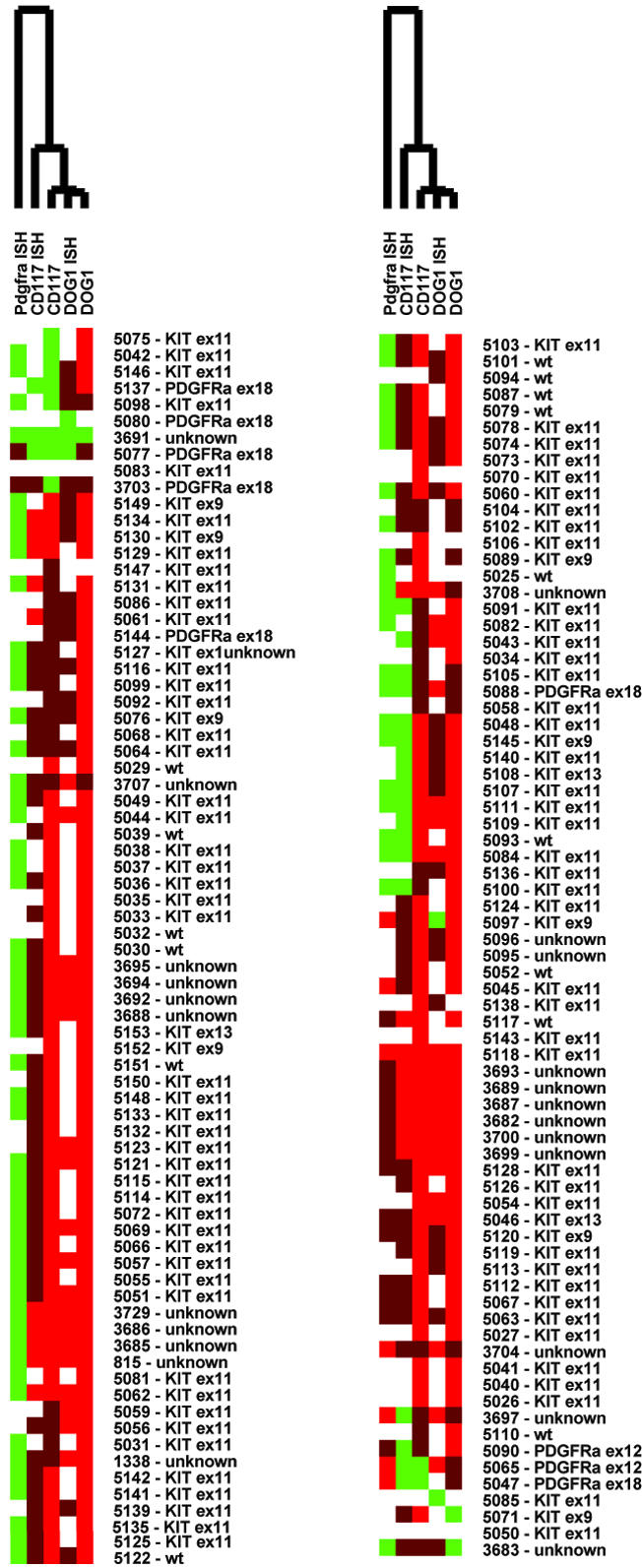
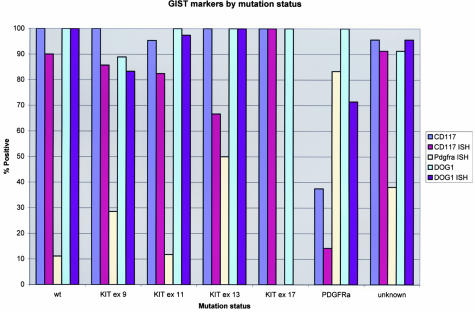
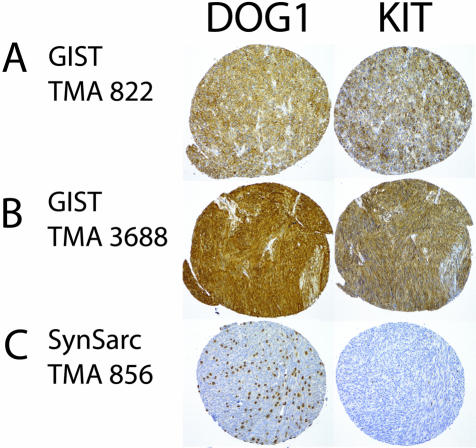
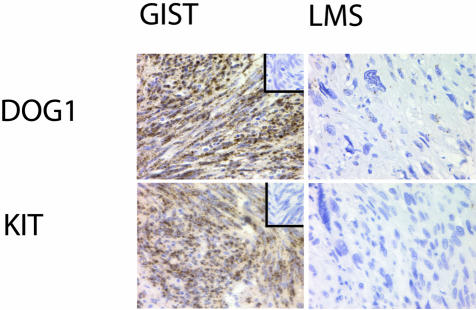
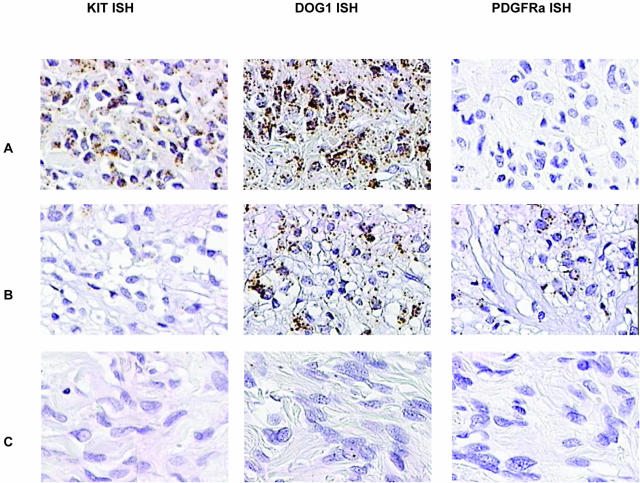
We recently characterized gene expression patterns in gastrointestinal stromal tumors (GISTs) using cDNA microarrays, and found that the gene FLJ10261 (DOG1, discovered on GIST-1), encoding a hypothetical protein, was specifically expressed in GISTs. The immunoreactivity of a rabbit antiserum to synthetic DOG1 peptides was assessed on two soft tissue tumor microarrays. The tissue microarrays included 587 soft tissue tumors, with 149 GISTs, including 127 GIST cases for which the KIT and PDGFRA mutation status was known. Immunoreactivity for DOG1 was found in 136 of 139 (97.8%) of scorable GISTs. All seven GIST cases with a PDGFRA mutation were DOG1-positive, while most of these failed to react for KIT. The immunohistochemical findings were confirmed with in situ hybridization probes for DOG1, KIT, and PDGFRA. Other neoplasms in the differential diagnosis of GIST, including desmoid fibromatosis (0 of 17) and Schwannoma (0 of 3), were immunonegative for DOG1. Only 4 of 438 non-GIST cases were immunoreactive for DOG1. DOG1, a protein of unknown function, is expressed strongly on the cell surface of GISTs and is rarely expressed in other soft tissue tumors. Reactivity for DOG1 may aid in the diagnosis of GISTs, including PDGFRA mutants that fail to express KIT antigen, and lead to appropriate treatment with imatinib mesylate, an inhibitor of the KIT tyrosine kinase.
Figures
References
-
- Weiss SW, Goldblum JR. St Louis: Mosby; Soft Tissue Tumors. 2001
-
- Heinrich MC, Corless C, Demetri GD, Blanke C, von Mehren M, Joensuu H, McGreevey L, Chen CJ, Van den Abbeele A, Druker B, Kiese B, Eisenberg B, Roberts P, Singer S, Fletcher CD, Silberman S, Dimitrijevic S, Fletcher JA. Kinase mutations and imatinib response in patients with metastatic gastrointestinal stromal tumor. J Clin Oncol. 2003;21:4342–4349. - PubMed
-
- van Oosterom AT, Judson I, Verweij J, Stroobants S, Donato di Paola E, Dimitrijevic S, Martens M, Webb A, Sciot R, Van Glabbeke M, Silberman S, Nielsen OS, European Organization for Research and Treatment of Cancer Soft Tissue and Bone Sarcoma Group Safety and efficacy of imatinib (STI571) in metastatic gastrointestinal stromal tumours: a phase I study. Lancet. 2001;358:1421–1423. - PubMed
-
- Demetri G, von Mehren M, Blanke C, Van den Abbeele A, Eisenberg B, Roberts P, Heinrich M, Tuveson D, Singer S, Janicek M, Fletcher J, Silverman S, Silberman S, Capdeville R, Kiese B, Peng B, Dimitrijevic S, Druker B, Corless C, Fletcher C, Joensuu H. Efficacy and safety of imatinib mesylate in advanced gastrointestinal stromal tumors. N Engl J Med. 2002;347:472–480. - PubMed
-
- Joensuu H, Roberts P, Sarlomo-Rikala M, Andersson L, Tervahartiala P, Tuveson D, Silberman S, Capdeville R, Dimitrijevic S, Druker B, Demetri G. Effect of the tyrosine kinase inhibitor STI571 in a patient with a metastatic gastrointestinal stromal tumor. N Engl J Med. 2001;344:1052–1056. - PubMed
Publication types
MeSH terms
Substances
Grants and funding
LinkOut - more resources
Full Text Sources
Other Literature Sources
Molecular Biology Databases
Miscellaneous
