


BCL2 translocation defines a unique tumor subset within the germinal center B-cell-like diffuse large B-cell lymphoma
- PMID: 15215171
- PMCID: PMC1618550
- DOI: 10.1016/s0002-9440(10)63284-1
BCL2 translocation defines a unique tumor subset within the germinal center B-cell-like diffuse large B-cell lymphoma
Abstract
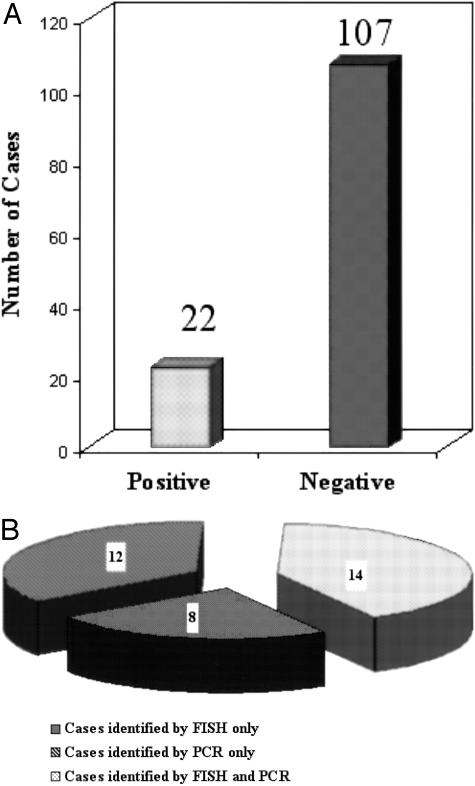
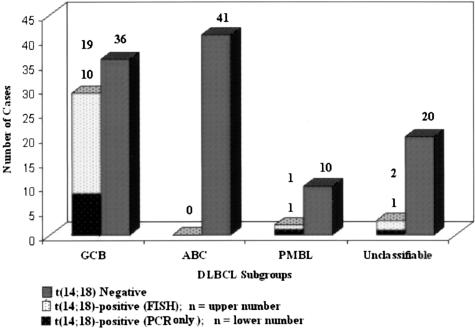
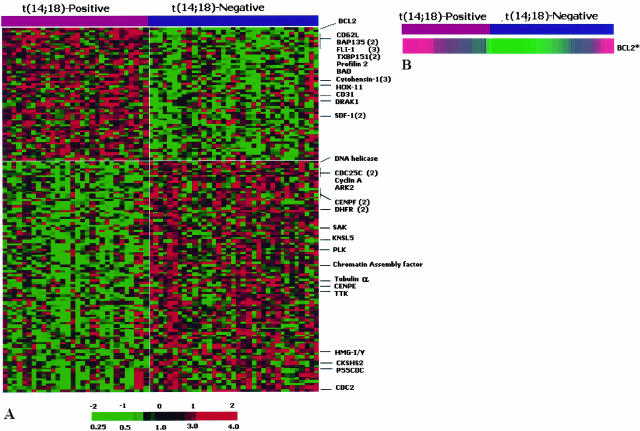
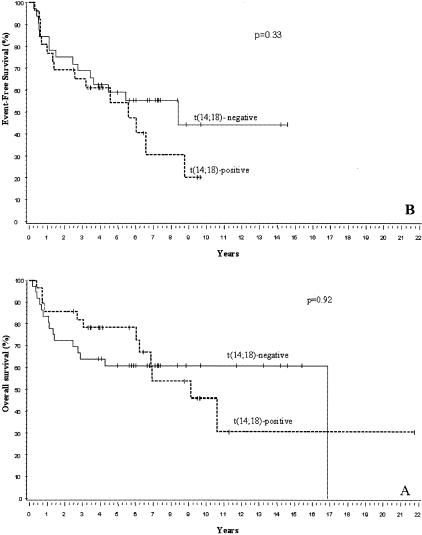
Gene expression profiling of diffuse large B-cell lymphoma (DLBCL) has revealed prognostically important subgroups: germinal center B-cell-like (GCB) DLBCL, activated B cell-like (ABC) DLBCL, and primary mediastinal large B-cell lymphoma. The t(14;18)(q32;q21) has been reported previously to define a unique subset within the GCB-DLBCL. We evaluated for the translocation in 141 cases of DLBCL that were successfully gene expression profiled. Using a dual-probe fluorescence in situ hybridization assay, we detected the t(14;18) in 17% of DLBCLs and in 34% of the GCB subgroup which contained the vast majority of positive cases. In addition, 12 t(14;18)-positive cases detected by polymerase chain reaction assays on additional samples were added to the fluorescence in situ hybridization-positive cases for subsequent analysis. Immunohistochemical data indicated that BCL2, BCL6, and CD10 protein were preferentially expressed in the t(14;18)-positive cases as compared to t(14;18)-negative cases. Within the GCB subgroup, the expression of BCL2 and CD10, but not BCL6, differed significantly between cases with or without the t(14;18): 88% versus 24% for BCL2 and 72% versus 32% for CD10, respectively. In the GCB-DLBCL subgroup, a heterogeneous group of genes is overexpressed in the t(14;18)-positive subset, among which BCL2 is a significant discriminator. Interestingly, the t(14;18)-negative subset is dominated by overexpression of cell cycle-associated genes, indicating that these tumors are significantly more proliferative, suggesting distinctive pathogenetic mechanisms. However, despite this higher proliferative activity, there was no significant difference in overall or failure-free survival between the t(14;18)-positive and -negative subsets within the GCB subgroup.
Figures
References
-
- Alizadeh AA, Eisen MB, Davis RE, Ma C, Lossos IS, Rosenwald A, Boldrick JC, Sabet H, Tran T, Yu X, Powell JI, Yang L, Marti GE, Moore T, Hudson J, Jr, Lu L, Lewis DB, Tibshirani R, Sherlock G, Chan WC, Greiner TC, Weisenburger DD, Armitage JO, Warnke R, Levy R, Wilson W, Grever MR, Byrd JC, Botstein D, Brown PO, Staudt LM. Distinct types of diffuse large B-cell lymphoma identified by gene expression profiling. Nature. 2000;403:503–511. - PubMed
-
- Rosenwald A, Wright G, Chan WC, Connors JM, Campo E, Fisher RI, Gascoyne RD, Muller-Hermelink HK, Smeland EB, Giltnane JM, Hurt EM, Zhao H, Averett L, Yang L, Wilson WH, Jaffe ES, Simon R, Klausner RD, Powell J, Duffey PL, Longo DL, Greiner TC, Weisenburger DD, Sanger WG, Dave BJ, Lynch JC, Vose J, Armitage JO, Montserrat E, Lopez-Guillermo A, Grogan TM, Miller TP, LeBlanc M, Ott G, Kvaloy S, Delabie J, Holte H, Krajci P, Stokke T, Staudt LM. The use of molecular profiling to predict survival after chemotherapy for diffuse large-B-cell lymphoma. N Engl J Med. 2002;346:1937–1947. - PubMed
-
- Rosenwald A, Wright G, Leroy K, Yu X, Gaulard P, Gascoyne RD, Chan WC, Zhao T, Haioun C, Greiner TC, Weisenburger DD, Lynch JC, Vose J, Armitage JO, Smeland EB, Kvaloy S, Holte H, Delabie J, Campo E, Montserrat E, Lopez-Guillermo A, Ott G, Muller-Hermelink HK, Connors JM, Braziel R, Grogan TM, Fisher RI, Miller TP, LeBlanc M, Chiorazzi M, Zhao H, Yang L, Powell J, Wilson WH, Jaffe ES, Simon R, Klausner RD, Staudt LM. Molecular diagnosis of primary mediastinal B cell lymphoma identifies a clinically favorable subgroup of diffuse large B cell lymphoma related to Hodgkin lymphoma. J Exp Med. 2003;198:851–862. - PMC - PubMed
-
- Savage KJ, Monti S, Kutok JL, Cattoretti G, Neuberg D, De Leval L, Kurtin P, Dal Cin P, Ladd C, Feuerhake F, Aguiar RC, Li S, Salles G, Berger F, Jing W, Pinkus GS, Habermann T, Dalla-Favera R, Harris NL, Aster JC, Golub TR, Shipp MA. The molecular signature of mediastinal large B-cell lymphoma differs from that of other diffuse large B-cell lymphomas and shares features with classical Hodgkin’s lymphoma. Blood. 2003;102:3871–3879. - PubMed
-
- Bakhshi A, Jensen JP, Goldman P, Wright JJ, McBride OW, Epstein AL, Korsmeyer SJ. Cloning the chromosomal breakpoint of t(14;18) human lymphomas: clustering around JH on chromosome 14 and near a transcriptional unit on 18. Cell. 1985;41:899–906. - PubMed
Publication types
MeSH terms
Substances
Grants and funding
LinkOut - more resources
Full Text Sources
Other Literature Sources
Research Materials
