


. 2004 Jul 1;32(Web Server issue):W37-40.
doi: 10.1093/nar/gkh382.
3DCoffee@igs: a web server for combining sequences and structures into a multiple sequence alignment
Affiliations
- PMID: 15215345
- PMCID: PMC441520
- DOI: 10.1093/nar/gkh382
Item in Clipboard
3DCoffee@igs: a web server for combining sequences and structures into a multiple sequence alignment
Nucleic Acids Res.
.
Abstract
This paper presents 3DCoffee@igs, a web-based tool dedicated to the computation of high-quality multiple sequence alignments (MSAs). 3D-Coffee makes it possible to mix protein sequences and structures in order to increase the accuracy of the alignments. Structures can be either provided as PDB identifiers or directly uploaded into the server. Given a set of sequences and structures, pairs of structures are aligned with SAP while sequence-structure pairs are aligned with Fugue. The resulting collection of pairwise alignments is then combined into an MSA with the T-Coffee algorithm. The server and its documentation are available from http://igs-server.cnrs-mrs.fr/Tcoffee/.
Figures
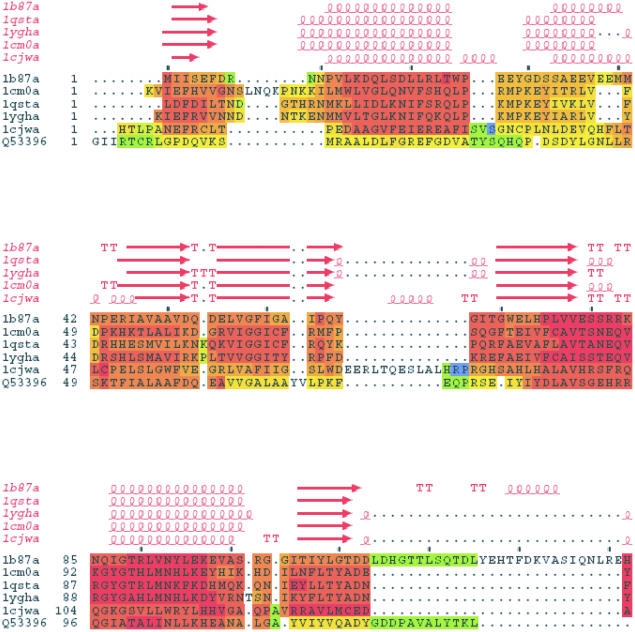
Typical output of a standard 3D-Coffee computation. Five structures have been aligned with a sequence (Q53396). The display is the ESPript (18) output produced by the Tcoffee@igs server. The CORE index is displayed on the alignment and indicates the relative reliability of the various sections (color code: blue, unreliable; green, low reliability; red, highly reliable portion of the alignment). DSSP (19) is used to determine the secondary structures from the PDB coordinates. Blue, green and yellow portions are mostly incorrectly aligned, as judged by comparison with HOMSTRAD reference alignment (9).
References
MeSH terms
Substances
LinkOut - more resources
Full Text Sources
Other Literature Sources
Miscellaneous
