


CRASP: a program for analysis of coordinated substitutions in multiple alignments of protein sequences
- PMID: 15215352
- PMCID: PMC441589
- DOI: 10.1093/nar/gkh451
CRASP: a program for analysis of coordinated substitutions in multiple alignments of protein sequences
Abstract
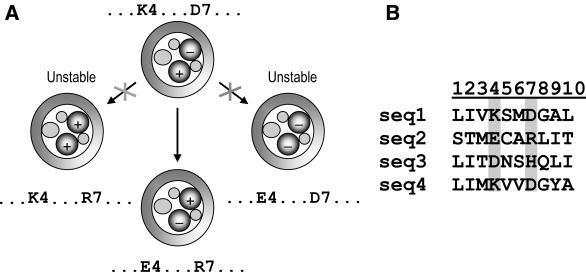
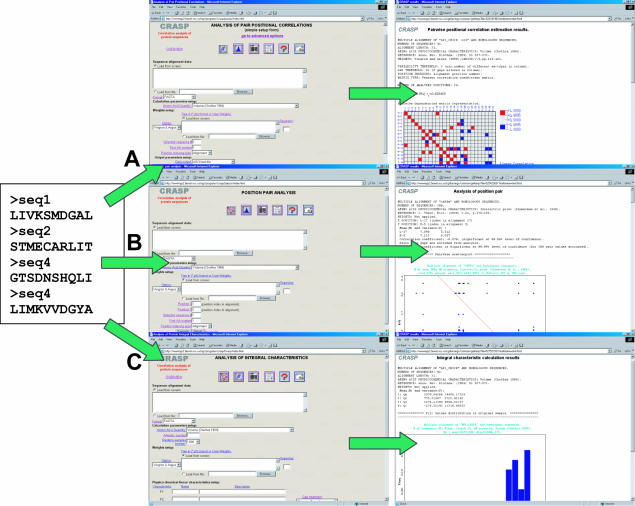
Recent results suggest that during evolution certain substitutions at protein sites may occur in a coordinated manner due to interactions between amino acid residues. Information on these coordinated substitutions may be useful for analysis of protein structure and function. CRASP is an Internet-available software tool for the detection and analysis of coordinated substitutions in multiple alignments of protein sequences. The approach is based on estimation of the correlation coefficient between the values of a physicochemical parameter at a pair of positions of sequence alignment. The program enables the user to detect and analyze pairwise relationships between amino acid substitutions at protein sequence positions, estimate the contribution of the coordinated substitutions to the evolutionary invariance or variability in integral protein physicochemical characteristics such as the net charge of protein residues and hydrophobic core volume. The CRASP program is available at http://wwwmgs.bionet.nsc.ru/mgs/programs/crasp/.
Figures
References
-
- Benner S.A., Badcoe,I., Cohen,M.A. and Gerloff,D.L. (1994) Bona fide prediction of aspects of protein conformation. Assigning interior and surface residues from patterns of variation and conservation in homologous protein sequences. J. Mol. Biol., 235, 926–958. - PubMed
-
- Livingstone C.D. and Barton,G.J. (1996) Identification of functional residues and secondary structure from protein multiple sequence alignment. Meth. Enzymol., 266, 497–512. - PubMed
-
- Lichtarge O., Bourne,H.R. and Cohen,F.E. (1996) An evolutionary trace method defines binding surfaces common to protein families. J. Mol. Biol., 257, 342–358. - PubMed
-
- Benner S.A. and Gerloff,D. (1991) Patterns of divergence in homologous proteins as indicators of secondary and tertiary structures: the catalytic domain of protein kinases. Advan. Enzyme Regulat., 31, 121–181. - PubMed
