. 2004 Jul 1;32(Web Server issue):W313-7.
doi: 10.1093/nar/gkh406.

GOblet: a platform for Gene Ontology annotation of anonymous sequence data

Affiliations

GOblet: a platform for Gene Ontology annotation of anonymous sequence data

Detlef Groth et al. Nucleic Acids Res. .

Abstract

GOblet is a comprehensive web server application providing the annotation of anonymous sequence data with Gene Ontology (GO) terms. It uses a variety of different protein databases (human, murines, invertebrates, plants, sp-trembl) and their respective GO mappings. The user selects the appropriate database and alignment threshold and thereafter submits single or multiple nucleotide or protein sequences. Results are shown in different ways, e.g. as survey statistics for the main GO categories for all sequences or as detailed results for each single sequence that has been submitted. In its newest version, GOblet allows the batch submission of sequences and provides an improved display of results with the aid of Java applets. All output data, together with the Java applet, are packed to a downloadable archive for local installation and analysis. GOblet can be accessed freely at http://goblet.molgen.mpg.de.


Figures

Figure 1
Figure 1
The main result window. (A) Zip archive for download and local installation of the complete set of analysis files and the java executable. (B) Summary results via links to the offline (local) or online (GOblet server) data sources. The two ‘gostatistics’ links provide displays of all query–GO id relationships and summary statistics in simple ASCII format for easy download. (C) Listing of all single query results. The links point to the query sequence, original BLAST output files and GOblet analysis page for each single query. (D) Frame controlled by the Java applet: a dynamic tree with summary statistics for the respective GO terms (nodes) is shown; clicking on a specific node opens the list of all query ids positive with that GO term. Selection of a specific query id in the list opens a summary tree for that query sequence.
Figure 2
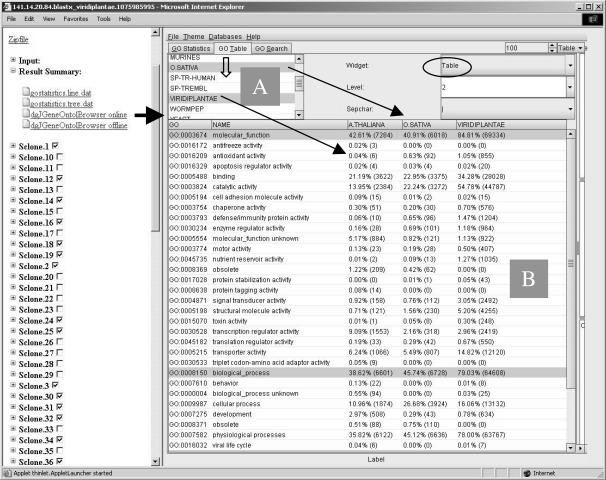
Figure 2
The comparative data view of the interface. (A) On selection of the ‘GO Table’ button a small menu pops up wherein several datasets can be selected. (B) After selection, activating the ‘Table’ field (top right) will give the percentages (numbers) of all genes/proteins falling into the respective GO classes. The specificity of classes can be controlled by the ‘level’ value (top right): level 1 refers to the three main classes of GO, level 2 contains the child terms of level 1, and so on. Note that GO associations for any set of genes or proteins can be uploaded from the user's end for comparative statistics.

References

    1. Ashburner M., Ball,C.A., Blake,J.A., Botstein,D., Butler,H., Cherry,J.M., Davis,A.P., Dolinski,K., Dwight,S.S., Eppig,J.T. et al. (2000) Gene ontology: tool for the unification of biology. The Gene Ontology Consortium. Nature Genet., 25, 25–29. - PMC - PubMed
    1. Harris M.A., Clark,J., Ireland,A., Lomax,J., Ashburner,M., Foulger,R., Eilbeck,K., Lewis,S., Marshall,B., Mungall,C. et al. (2004) The Gene Ontology (GO) database and informatics resource. Nucleic Acids Res., 32, D258–D261. - PMC - PubMed
    1. Camon E., Magrane,M., Barrell,D., Binns,D., Fleischmann,W., Kersey,P., Mulder,N., Oinn,T., Maslen,J., Cox,A. et al. (2003) The Gene Ontology Annotation (GOA) project: implementation of GO in SWISS-PROT, TrEMBL, and InterPro. Genome Res., 13, 662–672. - PMC - PubMed
    1. Camon E., Magrane,M., Barrell,D., Lee,V., Dimmer,E., Maslen,J., Binns,D., Harte,N., Lopez,R. and Apweiler,R. (2004) The Gene Ontology Annotation (GOA) Database: sharing knowledge in Uniprot with Gene Ontology. Nucleic Acids Res., 32, D262–D266. - PMC - PubMed
    1. Dwight S.S., Harris,M.A., Dolinski,K., Ball,C.A., Binkley,G., Christie,K.R., Fisk,D.G., Issel-Tarver,L., Schroeder,M., Sherlock,G. et al. (2002) Saccharomyces Genome Database (SGD) provides secondary gene annotation using the Gene Ontology (GO). Nucleic Acids Res., 30, 69–72. - PMC - PubMed

Substances