


pvSOAR: detecting similar surface patterns of pocket and void surfaces of amino acid residues on proteins
- PMID: 15215448
- PMCID: PMC441528
- DOI: 10.1093/nar/gkh390
pvSOAR: detecting similar surface patterns of pocket and void surfaces of amino acid residues on proteins
Abstract
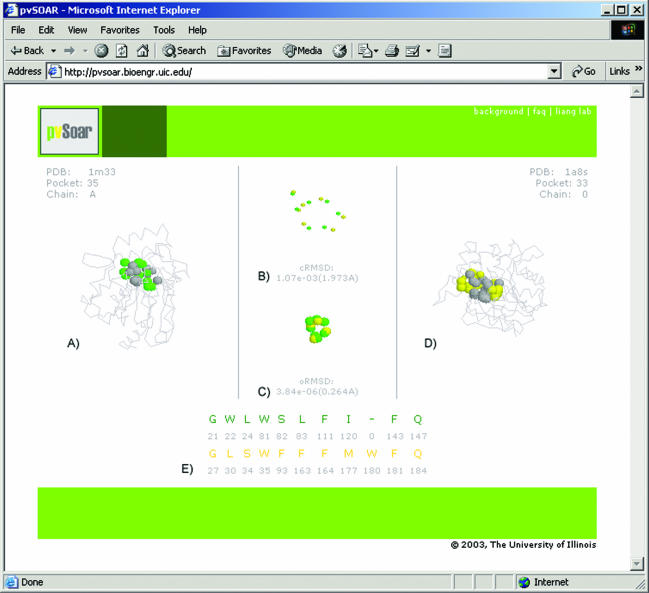
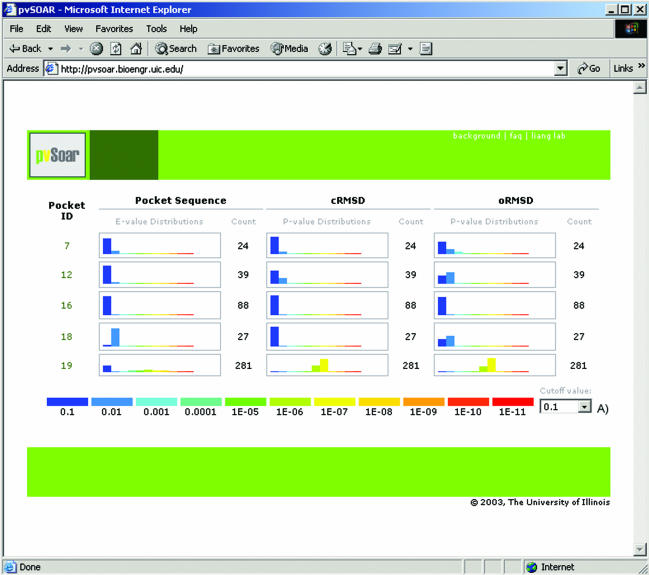
Detecting similar protein surfaces provides an important route for discovering unrecognized or novel functional relationship between proteins. The web server pvSOAR (pocket and void Surfaces Of Amino acid Residues) provides an online resource to identify similar protein surface regions. pvSOAR can take a structure either uploaded by a user or obtained from the Protein Data Bank, and identifies similar surface patterns based on geometrically defined pockets and voids. It provides several search modes to compare protein surfaces by similarity in local sequence, local shape and local orientation. Statistically significant search results are reported for visualization and interactive exploration. pvSOAR can be used to predict biological functions of proteins with known three-dimensional structures but unknown biological roles. It can also be used to study functional relationship between proteins and for exploration of the evolutionary origins of structural elements important for protein function. We present an example using pvSOAR to explore the biological roles of a protein whose structure was solved by the structural genomics project. The pvSOAR web server is available at http://pvsoar.bioengr.uic.edu/.
Figures
References
-
- Binkowski T.A., Adamian,L. and Liang,J. (2003) Inferring functional relationships of proteins from local sequence and spatial surface patterns. J. Mol. Biol., 332, 505–526. - PubMed
-
- Umeyama S. (1991) Least-squares estimation of transformation parameters between two point patterns. IEEE Trans. Pattern Anal. Mach. Intell., 13, 376–380.
-
- Murzin A.G., Brenner,S.E., Hubbard,T. and Chothia,C. (1995) SCOP: a structural classification of proteins database for the investigation of sequences and structures. J. Mol. Biol., 247, 536–540. - PubMed
MeSH terms
Substances
Associated data
- Actions
- Actions
