


S100A7 and the progression of breast cancer
- PMID: 15217486
- PMCID: PMC468668
- DOI: 10.1186/bcr816
S100A7 and the progression of breast cancer
Abstract
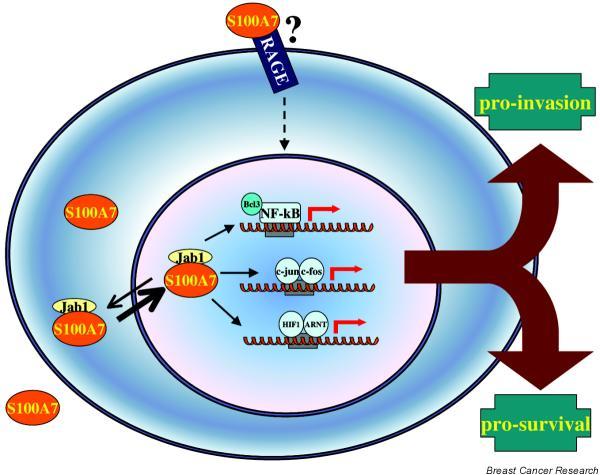
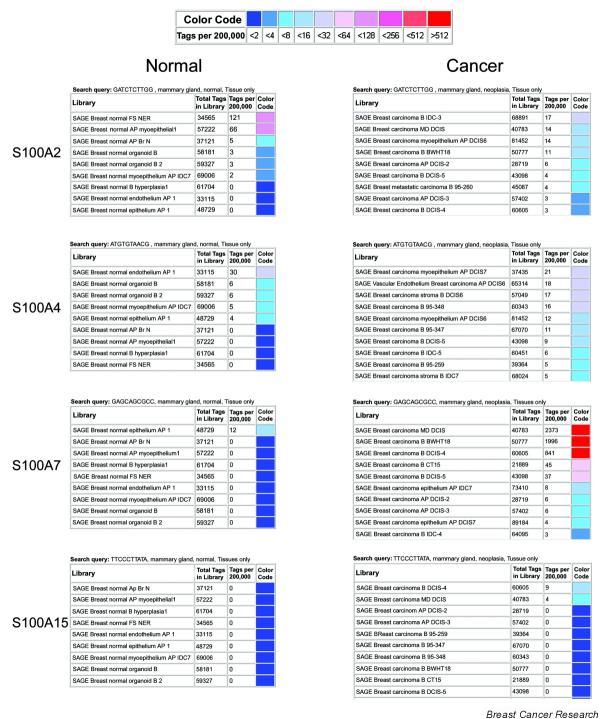
The S100 gene family comprises more than 20 members whose protein sequences encompass at least one EF-hand Ca2+ binding motif. The expression of individual family members is not ubiquitous for all tissues and there appears to be an element of tissue-specific expression. Molecular analysis of breast tumors has revealed that several S100s, including S100A2, S100A4 and S100A7, exhibit altered expression levels during breast tumorigenesis and/or progression. Subsequent studies have started to describe a functional role for these S100 proteins as well as their mechanism of action and the biochemical pathways they modify. The present review outlines what is known about S100A7 in breast cancer and summarizes the need to better understand the importance of this protein in breast cancer.
Figures
References
-
- Perou CM, Sorlie T, Eisen MB, van de RM, Jeffrey SS, Rees CA, Pollack JR, Ross DT, Johnsen H, Akslen LA, Fluge O, Pergamenschikov A, Williams C, Zhu SX, Lonning PE, Borresen-Dale AL, Brown PO, Botstein D. Molecular portraits of human breast tumours. Nature. 2000;406:747–752. doi: 10.1038/35021093. - DOI - PubMed
-
- Porter DA, Krop IE, Nasser S, Sgroi D, Kaelin CM, Marks JR, Riggins G, Polyak K. A SAGE (serial analysis of gene expression) view of breast tumor progression. Cancer Res. 2001;61:5697–5702. - PubMed
-
- Porter D, Lahti-Domenici J, Keshaviah A, Bae YK, Argani P, Marks J, Richardson A, Cooper A, Strausberg R, Riggins GJ, Schnitt S, Gabrielson E, Gelman R, Polyak K. Molecular markers in ductal carcinoma in situ of the breast. Mol Cancer Res. 2003;1:362–375. - PubMed
-
- Davies BR, Davies MP, Gibbs FE, Barraclough R, Rudland PS. Induction of the metastatic phenotype by transfection of a benign rat mammary epithelial cell line with the gene for p9Ka, a rat calcium-binding protein, but not with the oncogene EJ-ras-1. Oncogene. 1993;8:999–1008. - PubMed
Publication types
MeSH terms
Substances
LinkOut - more resources
Full Text Sources
Medical
Research Materials
Miscellaneous
